mrkeyoor.com_
Tue 01 Sept 17:40 UTC
Dev Toolsevaluationupdated 27 Aug 2026

rust review

rust-lang/rust is the main source repository for the Rust compiler, standard library, and official language documentation. Application developers normally install released Rust toolchains through rustup; this checkout is for compiler work, standard-library changes, platform ports, documentation, and source builds.

+528stars / 7d
Verdict

Our harness installed 138 Yarn packages in 33 seconds but compiled no Rust code and ran no Rust tests, so it says nothing about rustc health. Use the released Rust toolchain for application development; clone this 3,489.9 MB source tree only when the compiler, standard library, documentation, or a supported platform is the work itself. For that audience, the active release cadence, detailed contributor guides, and staged bootstrap system justify the complexity.

We ran it

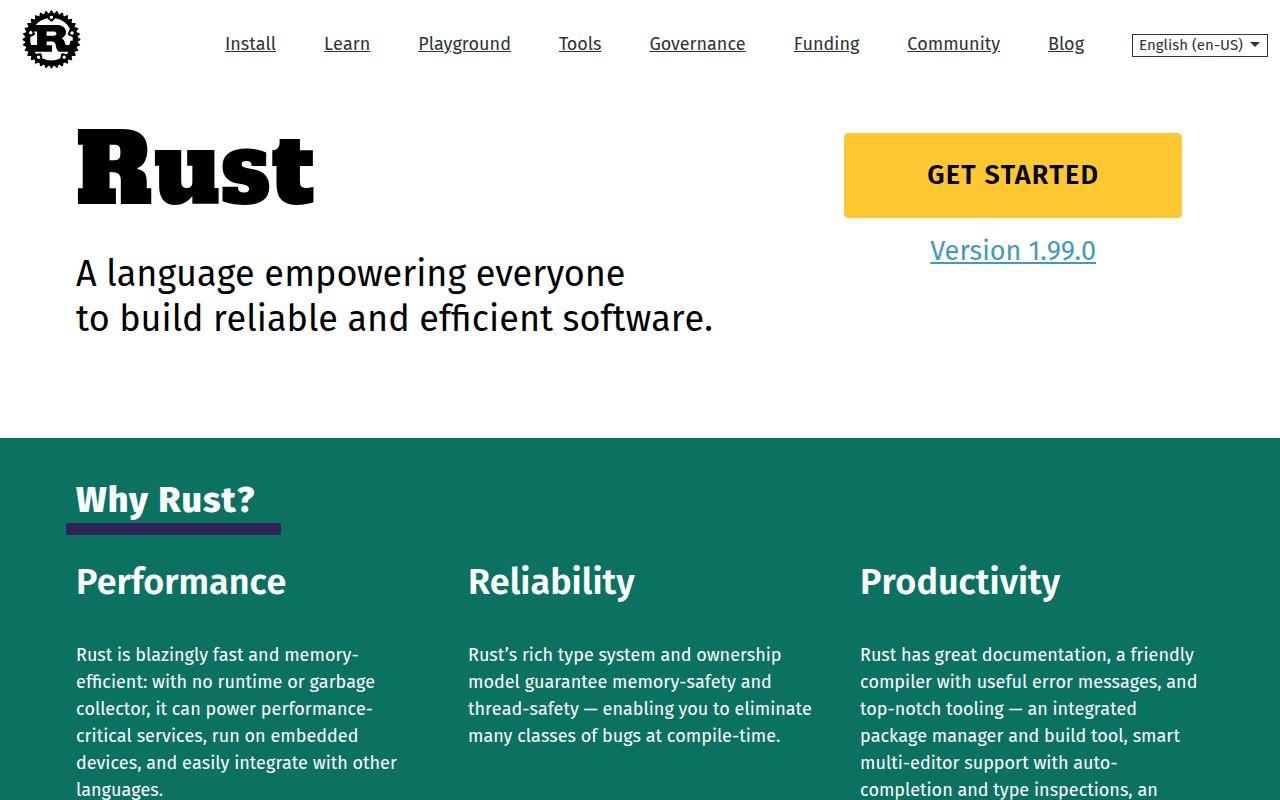
Lab card: what happened when we ran rustScreenshot of rust (www.rust-lang.org)
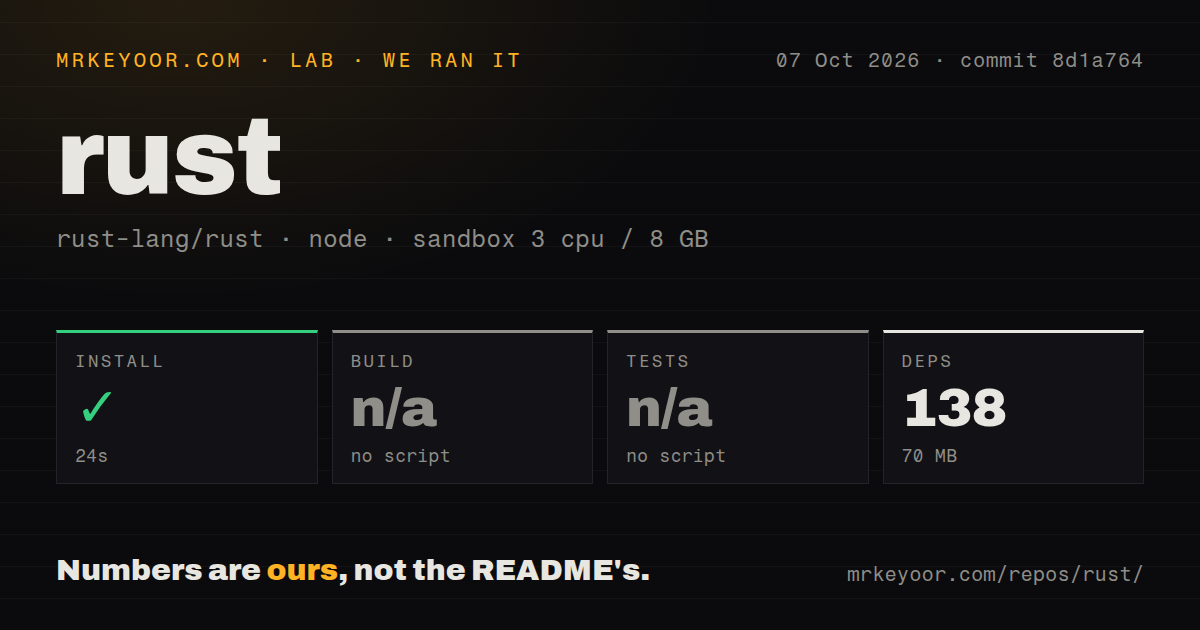
Install✓ · 33s138 packages · 70 MB
Buildn/ano build script
Testsn/ano test script
Repo421521 files~35,553,394 lines of source · 3489.9 MB · 3 CI workflows · tests dir

Answers from our run

Does rust build from source?

Dependencies installed in 33 seconds (138 packages), and the project has no separate build step. We cloned commit cc05892 into a clean Debian container with 3 CPUs and no project-specific setup.

Does rust have tests you can run?

Not through a standard command: the project exposes no test script or target that our harness could run.

Who should not use rust?

Developers who only want to write Rust applications: the README recommends the normal installation path and says source installation is not recommended.

What are the alternatives to rust?

Go, Swift, LLVM Project. Our harness installed 138 Yarn packages in 33 seconds but compiled no Rust code and ran no Rust tests, so it says nothing about rustc health.

Setup1/53,489.9 MB checkout; real x.py build was not exercised
Docs5/5The Book, rustc guide, install guide, and platform docs are deep
Community5/5116,190 stars and a push on August 27, 2026
Maturity5/5Rust 1.98.0 shipped August 20 with tiered platform policy

Discussed on

  1. hnRust: 128 bit integers preparing to be released278 points
  2. hnDon't remove the $(nop) command below249 points
  3. hnRust Weird Expressions248 points
  4. hnRust project goals: Immobile types and guaranteed destructors245 points
  5. hn&& operator chains (and ||, possibly) generates unoptimizable LLVM IR228 points

Who it’s for

Compiler engineers and contributors changing rustc, rustdoc, the standard library, or bootstrap.
Platform maintainers adding or repairing Rust targets and host toolchains.
Researchers studying ownership, type checking, code generation, diagnostics, and language implementation.
Organizations prepared to maintain a configured source build or a patched compiler fork.

Who it’s NOT for

Developers who only want to write Rust applications: the README recommends the normal installation path and says source installation is not recommended.
Small disks or quick CI jobs: our checkout was 3,489.9 MB with 421,521 files before any compiler build output.
Offline source builds: the bootstrap documentation says it downloads a stage 0 compiler, standard library, and Cargo snapshots.
Unsupported host platforms expecting a native bootstrap: source builds need an available snapshot binary, otherwise cross-compilation is required.
Teams wanting a small, isolated component repository: rustc, rustdoc, standard library, documentation, bootstrap, tests, and integrated tools share this tree.

Setup reality

Our sandbox checkout had 421,521 files, about 35,553,394 source lines, and occupied 3,489.9 MB. The detected Yarn layer installed 138 packages in 33 seconds and used 70 MB. No build script or target was found, so build was skipped; no test script or target was found, so tests were skipped.

Those results do not compile rustc or run Rust's test suites. The actual source build uses x.py, a bootstrap configuration, a downloaded stage 0 Rust toolchain, Git, Python, a C compiler, and platform dependencies. Building LLVM locally adds C++, CMake, and Ninja or Make.

Most users should install a release through rustup. Contributors choose an x.py setup profile, fetch snapshots over the internet, build selected compiler stages, and run targeted suites. Windows adds an ABI choice plus MSVC or MinGW requirements. Source builds create substantial staged output beyond the 3,489.9 MB checkout.

This repository is the language implementation

rust-lang/rust contains rustc, rustdoc, the standard library, language documentation, bootstrap machinery, and tests. It is the upstream development tree behind released Rust toolchains. That scope makes the repository useful for changing type checking, diagnostics, code generation, library APIs, documentation behavior, or platform support. It is unnecessary overhead for a developer who only needs Cargo and a stable compiler.

The scale is exceptional. Our checkout contained 421,521 files, roughly 35,553,394 source lines, and 3,489.9 MB before any source build output. The lab found a tests directory and 3 CI workflow files, though those counts barely describe the project's actual validation infrastructure. Compiler suites, standard-library tests, rustdoc cases, platform jobs, and integrated tool checks are selected through the bootstrap system rather than one ordinary package script.

Rust users should install releases instead of this checkout

The README directs new users to The Rust Programming Language and its normal installation instructions. Its source-install section explicitly says building from source is not recommended for people who only want Rust. That advice is correct. rustup manages stable, beta, nightly, targets, and components without asking each application developer to bootstrap a compiler and standard library.

Rust 1.98.0 was released on August 20, 2026. Its notes cover language behavior, platform tiers, standard-library APIs, lints, and compatibility changes. Teams should read those notes before raising their minimum supported Rust version or moving CI to a new toolchain. A source checkout follows active development beyond the latest stable release, so pinning a commit is mandatory for any custom compiler build.

What happened when we ran it

Our sandbox detected a Yarn package layer and installed 138 packages in 33 seconds, occupying 70 MB. The repository had no build script or target matching that harness, so build was skipped. It also had no matching test script or target, so tests were skipped. We did not compile rustc, build the standard library, or run a Rust compiler test suite.

The checkout itself measured 3,489.9 MB and about 35,553,394 source lines at commit cc05892. The environment was an unprivileged Debian container with 3 CPUs, 8 GB of RAM, and no secrets. Calling the Yarn installation a successful Rust build would be false. It only confirms that the detected JavaScript dependency step completed, likely supporting repository tools or documentation rather than the compiler bootstrap.

x.py manages a staged self-hosting build

Rust is written in Rust, so a source build begins with a previously compiled stage 0 toolchain. The bootstrap entry point downloads that compiler, standard library, and Cargo, builds the Rust bootstrap program, then produces later compiler and library stages. x.py setup helps select a contributor profile, while bootstrap.toml controls targets, LLVM choices, tools, assertions, optimization, and installation paths.

A Unix-like host needs Python, Git, a C compiler, curl, and platform libraries. Building Cargo adds OpenSSL. Building LLVM locally adds a C++ compiler, CMake, and Ninja or Make, while supported hosts can choose a downloaded CI LLVM. Source builds need network access for snapshots and a host capable of running an available snapshot binary. Windows adds MSVC or MinGW setup and an ABI decision.

Targeted tests are the practical contributor path

The bootstrap tool accepts paths and named steps so contributors can build and test the area they changed. Bootstrap's own tests run through x test bootstrap; compiler, library, documentation, and UI suites have separate selectors described in the rustc development guide. This matters because rebuilding and retesting every part of a repository with 421,521 files would make small changes unnecessarily expensive.

Contributors still need to understand stage effects. A stage 1 compiler is built by stage 0, then helps build the next standard library and compiler. Artifacts live under a large build tree containing snapshots, stage directories, LLVM output, tools, documentation, and test results. Keep that output on a filesystem with ample space and use the documented clean or targeted commands instead of deleting unexplained stage files mid-build.

Stable releases and nightly development serve different buyers

The latest open issue list includes internal compiler errors against nightly 1.100 builds, while release 1.98.0 is the current stable tag returned by GitHub. Nightly exists to expose unfinished language and compiler work; an issue against nightly should not be presented as a stable release defect without reproduction there. Production teams should pin stable or a named version and move only after their own workspace passes.

GitHub showed 116,190 stars, 12,617 combined issues and pull requests, and a last push on August 27, 2026. That open count includes design tracking, platform work, regressions, documentation, and pull requests, so it is not a bug total. The dual MIT and Apache 2.0 licensing is friendly to toolchain use. This repository is mature infrastructure with a contributor setup that correctly assumes serious compiler work.

Alternatives

ProjectWhat it isPick it when
Go gh↗A garbage-collected systems and server language with a smaller toolchain model and fast builds.pick this instead when simple deployment, quick compilation, and a smaller language surface matter more than Rust's ownership model.
Swift gh↗A compiled language and toolchain aimed at Apple platforms, servers, and systems work.pick this instead when Apple ecosystem integration and Swift libraries drive the choice.
LLVM Project gh↗The compiler infrastructure and toolchain collection used beneath Rust and many other languages.pick this instead when the work belongs in optimization, code generation, linkers, debuggers, or shared compiler infrastructure.

What people are saying

  1. [github-trending] rust-lang/rust
  2. [github-trending] rust-lang/book
  3. [github-trending] rust-lang/rust-analyzer
  4. [hackernews] MartyPC is a cross-platform emulator of early PCs written in Rust
  5. [lobsters] A 2026 Survey of Rust GUI Libraries
  6. [github-trending] rust-lang/cargo

Sources

  1. Rust repository README
  2. Rust source installation guide
  3. Rust contribution guide
  4. Rust bootstrap README
  5. Rust 1.98.0 release notes

More dev tools reviews

workmux · v2rayNG · SecLists · hashcat · eslint · fastfetch · the whole board →