v1.1.0 is a five-lane checklist, not an SEO application
fire-your-seo-agency v1.1.0 divides search work into five lanes: SEO, AEO, GEO, LLMO, and NEO for Naver. It is a Claude Code skill made of Markdown instructions, reference files, and plugin metadata. The skill tells an agent how to inspect a site, propose priorities, make approved changes, and schedule another measurement. It does not ship a crawler, dashboard, database, or scoring binary. That distinction determines whether this repo is useful to you.
The scope is wider than a routine technical SEO checklist. Its six English reference guides cover server-rendered HTML, sitemaps, metadata, structured data, answer-friendly paragraphs, AI crawler policies, brand consistency, Naver Search Advisor, and measurement. The GEO guide separates training bots, search-indexing bots, and live-fetch agents instead of treating every AI user-agent alike. The Naver material is a genuine point of difference for Korean publishers, since most English SEO tools stop with Google and Bing.
Phase 0 requires evidence before any edits
The six-phase operating procedure begins with a Phase 0 audit using plain HTTP checks. It asks Claude Code to inspect whether important content appears without JavaScript, whether robots directives accidentally block indexing, whether sitemaps exist, and whether missing pages return a real 404. That crawler-eye framing is sound. A component existing in source code does not prove that a search crawler receives it after routing, rendering, caching, and deployment.
The skill also places an approval point between diagnosis and implementation. After scoring the five lanes, the agent must propose priorities and wait for the user to approve changes. If it can access the codebase, it may edit directly; otherwise it should identify files and lines for a developer. This makes the repository more suitable for an operator who reviews diffs than for anyone seeking a fully autonomous production agent. The instructions still depend on Claude following them accurately.
What happened when we ran it
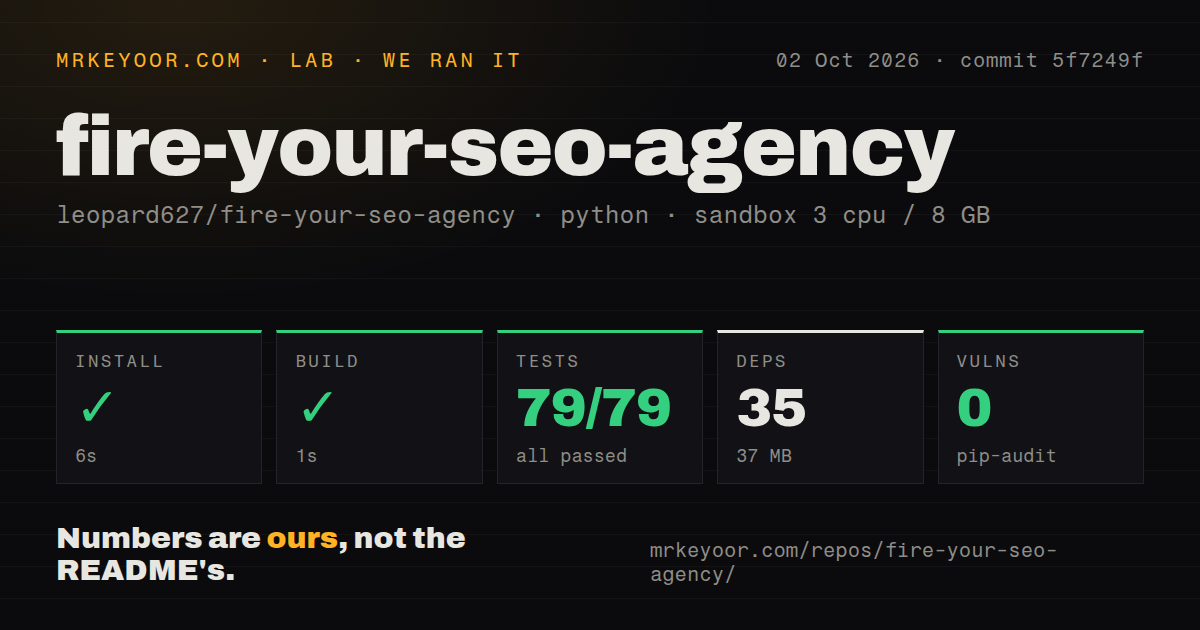
Our sandbox did not run commit eb9be9f. The checkout declared no supported language ecosystem, and it contained no Dockerfile. There was therefore no install, build, or test step for our fresh Debian container with 3 CPUs and 8 GB of RAM to execute. We are not treating the documented audit process, the sample scorecard, or the README's outcome claims as results reproduced by MrKeyoor.
That non-run is informative because the repository presents a procedure, not software with an entry point. The tree contains Markdown, an MIT license, a social image, and two Claude plugin manifests. Installation means registering the marketplace plugin or cloning the files into a Claude skill directory. A user can try those instructions in Claude Code, but there is no deterministic command here that another lab can invoke to compare findings across sites.
Six English mirrors sit behind Korean canonical instructions
The project has six English reference mirrors, but SKILL.md says the Korean files under references/ are canonical and the English copies are for human readers. That arrangement is workable for a Korean-speaking maintainer and international readers evaluating the method. It is a harder fit for an English-only team that needs to audit the exact instructions its agent follows, because edits can land in the canonical files before or differently from their mirrors.
The English material is specific enough to be useful on its own. The SEO guide warns about client-rendering bailouts and cached 404 responses. AEO covers Bing registration, direct answers, and honest update dates. GEO provides a crawler-policy table. The measurement guide requires a baseline, a recheck 14 days after changes, and attention to stale data. Some statements about how answer engines extract or rank passages are presented as firm rules without linked primary documentation, so treat them as hypotheses to measure on your own site.
The 14-day recheck is the strongest operating habit
The measurement guide tells the operator to record a baseline and remeasure 14 days after a change, excluding the newest 2 to 3 days when reporting lag applies. It tracks impressions, clicks, index counts, citation checks, and AI crawler visits. This is the best part of the project because it makes the agent define success before editing. A generated llms.txt file or schema block is only an output; movement in the chosen metric is the outcome.
There are limits to that method. Search Console, Bing Webmaster Tools, Naver Search Advisor, server logs, and live answer-engine checks require different credentials and access paths. The Naver guide says account registration needs the user. The core skill says to request approval before implementation. Those boundaries are responsible, though they also mean the one-command README example is merely the beginning of a supervised engagement. Expect account work, source review, deployment, and later measurement outside the plugin installation itself.
A 2-day activity window cannot establish maturity
GitHub shows the repository was created on August 26, 2026 and pushed on August 27, when v1.1.0 was released. It had 335 stars, 87 forks, and 0 open issues or pull requests when fetched on August 29. The recent push confirms current maintainer activity, while the empty issue list supplies no evidence about how maintainers handle reports. A project this new has not had enough public time to build a support record.
The release adds English mirrors, plugin installation, Bing guidance, an AI crawler policy table, and prompt-injection instructions. Those are sensible additions for a documentation project. They do not solve the verification gap: there is still no runnable audit harness, fixture site, or expected-output test that proves two agents apply the checklist consistently. Use the skill to structure a careful human-reviewed audit. Use SiteOne Crawler, Lighthouse, or GEO Optimizer when you need repeatable executable findings.