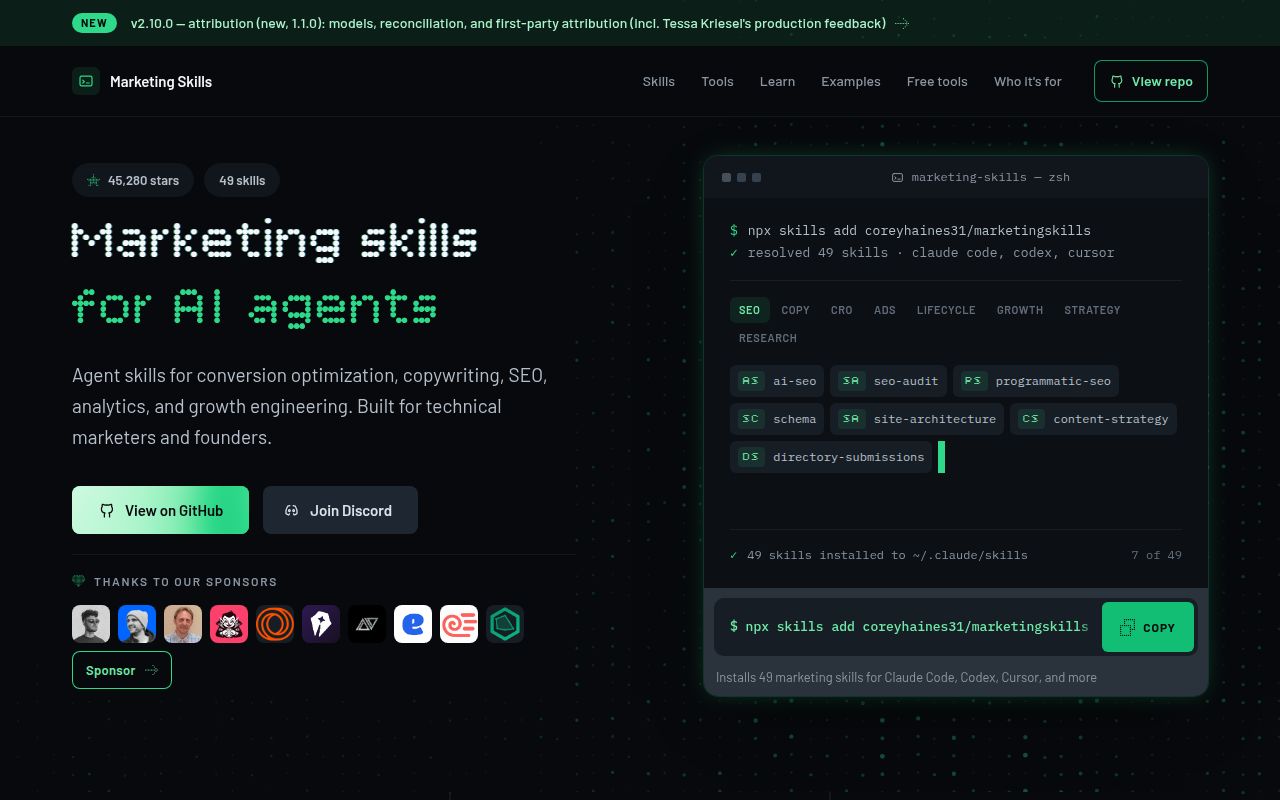
General-purpose AI agents are powerful, but they are just that: general. Ask one to write a Python script and it excels; ask it to devise a SaaS churn-reduction strategy, and you'll get generic, surface-level advice. The coreyhaines31/marketingskills repository is a brilliant and practical solution to this problem, acting as a specialized knowledge base that grafts years of marketing expertise directly onto your AI coding assistant.
Created by Corey Haines, a well-known figure in the conversion rate optimization space, this open-source project isn't an application but a library of what it calls "skills." These skills are meticulously crafted markdown files, each one a playbook for a specific marketing task. They are designed to be read and understood by AI agents like Claude Code, Cursor, and others that support the Agent Skills spec, a promising move towards a standardized format for augmenting LLMs.
How It Works: A Library for Your AI Co-pilot
The project's architecture is its most impressive feature. It's not just a flat folder of disconnected text files. At its core is the product-marketing skill, a foundational document that every other skill consults first. This is where you define your product, target audience, positioning, and key messaging. This simple but powerful mechanism gives the AI agent a persistent, shared context, ensuring that when you ask it to write ad copy, it does so with a deep understanding of who you're selling to and why they should care. It’s the difference between a random freelancer and an in-house expert.
From this foundation, the skills branch out into every conceivable marketing discipline. A diagram in the README clearly illustrates how categories like SEO, CRO, Content & Copy, and Paid Advertising are all interconnected. Skills frequently cross-reference each other. For example, the copywriting skill might use insights from customer-research, while the cro skill works in tandem with ab-testing. This creates a holistic system where the AI can reason about marketing problems from multiple angles, just as a human expert would.
The Arsenal: A Tour of the Skills
The sheer breadth of the skills library is staggering. It covers the full marketing funnel, from top-level strategy to granular execution. For content and SEO, you have skills for seo-audit, content-strategy, site-arch (site architecture), and even ai-seo, a forward-thinking skill for optimizing content to be cited by LLMs and appear in AI-generated answers.
For those focused on conversion and product-led growth, there are skills for cro (conversion rate optimization), signup and onboarding flows, paywalls, and churn-prevention. These aren't just high-level ideas; they contain specific frameworks and prompts to guide an AI agent in analyzing user flows, identifying friction points, and proposing concrete improvements.
Sales and go-to-market teams are also covered with skills for cold-email, sales-enablement, launch strategies, and pricing. The library even includes skills for more niche but valuable tactics like building free-tools as lead magnets, running co-marketing campaigns, and getting listed via directory-submissions.
Strengths and Weaknesses
The project's primary strength is its expert-driven, structured approach. This isn't just a collection of prompts; it's a codified system of marketing best practices. By relying on this library, a solo founder can execute a marketing plan with the discipline of a seasoned professional. The adherence to an open Agent Skills spec is another major plus, suggesting longevity and interoperability beyond any single AI platform.
However, the project's greatest strength is also its main prerequisite. Its value is directly proportional to your adoption of AI coding agents. For marketers who live in Google Docs and Canva, this project is inaccessible. It is explicitly for the growing cohort of technical marketers and founders who are comfortable working in a code editor.
Furthermore, the quality of the final output is still dependent on the underlying intelligence of the AI agent. These skills provide an excellent map, but the agent's LLM is the engine driving the car. A more capable model will produce better results. Finally, while the project is very active now, with a release just last week, the fast-changing marketing landscape means the skills will require continuous updates to remain cutting-edge.
Community and Where It Fits
With over 42,000 stars, Marketing Skills has clearly struck a chord. This is not a niche experiment. The repository shows healthy activity, and with 88 open issues, there's an engaged user base providing feedback. The project is backed by Corey Haines' broader ecosystem of courses, newsletters, and an agency, which provides a strong foundation of domain expertise and credibility.
In a real-world stack, Marketing Skills doesn't replace your core marketing tools like HubSpot, Google Analytics, or Ahrefs. Instead, it acts as an intelligent middleware layer. It's the brain that helps you, via your AI agent, to better plan what to do with those tools. It helps you generate the strategy for your next SEO article, write the copy for your new landing page, or design the A/B test you'll implement in your analytics platform. It is a powerful tool for thought and execution, bridging the gap between high-level strategy and the code and copy that brings it to life.