Photos, Auth, and Locker share one encrypted service
Ente's 10,522-file checkout also contains the clients, Museum server, infrastructure code, and shared Rust components behind its three apps. Photos handles encrypted backup, search, sharing, albums, and imports. Auth stores two-factor codes with encrypted sync. Locker covers documents, credentials, notes, private sharing, and emergency access. The common service gives users one account and lets developers inspect server and client code in the same repository. The README names external security reviews by Cure53, Symbolic Software, and Fallible.
The measured checkout was 142.2 MB and held roughly 419,095 lines of source. This is a product suite, far larger than a tidy server utility. Mobile, web, desktop, Apple, Android, Go, TypeScript, Dart, and Rust work coexist. A storage or encryption change may cross several clients. The short root README is an introduction; setup details live in the self-hosting documentation and component directories.
Prebuilt images sidestep the 142.2 MB source build
Our clone includes a quick-start script that pulls prebuilt images and keeps its setup in a local directory. Ente documents a minimum of 1 CPU core, 1 GB of RAM, and Docker Compose 2.30 or newer. Photos then opens on port 3000, public albums use port 3002, and the verification code can be read from the Compose logs. The packaged route avoids compiling the full workspace.
The service behind those clients is Museum, backed by Postgres and S3-compatible object storage. The default Compose path supplies local MinIO, while an external provider needs endpoints and credentials in the configuration. SMTP replaces log-based verification for normal users. A public deployment also needs TLS, correct app URLs, protected credentials, and a registration policy. This packaged route avoids the 1,114-package Rust build, but operators still own those settings. The server README says routine self-hosting support cannot be prioritized.
What happened when we ran it
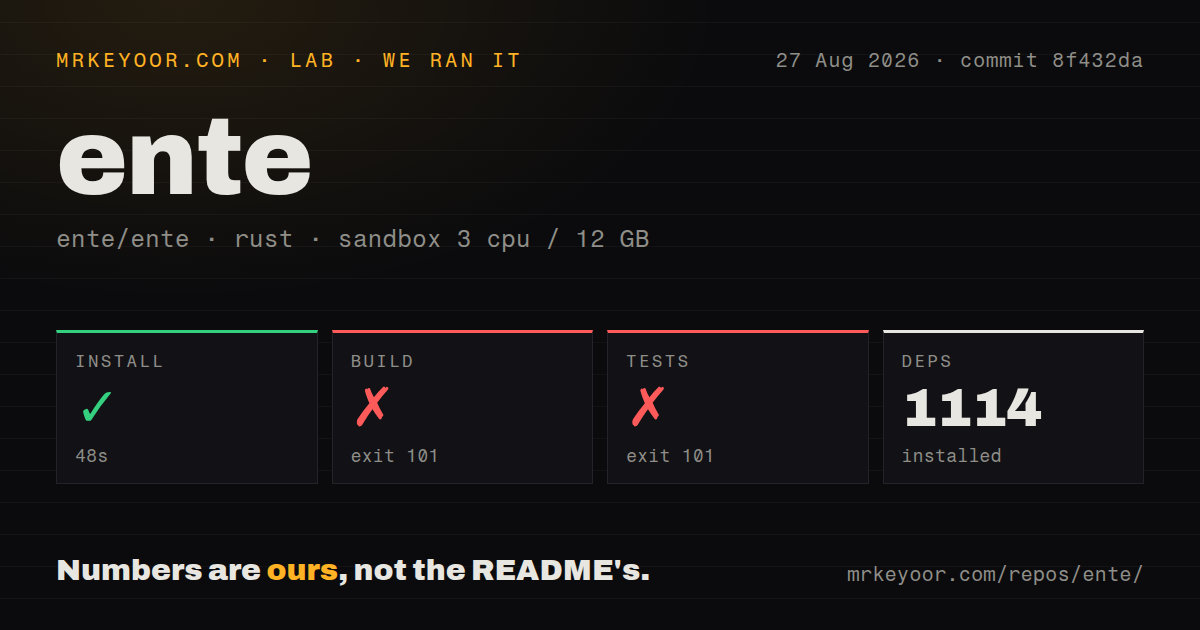
We ran commit 8f432da in our sandbox, where the Rust workspace installed 1,114 packages in 48 seconds. The build then ran for 423 seconds and exited with code 101. Its tail first reported that rustfmt was missing for the Rust 1.98.0 toolchain, explicitly called that formatting error non-fatal, and continued. The final failure came from llama-cpp-sys: CMake tried to build its output directory, gmake found no Makefile, and the crate's build script panicked.
The test command also exited with code 101 after 45 seconds. Its last lines show the same two events, the non-fatal rustfmt warning followed by the llama-cpp-sys CMake build with no Makefile. No test summary appears in the supplied tail, so we cannot say how many tests started or passed. Our measurement setup was a fresh unprivileged Debian container with 3 CPUs, 12 GB RAM, no secrets, and the lab-rust:1 image.
Object storage alone cannot recover an Ente library
The backup guide names three required pieces: Museum configuration, Postgres data, and object storage. The 10,522-file checkout had 37 CI workflow files, while our scan recorded no Dockerfile or tests directory in the measured Rust target. The database holds encrypted file and collection material needed to use the bucket's objects, and the user's password supplies the master secret. Self-hosters still own data recovery, regardless of how many checks run upstream.
The 142.2 MB checkout includes deployment code, yet Ente advises new operators to keep a plaintext photo backup and test a full restoration before trusting instance backups. That warning should change the purchase decision. A household NAS admin who already snapshots databases and buckets can absorb the work. Someone seeking an appliance should use Ente's hosted service or choose a system whose recovery model matches an existing backup routine. Encryption raises the cost of an incomplete backup.
Windows Photos and Auth still have open platform reports
Issue 1296 has tracked broken typing in Ente Auth search on Windows since April 2024. Reports tie it to unlocking with Windows Hello or passkeys, and users say changing focus restores input. On September 8, 2026, a contributor asked users to retest a nightly build after a Flutter upgrade. Issue 12636 separately reports that the Photos v1.7.28 Arm64 installer failed on a Surface Laptop 7, while its x64 build installed. A maintainer said the team would investigate.
A repository with 37 CI workflow files still spans platform behavior that automation may miss. Neither open issue proves a general failure on every Windows machine, and the nightly retest may resolve the Auth case. Windows users should install on the actual hardware and exercise unlock, search, upload, and playback before migrating. The Arm64 report is a reason to keep the x64 installer or another photo client available until the issue closes.
A September 8 push and v1.3.63 release show current maintenance
GitHub recorded Ente's last push on September 8, 2026, and listed 28,708 stars, 217 open issues, and 14 open pull requests. Photos v1.3.63 was published on September 7 with Library Sharing and album slideshows, plus changes for large uploads and large libraries. Issue 1296 also received a contributor response on September 8. This monorepo ships several products, so one Photos tag cannot describe every component's pace.
Our 48-second install proves that Cargo could resolve and obtain the 1,114-package Rust dependency set, while the 423-second build failure blocks a clean source recommendation for commit 8f432da. The packaged apps and Compose route remain reasonable trials because they follow different delivery paths. For a private family photo service, start with the packaged Ente apps. For source development or long-term self-hosting, require a successful local build and a full restore rehearsal before moving the only copy of anything important.