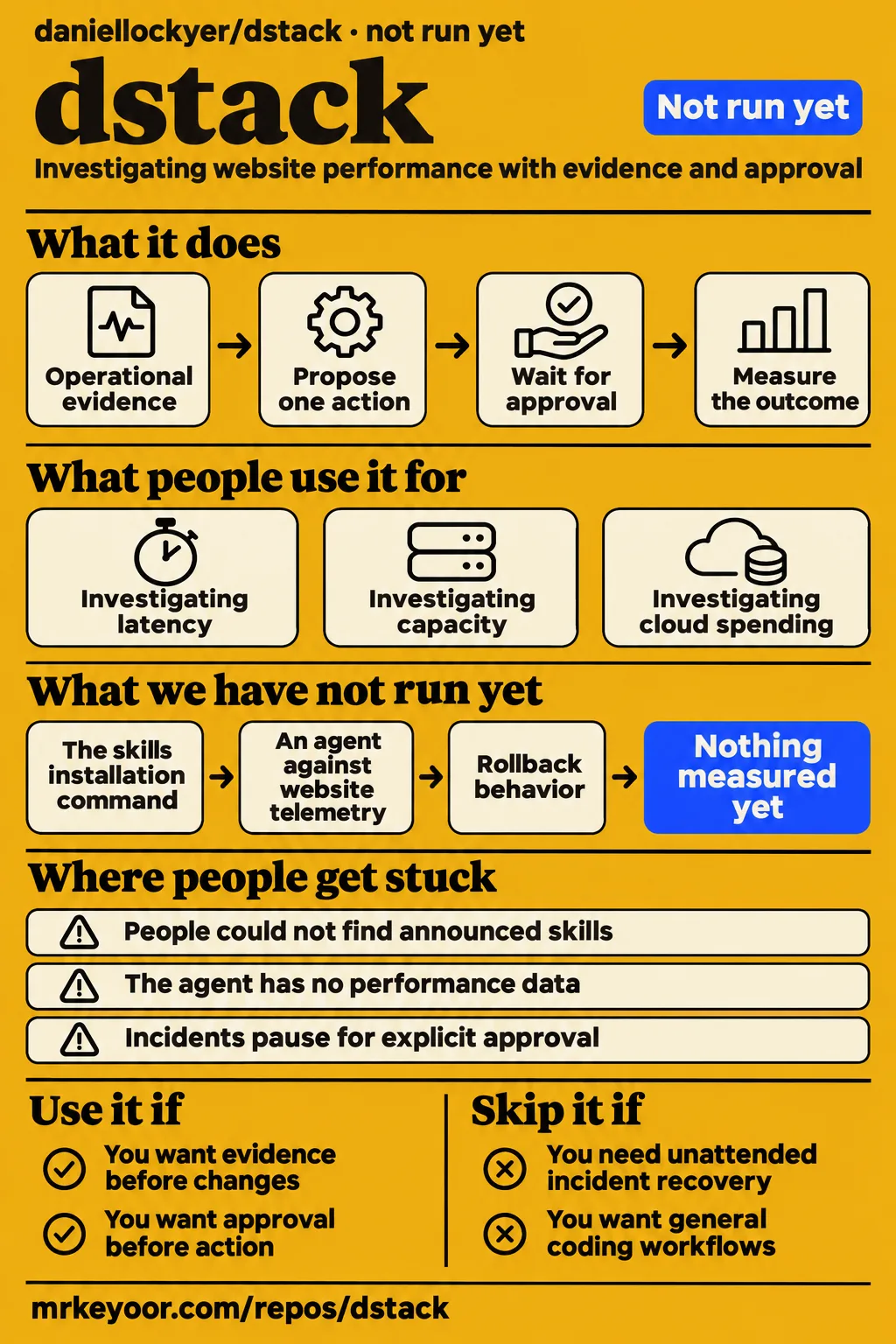
Daniel Lockyer's dstack contains a published OODA-loop skill for investigating website performance. Its central rule is straightforward: collect operational evidence, propose one action and wait for approval before making changes. Use it if that is how you want an agent to approach latency, errors, capacity or spending. Choose a broader development toolkit for general coding, and skip this workflow if you need unattended incident recovery.
What you can do with dstack
The OODA-loop skill covers website performance, scalability, cost, errors and outages. Its website systems instructions organize an investigation into Observe, Orient, Decide and Act. The user owns the measurable objective; the agent collects evidence, explains the situation and proposes a reversible experiment. Approval separates the proposed action from the change itself. That gives an operator a specific working method to inspect before adding it to an existing agent environment.
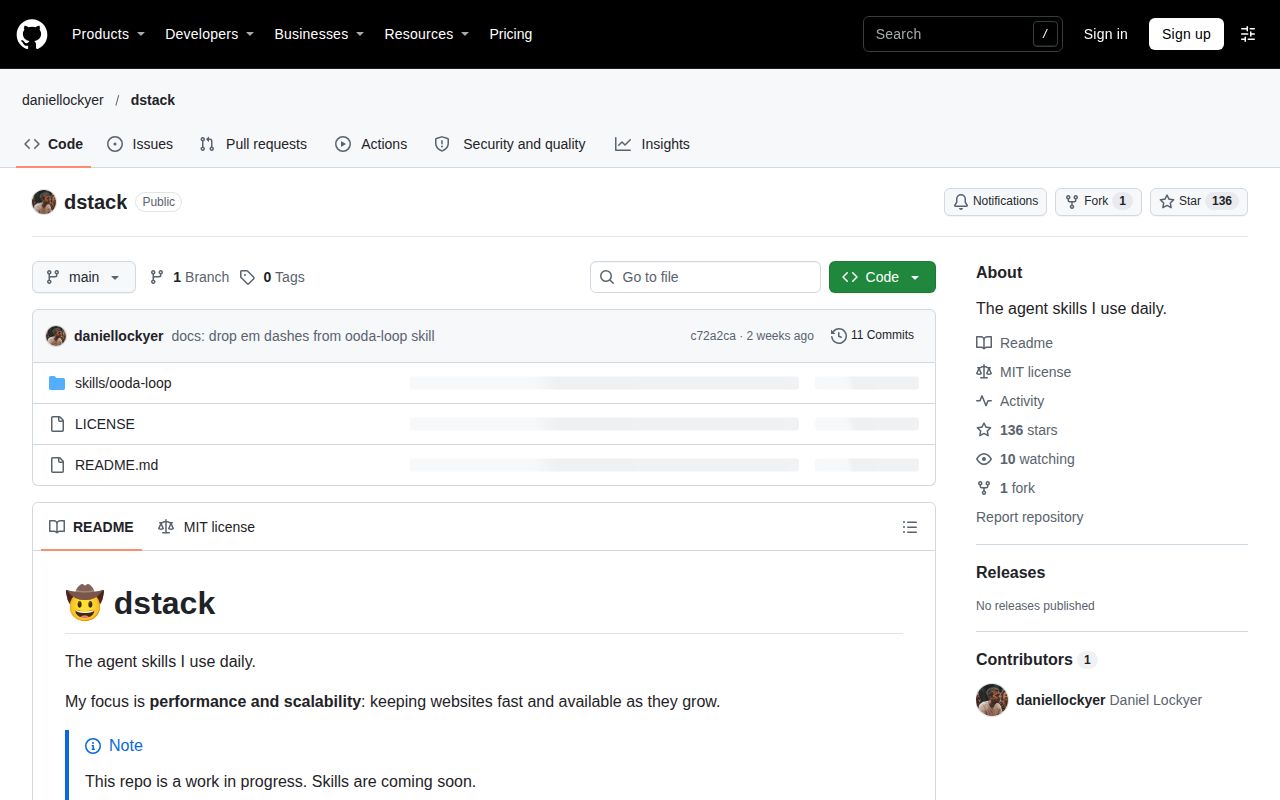
The dstack README describes the collection as the skills Lockyer uses daily, focused on keeping websites fast and available as they grow. That is the author's description of his practice. The published skill makes the scope more concrete: it names latency, throughput, capacity and cloud spending, then specifies how to gather evidence and judge an action against its hypothesis. The useful question is whether those instructions fit the investigation you need to conduct.
What people use dstack for
The published skill is intended for investigating website latency, errors, capacity and cloud spending using operational evidence. For a latency or error investigation, the Observe phase asks for dated signals such as latency, errors, traces and recent changes. For a capacity problem, the same phase includes saturation, traffic and queue depth. For a spending investigation, the objective and decision rules connect a measurable goal to an action and its tradeoffs.
These applications come from the skill's written scope. The target-specific community record concerns publication: in the reply to Missing Skills issue #1, Lockyer linked the OODA-loop directory after readers asked about the announced skills. That reply supplies a place to inspect the workflow. It is an availability update from the author, rather than an account of a customer's latency, capacity or spending investigation.
The distinction between these tasks matters when preparing an investigation. A latency objective calls for evidence about response behavior; a capacity objective calls for evidence about demand and saturation; a spending objective includes cost alongside reliability constraints. The skill names those categories explicitly. It then asks the agent to identify the dominant constraint rather than propose a collection of unrelated optimizations. That structure gives the operator a way to ask why this particular action follows from the available evidence.
What happened when we ran it
Our November 17, 2026 harness attempt at commit c72a2ca lasted 6 seconds and ended at ecosystem detection. The harness reported no supported ecosystem, language null and no Dockerfile. Its recorded sandbox configuration was 3 CPUs and 8 GB of RAM, with image n/a. The 6 seconds measure harness duration, not software performance. Our run produced the stopped-at-detection outcome shown below.
| Recorded check | Result | What it means for this review |
|---|---|---|
| November 17 repository harness | NOT RUN: no supported ecosystem; language null; no Dockerfile | The 6-second harness attempt ended at ecosystem detection |
| November 18 hands-on safety step | FAILED: none of compose.yaml, compose.yml, docker-compose.yaml or docker-compose.yml exists | The runner required a Compose file and stopped |
| November 18 teardown | ok | Cleanup was recorded |
The November 18 safety step describes the repository as unsafe because its runner requires a Compose file. That is an admission rule for this runner. The README instead documents adding agent skills. Reading the failure alongside that installation route explains the mismatch: the recorded check looked for a container application entry point, while the supplied project instructions describe installing a workflow into an agent environment.
The November 18 run summary says the repository was deployed with its own Docker Compose and every port bound to 127.0.0.1. The explicit missing-Compose failure conflicts with that summary, so the recorded outcome remains a stopped attempt. The teardown record says "teardown: ok." Both records belong in the account: cleanup was recorded, while the deployment summary and safety step disagree.
Install the published skill
The README's command for selecting the published skill is npx skills add daniellockyer/dstack --skill ooda-loop. Its installation section also documents adding the collection, installing for the user and listing available skills. These are the supplied project's commands, reproduced as documentation. Selecting the named skill gives an interested reader a concrete starting point aligned with the file assessed in this review.
npx skills add daniellockyer/dstack --skill ooda-loop
The README uses npx skills add daniellockyer/dstack for the collection and npx skills add daniellockyer/dstack --global for a user installation. It gives npx skills add daniellockyer/dstack --list to list available skills. The important choice is scope: the README distinguishes choosing one skill from installing for the user instead of the project. Read those options before choosing the command that matches where you want the instructions available.
Installation and investigation access are separate steps in the documented workflow. The Observe instructions name observability tools, vendor CLIs or APIs, MCPs and local logs as possible sources of signals. Installing the instruction file supplies the method; access to the website's operational data supplies the evidence. The skill tells the agent to ask for that access by name when the required live or exported signals are missing.
Where people get stuck: finding the skill and supplying evidence
The README names ooda-loop in its installation examples, while its work-in-progress note still says skills are coming soon. The OODA-loop directory linked in issue #1 provides a specific entry point alongside those commands. Read the statements together: the collection carries an unfinished-project notice, and a particular published skill has a documented location. For a first inspection, that location is more useful than the general notice.
| Situation | Evidence-backed next step | Basis |
|---|---|---|
| You cannot find the announced skills | Open the OODA-loop directory linked by Lockyer | His reply in issue #1 |
| The agent has no performance data | Provide live or exported signals before diagnosis | The skill's Observe data gate |
| You want a general coding workflow | Consider pstack, which Lockyer recommends for that role | The repository README |
| Your automation expects a container stack | Use an evaluation designed for agent skills | Our stopped Compose-based attempt |
The data requirement is the next practical obstacle. The skill says documentation and architecture reasoning alone do not count as operational evidence. It asks for real, dated and sourced data covering the objective, including relevant changes and alerts. An operator can use that requirement to prepare the investigation: identify the affected system, choose the objective and make the relevant logs or observability interface available. That preparation follows directly from the workflow's Observe phase.
Approval comes before changes, even in incidents
Observe, Orient and Decide are read-only phases in the published skill. The OODA-loop approval rules prohibit edits, deploys, restarts, scaling and configuration or flag changes before an approved Act. The definition also includes activities that add load or alter runtime state, such as load tests, cache warming and changes to debug logging or sampling. An experiment can therefore require approval even when it sounds like information gathering.
The Decide phase asks for one action, its hypothesis, an invalidating result, rollback information and tradeoffs across performance, scale, cost and reliability. It then tells the agent to stop for explicit approval. Incidents use that pause too, unless the user already authorized a specific mitigation. This is a clear fit for an operator who wants to choose the intervention after reading the diagnosis. It conflicts with a requirement for autonomous recovery without a decision point.
The instructions also define what happens after an approved action. The agent captures before-and-after values for the chosen metrics, judges the result against the hypothesis and records side effects. If the invalidation condition occurs, it rolls back and returns to Observe rather than chaining further actions. These instructions define an agent workflow; the agent environment supplies the tools and permissions. The distinction matters when deciding how to integrate the method into existing operational access.
dstack vs pstack and Superpowers
Lockyer recommends pstack for general code development in the dstack README. That makes it the most direct alternative for a reader whose task extends beyond website performance. Pstack's README describes engineering skills and playbooks spanning investigation, bug fixes, performance work, features and refactoring. The Superpowers README describes a software development methodology built on composable skills. Their documented workflows give readers useful selection criteria without a numerical product ranking.
| Project | Documented focus | Choose it when |
|---|---|---|
| daniellockyer/dstack | Website performance, scalability, cost, errors and outages | You want an investigation process with approval before action |
| pstack, within cursor/plugins | General engineering workflows | You want the broader coding toolkit Lockyer recommends |
| obra/superpowers | Software development through composable agent skills | You want specification discussion, design approval and implementation planning |
The Superpowers README says its process begins by asking what the user is trying to build, discussing a specification and obtaining design sign-off before preparing an implementation plan. Dstack's published skill starts with a measurable operational objective and evidence about the running system. Choose according to the job's starting point. Building a feature and investigating an operational symptom call for different initial questions, even when both workflows use approval steps.
The availability correction and namesake confusion
Lockyer's later publication reply contradicts the allegation that he would share no skills. In the Missing Skills discussion, artile suggested the project was a joke and that access would require hiring the author. Lockyer objected to that guess and then linked the OODA-loop directory. That sequence corrects the allegation about availability: the commenter's prediction and the author's subsequent publication are different points in the discussion.
MobilesTalk's dstack review describes an orchestration layer for AI workloads, and iTechGuides' dstack review describes GPU infrastructure across cloud and on-premises systems. Their supplied titles and extracts identify that infrastructure subject. Those pages concern a different product, rather than misdescribing Lockyer's skills collection. Checking the repository owner resolves the namesake confusion before a reader imports installation advice or a verdict from a review answering a different question.
FAQ
Yes, Lockyer reported publishing an OODA-loop skill and linked its directory in the Missing Skills issue. That answers the availability question behind the target-specific discussion. The questions below address finding the skill, understanding its operational purpose and distinguishing daniellockyer/dstack from other repositories with the same name. Repository ownership matters here because the supplied search material includes both agent instructions and infrastructure software.
Where are the skills for daniellockyer/dstack, and has the author published any?
Lockyer's reply in issue #1 links to skills/ooda-loop in his repository. The README names the same skill in its selection command, so there are two supplied routes to the published material: the author's issue reply and the repository's installation instructions. Start with that named skill when assessing the investigation process described here, rather than treating the announcement alone as the product description.
What is Daniel Lockyer's dstack Performance Toolkit?
Daniel Lockyer's dstack is his collection of agent skills focused on website performance and scalability. The README describes that focus as keeping websites fast and available as they grow. The OODA-loop skill turns the description into instructions for setting an objective, gathering operational evidence, proposing an action and measuring its outcome. Its approval pause is part of that written process, including during incidents unless a specific mitigation was already authorized.
Which GitHub project does a search for dstack refer to?
daniellockyer/dstack is the skills repository reviewed here; dstackai/dstack describes GPU provisioning and orchestration, while dstack-TEE/dstack describes a framework for confidential AI. Use the repository owner to route the question. The supplied "dstack vs skypilot" search intent concerns the infrastructure comparison. The shared name alone is insufficient to assign GPU features or confidential-computing capabilities to Lockyer's website-performance instructions.
What we have not tested yet
The documented skills installation command was not executed in this review, and no recorded run exercised OODA-loop with an agent against website telemetry. The November 17 harness supplied no installation, build or test result, installation timing, dependency footprint or passing-test count. Its image field is n/a; actual runtime and operating-system versions require raw logs. The 3 CPUs and 8 GB describe sandbox configuration, not minimum requirements. The supplied current README and skill extract are not established as the exact contents of commit c72a2ca.
The November 18 deployment-summary conflict needs reconciliation against raw logs before a running deployment can be claimed. That attempt contains no task-answer or screenshot records. Agent compatibility, missing-data behavior, approval compliance, abort handling, rollback behavior, security enforcement and prolonged incident behavior remain untested. Written instructions provide a process to inspect, not a demonstrated permission boundary. The four rating dimensions remain unassessed because the supplied material does not support numerical judgments under the site's rubric.
The target-specific community sample contains availability discussion and the author's publication reply, without an independent user's incident outcome. There is no measured comparison with pstack, tstack or Superpowers. Search volume, ranking and demand are unknown, and the autocomplete record does not define the t0, t1 or t2 terms. A useful next evaluation would record an investigation using real signals, one explicitly approved action and its before-and-after outcome. For now, the supported recommendation is to inspect the published method and decide whether its approval pattern fits your operational work.