DwarfStar supports a short model list on purpose
DwarfStar runs DeepSeek V4 Flash, DeepSeek V4 PRO, and selected GLM 5.2 GGUF files. It is explicit about what it does not do: arbitrary GGUFs are unsupported because the engine expects particular tensor layouts, quantization mixes, metadata, and sometimes extra speculative-decoding state. That is the central buying decision. You get one native program whose loader, prompt formatter, KV cache, HTTP server, and coding agent were designed together, but only for models the repository names.
The hardware target is equally narrow. Metal is the primary backend, with 96 GB or more recommended for Macs. CUDA covers DGX Spark and multi-GPU servers, while ROCm work focuses on Strix Halo systems. The listed PRO Q2 download calls for a 512 GB machine. Users below those memory levels can investigate SSD streaming or distributed execution, but neither turns this into a casual laptop runner.
Our 5-second build did not make the CUDA test path portable
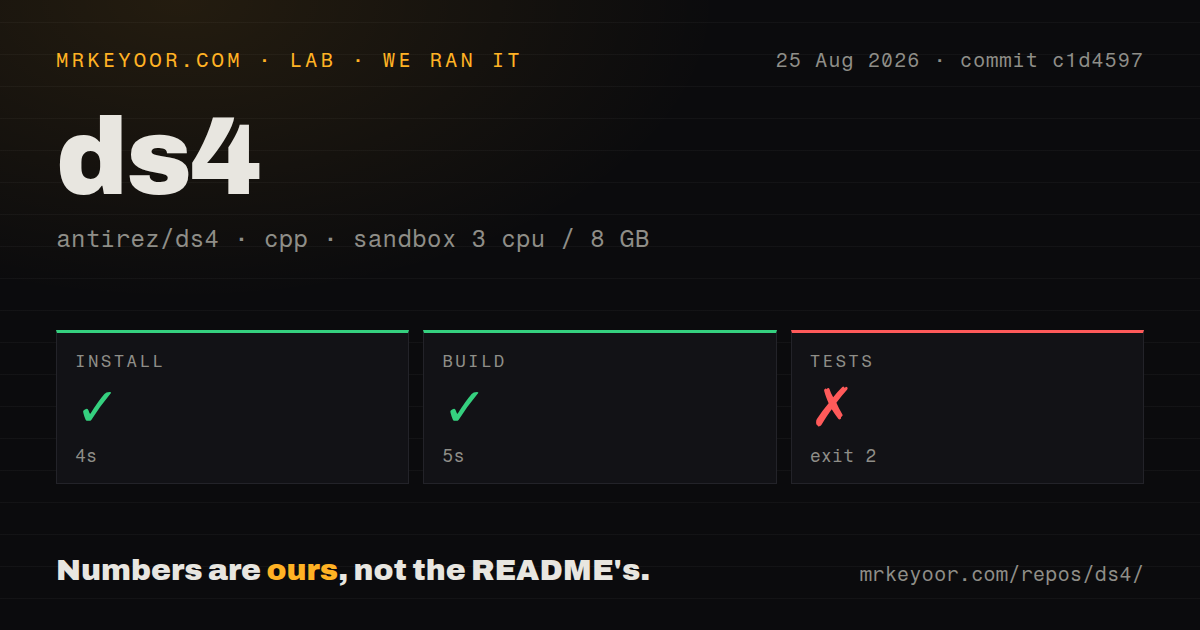
The checkout at commit c1d4597 contained 1,471 files, about 92,980 source lines, and occupied 112.5 MB. Our sandbox install succeeded in 4 seconds, followed by a successful 5-second build. That quick compile is useful because DwarfStar is mostly native code with a Makefile rather than a large package-manager stack.
The test command told a different story. After 56 seconds it stopped with exit code 2 while compiling ds4_cuda.cu. The final error was plain: /usr/local/cuda/bin/nvcc did not exist. The log does not say whether the test command should have selected a CPU-only target, so we will not invent that explanation. It shows that the default test path at this commit required a CUDA compiler that our fresh Debian container did not have.
What happened when we ran it
Our run installed the project in 4 seconds and built it in 5 seconds on 3 CPUs with 8 GB of RAM. The test step failed in 56 seconds when Make tried to invoke /usr/local/cuda/bin/nvcc. No benchmark or model inference ran in this sandbox, and none should be inferred from the successful compile.
The repository scan found no CI workflow files and no Dockerfile, although it does have a tests directory. That makes the 56-second failure more important for adopters: there is no root-level workflow in this checkout showing which toolchain the maintainers use for the same command. The README instead points contributors to a separate release QA matrix covering remote Metal, CUDA, and ROCm machines.
Model downloads and memory dwarf the source checkout
Building the binary is the small part. The download script fetches a chosen model from the project's Hugging Face repository and links it as the default model. Public files do not require authentication, though the script can use HF_TOKEN or a local token cache. The README lists different quantizations for 96 GB, 128 GB, 256 GB, and 512 GB classes of machine, and GLM files have their own supported layouts.
SSD streaming keeps non-routed weights resident and pulls expert weights from storage as needed. It expands what a high-memory Mac or supported ROCm machine can attempt, while adding cache sizing and storage behavior to the job. Distributed modes go further: pipeline parallelism can split model layers across machines, and tensor parallelism can divide work across supported GPUs or two Macs. Those paths require exact agreement on model IDs, layer slices, context capacity, and networking.
The server speaks familiar APIs but needs careful sizing
ds4-server exposes OpenAI-style chat completions and Responses endpoints plus an Anthropic-compatible Messages route. Tool schemas are converted into the model's DSML representation, and a replay map preserves exact sampled tool-call blocks across cached histories. Codex CLI can use the Responses endpoint, while other agent examples cover opencode and Pi. This is more useful than a bare text-generation binary if the supported model is your coding model.
Memory planning remains visible. Resident server sessions allocate separate KV states, so the number of sessions and chosen context window directly affect capacity. The README warns that a large context can consume tens of gigabytes on top of model weights. Open issue 836 reports a server left idle overnight being killed after exhausting memory. It is one report, not proof of a general leak, but it is enough reason to monitor resident memory during a long trial.
Beta status is credible, not boilerplate
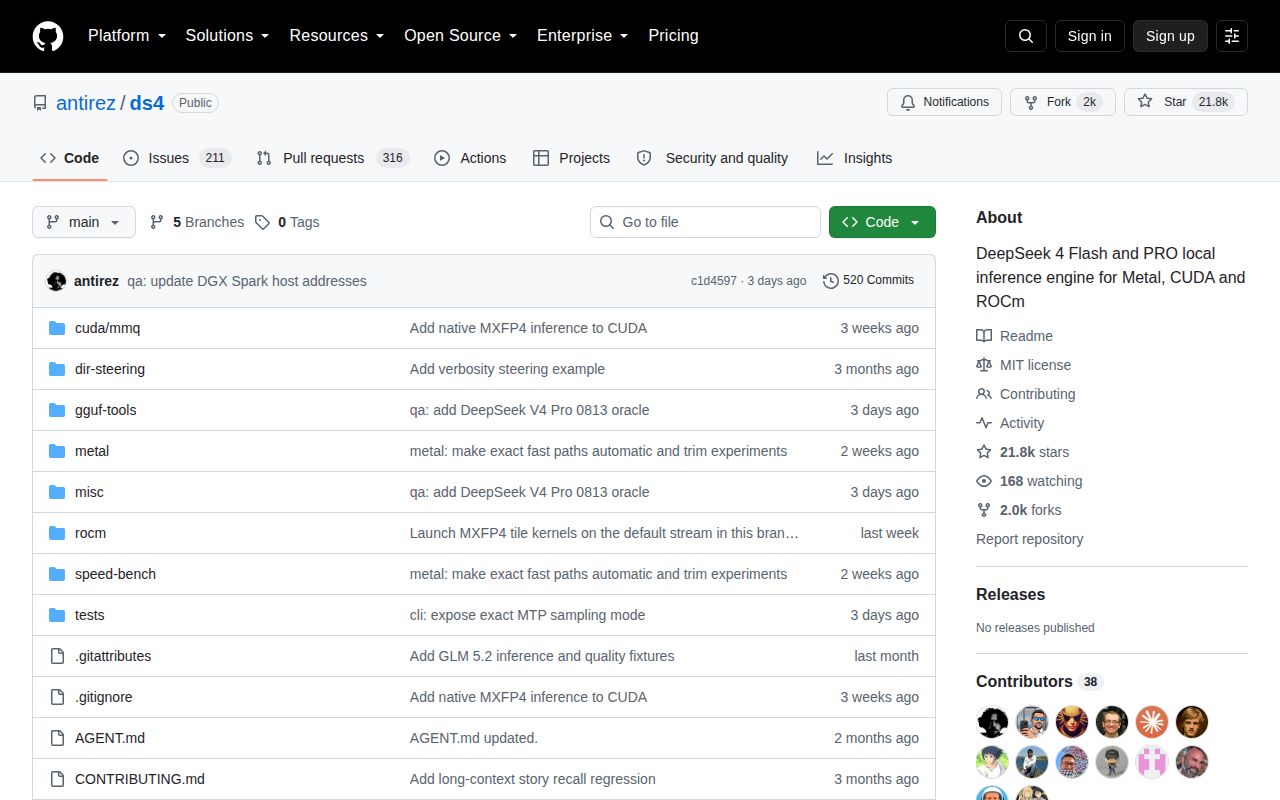
GitHub showed 21,782 stars and 527 combined open issues and pull requests when fetched. The last push was August 23, 2026, and recent issue and pull-request activity continued through August 26. There was no latest GitHub release returned by the release endpoint. The repository is active, while its README still calls the code beta quality and very fast changing.
A second open report describes a 64 GB M2 Max freezing and rebooting after launching ./ds4. That machine sits below the README's 96 GB primary Metal target, so it is not evidence against the stated configuration. It does show why the memory floor matters. DwarfStar is worth a measured trial on the exact Mac, NVIDIA server, or Strix Halo box you plan to operate. It is a poor default for anyone who mostly wants to browse models and press Run.