Version 0.2.0 follows Claude Code file by file
CometixCode is an unofficial Rust reimplementation of Claude Code, built after studying Anthropic's published CLI. The project maps TypeScript components and hooks to Rust counterparts instead of inventing a different agent. Its terminal interface runs on CometixTUI, a fork of iocraft with row-level diffing, event propagation, IME cursor support, bracketed paste, and grid layout. That makes the repository most interesting as an exercise in behavioral compatibility.
The README draws a firm line around the current state. Large parts of the interactive loop, tool execution, permissions, MCP, and slash commands exist, while other areas are partial. The Cargo manifest labels the package version 0.2.0 and compiles the normal build with MCP support enabled. Voice streaming remains unimplemented even when its feature flag exposes the related interface seams. This is working software under construction, not a finished substitute with a support promise.
A 33-second install still led to a 7-minute build
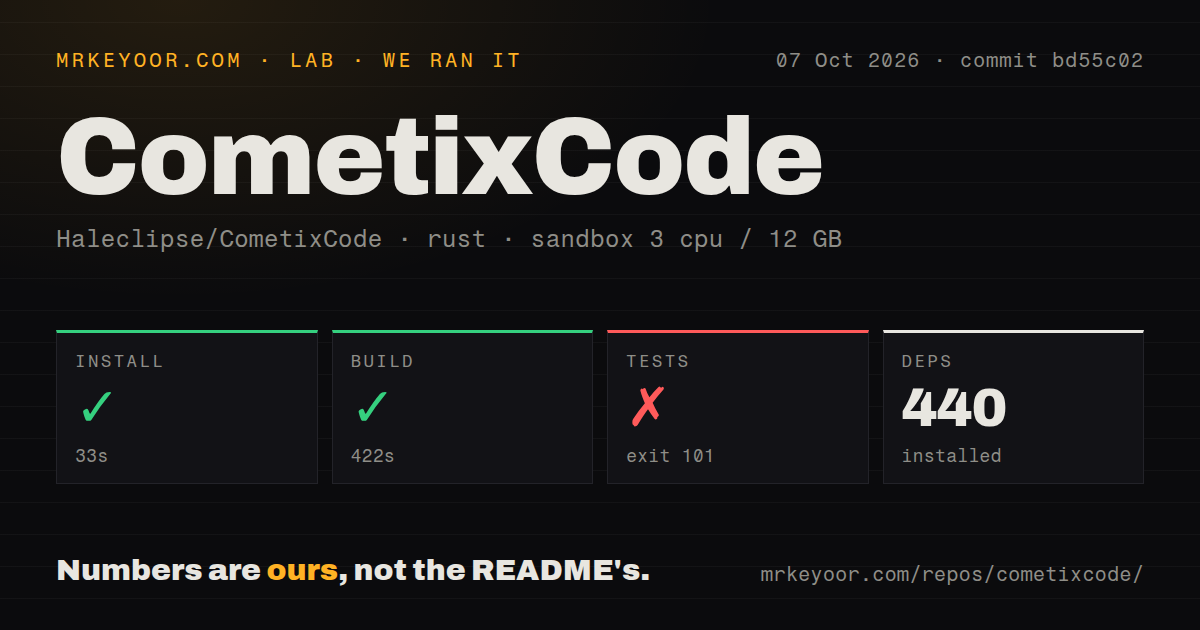
Our sandbox installed 440 packages in 33 seconds. The repository itself held 1,512 files, roughly 673,978 lines of source, and occupied 30.5 MB before installation. Its documented baseline is Rust 1.88 with the 2024 edition. Linux needs no pkg-config or separate ICU install because Unicode data is compiled into the binary, which keeps the prerequisite list shorter than the codebase suggests.
The release build then took 422 seconds, just over 7 minutes. File search still depends on rg: packaged archives may carry a pinned binary, development can use a vendored copy, and the final fallback is the host's PATH. Running the agent also requires valid Anthropic credentials. Open issue 6 records the client rejecting a session when it could not find an API key or auth token, while issue 4 discusses settings-based credentials and custom endpoints on Windows.
What happened when we ran it
Our fresh unprivileged sandbox ran commit bd55c02 with 3 CPUs, 12 GB of RAM, Rust 1.98.0, and no secrets. Installation succeeded in 33 seconds and the build succeeded in 422 seconds. The test step failed with exit 101 after 254 seconds. These measurements cover repository setup and compilation only. We did not send prompts to a model or compare its terminal behavior with Anthropic's client.
The retained log tail says the cometix-code library test generated 343 warnings, including 251 duplicates, before rustc exited unsuccessfully. Cargo then reported that it could not compile the library test target. The last lines do not contain the compiler diagnostic that triggered the failure, so blaming a missing package, a Rust version, or a code defect would be guesswork. The useful finding is exact: the application build passed, while the test target did not compile in our container.
The documented test gate needs process isolation
CometixCode's README says ordinary cargo test is not a valid gate because environment variables and OnceLock caches can leak between tests running inside one process. Its supported command is just test, which prepares isolated fixtures and runs the library suite through cargo-nextest. The justfile also clears host model and authentication variables so a developer's own Claude configuration cannot make a test pass or fail for the wrong reason.
That careful harness makes our failed test step more consequential, though it does not reveal the missing compiler message. The checkout has a tests directory, but our repository scan found 0 CI workflow files and no Dockerfile. A contributor can run the documented gate locally, yet GitHub does not show an in-repository workflow enforcing it on each change. For a 673,978-line port with platform-specific environment behavior, buyers should ask where the authoritative automated gate runs.
Windows has open shell and authentication reports
Open issue 5 describes Windows 11 sessions in which a Windows-format PATH is written into a Git Bash snapshot. External commands such as ls, rm, and head then fail with exit 127. Issue 4 covers a separate Windows path involving authentication settings and a custom base URL. The current Cargo manifest does declare crossterm for non-Unix targets, so its earlier missing-dependency report should not be treated as proof that the latest master still has that exact build defect.
Two other reports affect daily use. Issue 16 says file editing was denied immediately after launch and worked again after a restart. Issue 12 shows one long-running cometix process at 99.7% CPU and 2.1 GB of resident memory. These are user reports, not results from our sandbox, and neither issue supplies a general failure rate. They still matter because permission prompts, shell execution, and long sessions are central to a coding agent.
The repository reached 607 stars before its first tagged release
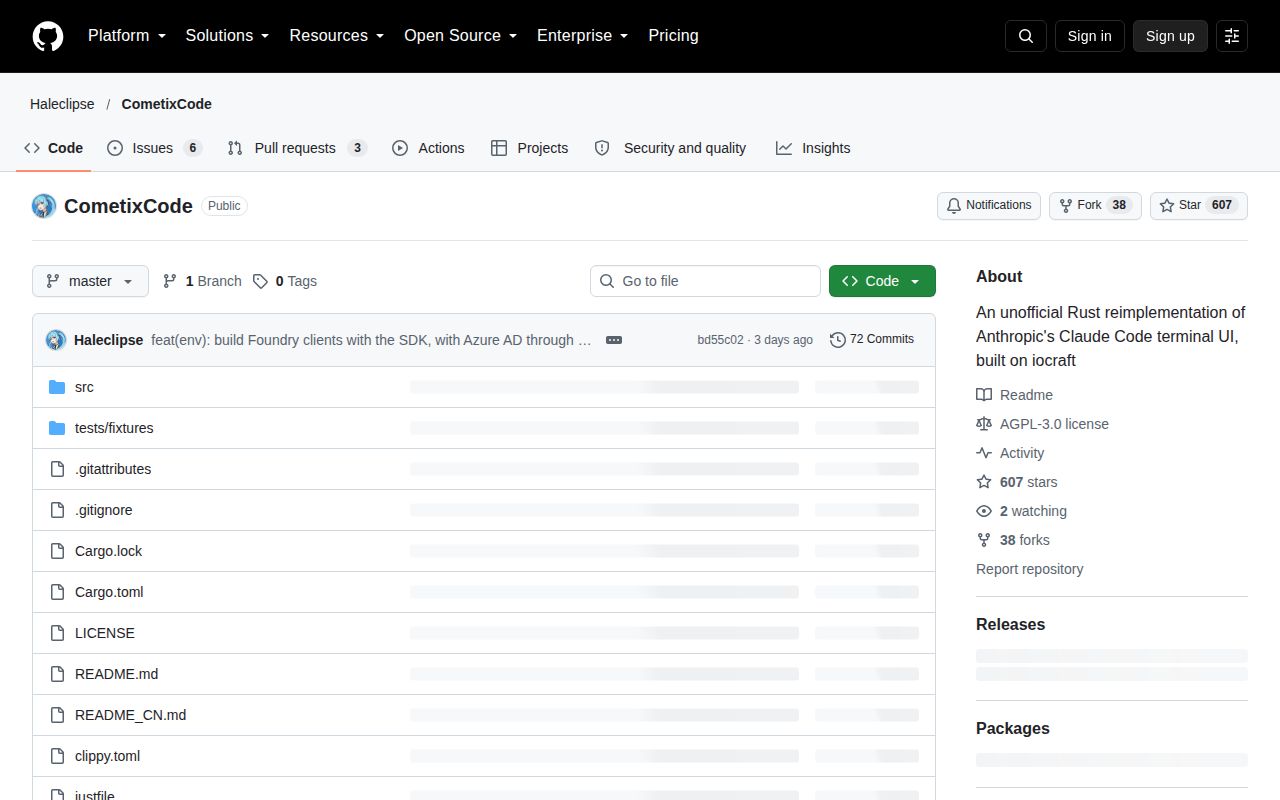
GitHub showed 607 stars and a last push on October 3, 2026. Its combined open count was 9, split into 6 issues and 3 pull requests. The latest-release endpoint returned no release, and the repository was created on September 20. Those dates describe a young project moving quickly, not a mature release line. The recent commit list is dominated by environment handling, subprocess configuration, test infrastructure, and service clients.
Activity is healthy for a project measured in weeks, but maintenance pace cannot stand in for compatibility. CometixCode deliberately chases a proprietary client whose behavior can change outside this repository. AGPL-3.0-only also matters if you plan to modify and distribute it. For studying a native terminal agent or contributing to a close behavioral port, those constraints may be acceptable. For a daily driver, our failed 254-second test step is enough reason to wait.