mrkeyoor.com_
Sat 03 Oct 06:48 UTC
Dev Toolsevaluationupdated 03 Oct 2026

birdview review

Birdview is a skill for coding agents that turns a project's architecture, local rules, proposed file scope, and reported checks into a standalone HTML map. It gives a reviewer a concrete plan to approve before the agent edits code, while openly admitting that the map records what the agent declares rather than independently watching every operation.

Verdict

Our Birdview run installed 22 packages, built in 10 seconds, and passed all 92 tests, so the repository mechanics are in good shape at commit acddbf0. Use it when a wrong agent plan is expensive enough to justify reviewing an evidence-linked map first. Skip it if you need enforced write controls or observed telemetry, because Birdview 0.3.1 provides neither.

We ran it

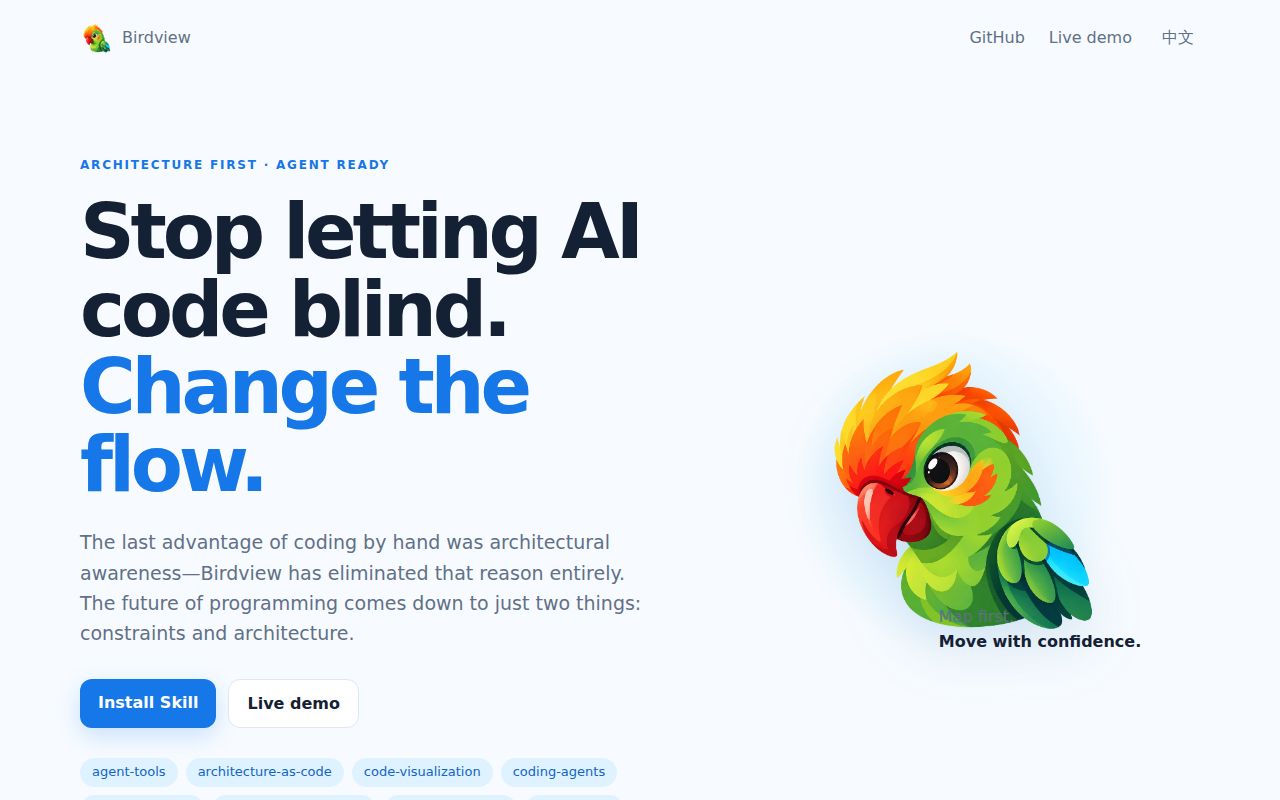
Lab card: what happened when we ran birdviewScreenshot of birdview (qiuner.github.io/birdview)
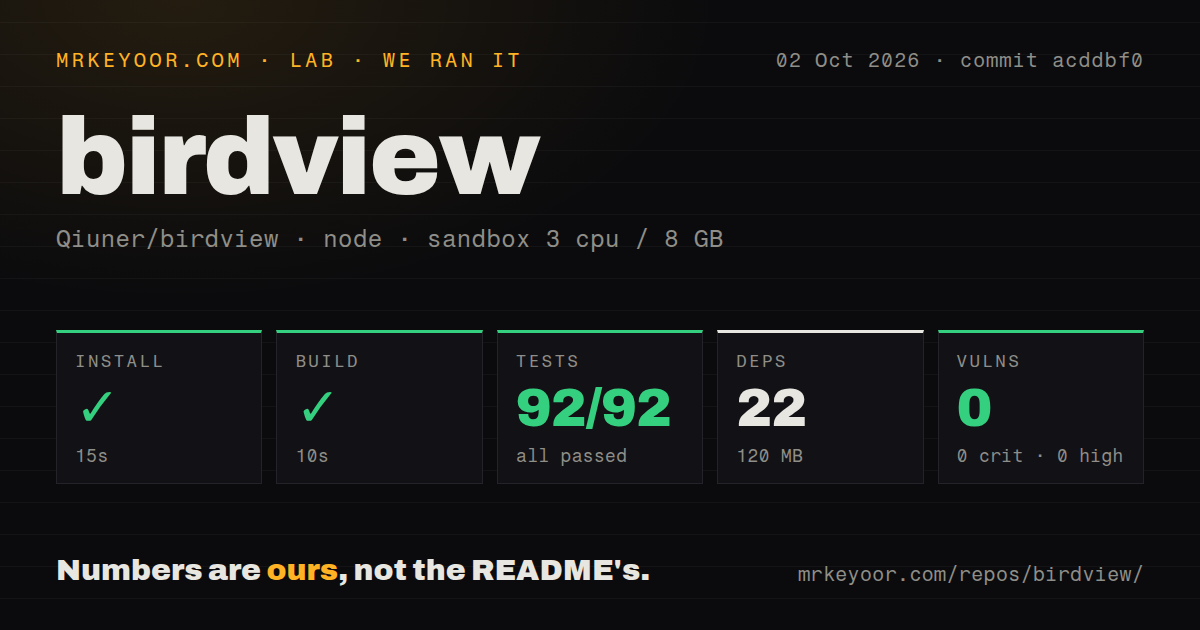
Install✓ · 15s22 packages · 120 MB
Build✓ · 10s
Tests✓ · 28s92 passed · 0 failed of 92 (node:test)
Known vulns00 critical · 0 high · 0 moderate · 0 low (npm audit)
Repo197 files~5,037 lines of source · 2.6 MB · 2 CI workflows · tests dir

Answers from our run

Does birdview build from source?

Dependencies installed in 15 seconds (22 packages), and the build succeeded in 10 seconds. We cloned commit acddbf0 into a clean Debian container with 3 CPUs and no project-specific setup.

Do birdview's tests pass?

Yes: 92 of 92 passed when we ran the project's own test command (node:test). Some failures need services or credentials a bare container does not have.

Does birdview have known vulnerabilities in its dependencies?

npm audit found none in the dependency tree at the time of our run.

Who should not use birdview?

Teams seeking a filesystem write lock or policy engine: the README says confirmation is conversational and the HTML does not enforce edits.

What are the alternatives to birdview?

Code Review Graph, Superpowers, Aider. Our Birdview run installed 22 packages, built in 10 seconds, and passed all 92 tests, so the repository mechanics are in good shape at commit acddbf0.

Setup3/515-second install, but skill setup spans a full bundle and project mode
Docs5/5Detailed bilingual install, mode, contract, and limitation guides
Community4/5687 stars, an October 2 push, and recent issue fixes
Maturity3/5All 92 tests passed, but v0.3.1 still uses declared snapshots

Who it’s for

Codex or Claude Code users who want an architecture and constraint review before a large edit.
Teams willing to make source evidence, affected modules, and planned checks part of agent approval.
Maintainers who can review a generated HTML map and challenge missing or incorrect ownership claims.
Bilingual Chinese and English teams that want the same viewer and documentation in both languages.

Who it’s NOT for

Teams seeking a filesystem write lock or policy engine: the README says confirmation is conversational and the HTML does not enforce edits.
Anyone who needs independently observed agent activity: Birdview renders agent-declared snapshots and does not watch every coding operation.
Developers expecting live updates: version 0.3.1 requires regenerating the HTML and refreshing the browser.
Users who want an npm-installed global CLI: the package is private and distribution is through the full GitHub skill bundle.
People who expect a diagram to prove code quality: Birdview says its schemas do not prove architectural claims, source existence, compliance, or successful checks.
Small one-file fixes where mapping, rendering, and confirmation would cost more attention than reviewing the diff.

Setup reality

Our sandbox installed commit acddbf0 in 15 seconds, adding 22 packages and using 120 MB on disk. The build passed in 10 seconds, and all 92 Node tests passed in 28 seconds. Npm audit reported 0 known vulnerabilities.

Using Birdview as a skill is a separate setup: install the complete GitHub bundle, run npm ci, run its doctor, configure a project mode, and start a fresh agent task. Codex uses AGENTS.md; Claude Code uses CLAUDE.md.

The 2.6 MB checkout contained 197 files and about 5,037 source lines, with 2 CI workflow files, a tests directory, and no Dockerfile. Node.js 18 or newer is required. Browser-level checks need Playwright installed locally or supplied through an environment path.

Birdview makes the agent show its model before it edits

Birdview asks a coding agent to map modules, responsibilities, file ownership, relationships, local constraints, and source evidence. For a coding task, the same page adds the proposed target files, intended behavior, progress, and verification records. The agent must present that scope and receive explicit confirmation before implementation. Map-only requests stop after the artifact. The output is one standalone HTML page rather than a hosted service.

The approval moment is useful because a bad architecture assumption is cheaper to catch before a 12-file change than after it. Birdview also records gaps: uninspected sources, uncertain relationships, and rules that could not be reviewed. Its contracts reject inconsistent sequences, invalid targets, and malformed ownership records. That gives a reviewer a better-shaped claim, though the reviewer still has to decide whether the claim matches the repository.

What happened when we ran it

Our sandbox installed commit acddbf0 in 15 seconds, adding 22 packages. The installed environment occupied 120 MB, compared with a 2.6 MB checkout containing 197 files and roughly 5,037 lines of source. The TypeScript build passed in 10 seconds. We used an unprivileged Node 22 container with 3 CPUs, 8 GB of RAM, and no secrets.

All 92 tests passed in 28 seconds. Npm audit reported 0 known vulnerabilities at critical, high, moderate, and low severity. The repository had 2 CI workflow files and a test directory, but no Dockerfile. Those results cover installation, compilation, and the Node test command. They do not measure whether an agent produced an accurate map of a real codebase or whether the confirmation step prevented a bad edit.

The map validates structure, not truth

Birdview's architecture.json stores modules and evidence, constraints.reviewed.json stores reviewed rules and coverage, and activity.jsonl stores the agent's declared task events. Validation can catch a file assigned to an unknown module or a check result with an invalid sequence. It cannot prove that a claimed module owns the file, that a cited source still exists, or that the agent touched only the files listed.

Version 0.3.1 is direct about that boundary. Activity is agent-declared, confirmation lives in the conversation, and the HTML page is not a write lock. A completed event does not establish that tests passed; only the recorded check results make that statement inside the artifact. Birdview also lacks live transport and automatic refresh. When the plan changes, the agent must regenerate the file and the reviewer must refresh the browser.

On-demand mode keeps the process from swallowing every edit

New projects default to on-demand use. In Codex, the user selects the skill or mentions $birdview; Claude Code exposes /birdview. Ordinary edits do not trigger a map unless a project opts into auto mode. Auto mode activates before every code-changing task, including small changes and planning that analyzes affected modules. An off mode disables the managed foundation and map workflow until the user explicitly invokes it.

Configuration writes a marked block to AGENTS.md for Codex and DeepSeek Harness, or CLAUDE.md for Claude Code. It preserves surrounding content and refuses malformed or duplicate markers. That is careful, but it depends on the host reading those instructions. A fresh task is part of verification. The doctor command runs one installed worker CLI and renders an example in memory; the documentation says this does not prove agent activation or exercise every command.

Installation is a full skill bundle, not an npm package

The quick path uses the third-party skills installer against Qiuner/birdview, followed by npm ci inside the installed directory and a doctor run. Manual Codex installation places the complete release under ~/.agents/skills/birdview. Scripts, schemas, assets, examples, references, package files, and notices must travel together. Copying only SKILL.md leaves the renderer and validators behind.

Node.js 18 or newer is required. The npm package is marked private, so npm install -g birdview is not the distribution route. Development browser checks require Playwright or a configured BIRDVIEW_PLAYWRIGHT_PATH. Release v0.3.1 says CI covers Windows and Linux on Node 18 and 24. The README and operational guides are paired in English and Chinese, which is unusually helpful for a tool whose workflow is mostly written instruction.

Active maintenance cannot turn declarations into enforcement

GitHub showed 687 stars and 2 open issues on October 3, 2026, with no open pull requests. The repository was pushed on October 2 after a fix for extra bends in architecture-map connectors. Release v0.3.1 shipped on September 22 with symlink-aware CLI startup, stricter doctor checks, reduced-motion work, and reproducible build checks. One open issue concerns a suspicious batch of stars, so the raw star count deserves less weight than the recent merged fixes.

Birdview earns a trial for migrations, cross-cutting features, and unfamiliar repositories where scope errors are costly. The 92 passing tests make the tool itself easier to trust, while its own caveats set the correct ceiling: it organizes an agent's explanation. It does not independently observe the work. Keep Git diffs, tests, and code review as the enforcement layer, and use the map to challenge the plan before those later checks become expensive.

Alternatives

ProjectWhat it isPick it when
Code Review Graph gh↗A local code-intelligence graph exposed through a CLI and MCP server for repository analysis.pick this instead when persistent code relationships and context retrieval matter more than a pre-edit confirmation page.
Superpowers gh↗A broad agent skill framework that structures planning, implementation, debugging, and review workflows.pick this instead when you want a wider development method rather than Birdview's architecture-map and scope-confirmation focus.
Aider gh↗A terminal pair programmer that edits a repository and works with Git directly.pick this instead when the priority is a mature coding interface with repository-map support, not a standalone visual approval artifact.

What people are saying

  1. [velocity-scout] Qiuner/birdview

Sources

  1. Birdview repository and README
  2. Birdview v0.3.1 release
  3. Birdview installation guide
  4. Birdview skill instructions
  5. Birdview activation modes
  6. Birdview measured commit

More dev tools reviews

ToolReplay · CUDA-for-AMD-Windows · DuoFold-Android · wutw-public · viserys-agent · YOINK · the whole board →