Backbone suits an existing application with explicit data and views
Changing a record in a Backbone application starts with the model, which emits an event that a view can respond to. That separation is still useful when you're maintaining a browser application whose data rules have become tangled with click handlers. Backbone supplies models, collections, and view conventions, plus routing and server synchronization. You choose how the screen renders and how those pieces fit together.
Our checkout contained 118 files and roughly 9,657 source lines, occupying 7.7 MB. The attraction is a codebase you can inspect without adopting a large application framework. For an existing Backbone product, that can justify maintaining the current architecture. For a new interface, ask whether the team wants to own rendering and event wiring, because those choices become recurring application work.
What happened when we ran it
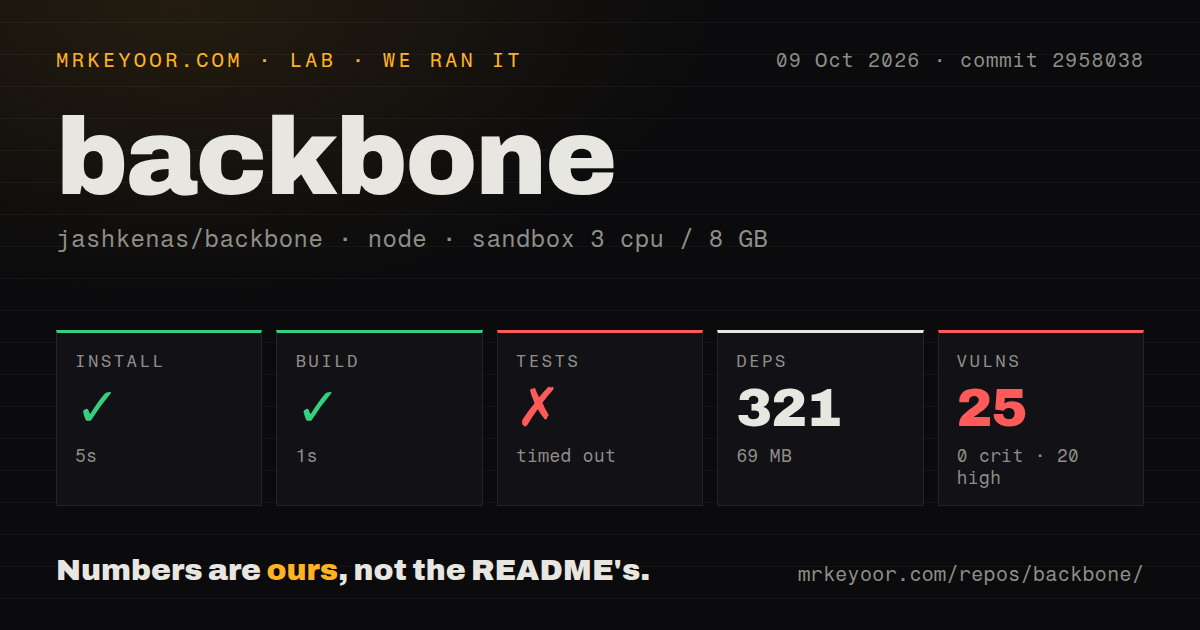
Our sandbox installed Backbone commit 2958038 in 5 seconds, adding 321 packages and occupying 69 MB. The build succeeded in 1 second. The October 9, 2026 measurement setup used the lab-node:22 image in an unprivileged container with 3 CPUs, 8 GB of RAM, and no secrets. Installation and build were quick on that setup, but the repository's test command did not complete.
Tests timed out after 900 seconds. The log identified backbone@1.6.1 and the command karma start && coffee test/model.coffee && npm run lint. Its last recorded line said Karma v6.3.19 had started a server at http://localhost:9877/. The supplied tail shows no completed test results and no explanation for the wait. We cannot attribute it to a missing browser, a configuration mistake, or a Backbone defect from that line alone. Npm audit reported 25 known vulnerabilities: 20 high and 5 moderate, with 0 critical and 0 low. The scan found 1 CI workflow file, no Dockerfile, and a tests directory. Those audit counts describe the installed dependency tree. The summary does not identify affected packages or reachable browser code, so claiming that Backbone itself exposes those vulnerabilities in a deployed application would go beyond the evidence.
A quick build leaves the contributor checks unfinished
The 1-second build is encouraging if you want to inspect or change the library. The 900-second timeout is a separate obstacle if your release process requires a completed upstream suite. Because the test command chains its stages with &&, the supplied result also gives us no evidence that the later CoffeeScript and lint stages completed. A green build cannot substitute for that missing result.
Keep the 69 MB installed environment available for diagnosis before making dependency changes. First capture enough runner output to establish why execution stops after Karma starts, then inspect the audit details and separate development tooling from dependencies your application ships. That is a proposed follow-up, not a cause found in the log. The failure is specific enough to guide investigation without pretending it already has an answer.
Views leave rendering decisions with your application
The current Backbone source makes the rendering boundary concrete: the default view render method returns the view without drawing anything. You implement rendering yourself. That suits a team with an established templating system or carefully controlled DOM updates. It is an awkward starting point if you expect a component template to update automatically whenever application state changes.
The 321 packages in our contributor installation don't tell you how much JavaScript an application sends to its users. Keep repository tooling and browser payload measurements separate. Useful application checks would cover the template path, model-change subscriptions, and repeated navigation through the same screen. Those checks should follow your product's behavior rather than assume the library's small source checkout guarantees a reliable user interface.
Event cleanup requires knowing how callbacks were registered
The API reference for view removal documents removal of the view element and cleanup through stopListening. That helps with subscriptions managed by listenTo. A view can still own other resources that your application must release. Decide who owns the lifetime of callbacks and any code that survives when the view disappears.
Recent documentation work makes that concern less abstract. Pull request 4309 explains context matching when stopListening encounters callbacks registered with on or once on an already tracked object. The distinction matters when debugging a callback that disappears unexpectedly. Our 900-second timeout leaves the suite unfinished, so this review treats the clarification as upstream documentation evidence rather than behavior we independently verified.
Direct links need server support as well as a router
Backbone's routing documentation explains that opting into browser history URLs also requires the server to handle direct visits to those paths. A route that works after clicking inside the app can still fail when someone opens a saved link. Open an application route directly and confirm that the server returns the intended page.
The 5-second package installation includes no application backend or hosting configuration. Default synchronization follows a REST-style JSON interface, and custom persistence requires application code. Backbone itself doesn't need a hosted service credential to provide its browser primitives. Your app still owns authentication and the API contract. Choose it when those responsibilities are understood rather than expecting a complete application stack.
October activity supports maintenance without a latest release entry
The repository was pushed on October 8, 2026. GitHub reported 28,095 stars and 65 open issues and PRs combined, with recent work on documentation and contribution guidance. The latest-release API returned no published release entry. That response is not evidence of abandonment, especially alongside current activity. The test log's 1.6.1 package version is the version evidence attached to our run.
React and Vue are better starting points when a new UI needs a defined component-rendering model. Backbone earns its place when preserving an existing model-and-event architecture saves more work than replacing it. I would keep a functioning Backbone application while investigating the 25 audit findings and unfinished suite. For a new product, choose it only if maintaining the rendering glue is a deliberate decision your team accepts.