Target environments decide whether Babel belongs in the build
Babel earns its place when source syntax and deployment runtimes do not match. @babel/preset-env reads specified targets, compares them with compatibility data, and selects the transforms those targets need. Browser projects can share the same Browserslist settings with other tools. That is more precise than compiling every modern feature for every user, and it gives teams one explicit compatibility policy.
The opposite case is just as important. If every supported browser or Node release already parses the syntax you ship, Babel may be an unnecessary stage. It can lengthen builds, complicate source maps, and create another configuration boundary. Start with the runtime list. Add the compiler for a missing capability, a required plugin, or a custom transform, rather than because a JavaScript template included it years ago.
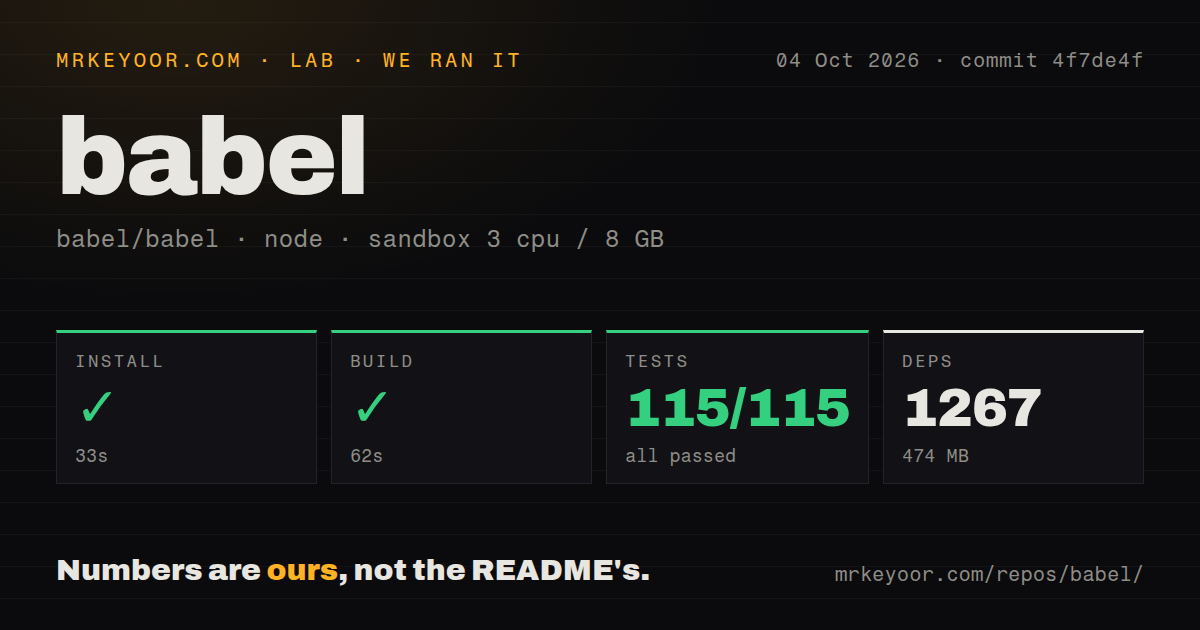
The repository installed 1,267 packages before its clean build
commit 4f7de4f contained 27,684 files, about 341,917 lines of source, and occupied 40.1 MB before dependencies. The large file count comes with a Yarn-workspace monorepo that keeps the parser, generator, traversal tools, presets, plugins, helpers, CLI, and test fixtures together. Our scan found 14 CI workflow files, a tests directory, and no Dockerfile.
Contributor setup requires Node 22.18.0 or newer, Yarn 4.0.0 or newer, and Make. The guide points Windows 10 users toward WSL 2 or its cross-platform Makefile implementation. make bootstrap prepares the workspace, while separate commands build once, watch changes, lint, run all tests, or target one package. An application consuming @babel/core and a preset does not clone this entire contributor environment.
What happened when we ran it
Our sandbox installed commit 4f7de4f in 33 seconds, pulling 1,267 packages and consuming 474 MB on disk. The build completed successfully in 62 seconds. We ran it in an unprivileged Node 22 Debian container with 3 CPUs, 8 GB of RAM, and no secrets. No credential or outside service was needed for those steps.
Jest passed all 115 of 115 tests in 668 seconds. Install, build, and test time totaled 763 seconds, with the suite accounting for most of it. That is a clean result for the exact commit and command we ran. It does not measure transform throughput, application bundle size, or the behavior of every published package under every configuration.
The passing suite is still meaningful because Babel changes executable code. Its fixture system compares input and output, and many tests execute transformed results. Contributors can select a package or name pattern instead of paying the full 668-second cost on every edit. A final broad run remains sensible for changes that cross the parser, traversal, and generator boundaries the monorepo was designed to keep together.
Babel strips TypeScript syntax but leaves type errors alone
The official TypeScript transform documentation states that the plugin does not type-check. Syntactically valid TypeScript can therefore be transformed even when tsc would reject its types. Teams using Babel for TypeScript should run the TypeScript checker separately, usually without emitting files. Skipping that step trades away the central safety feature of the language.
Parser compatibility also needs regression coverage during major upgrades. Open issue 18264 reports that @babel/parser 8.0.4 through 8.0.6 reject a specific valid TypeScript form: an async arrow with an explicit return type inside a conditional expression. The same example parses in 7.29.9, according to the report. The report covers one narrow case. It can still stop a tool that parses an entire source tree.
Configuration roots can surprise a monorepo
Babel supports project-wide babel.config.* files and file-relative .babelrc.* files. Its documentation warns that the current working directory affects how the project root and config files are found. A command launched from a package subdirectory may not load the root configuration unless the caller sets the root behavior correctly. This is the sort of failure that looks like a broken plugin while the real problem is config discovery.
Targets deserve the same discipline. preset-env can use Browserslist sources unless explicit targets override them. Polyfill behavior is optional and depends on configuration rather than appearing automatically in every transform. Check the emitted code, browser matrix, and source maps in CI. A config that merely runs without an error has not proved that it serves the intended runtimes.
Version 8.0.6 is active, volunteer-maintained infrastructure
Babel 8.0.6 shipped on September 18, 2026. The release updated identifier handling to Unicode 18, fixed Flow parsing and an invalid binary-literal error message, and changed internals across many packages. GitHub showed 44,082 stars, 772 open issues and pull requests combined, and a repository push on October 4. Pull requests were still moving on October 5.
The README says a handful of volunteers maintain Babel, with community funding and company contributions. The recent release and issue activity show current work, while the 772-item combined queue shows how much surface they carry. Babel remains the conservative choice when plugin compatibility and exact transforms matter. Our green 115-test run supports that judgment, but the 474 MB workspace and 668-second suite belong in contributor planning.