mrkeyoor.com_
Sat 08 Aug 21:01 UTC
Dev Toolsevaluationupdated 08 Aug 2026

swc

SWC is a Rust compiler that turns modern JavaScript and TypeScript into code older runtimes can execute, and it can also parse, transform, and minify source. It solves the slow compilation part of large web builds while exposing the compiler to both JavaScript and Rust tools.

Verdict

SWC is a proven default for fast JavaScript and TypeScript transpilation, especially when your framework already supports it. Use it as a compiler stage beside `tsc`, not as a substitute for the TypeScript type system. For a mature codebase, migrate with output fixtures and source-map checks rather than assuming syntax support guarantees identical runtime behavior.

Setup4/5Quick npm start, but serious migrations need semantic testing
Docs4/5Broad website guides, API docs, migrations, and playground
Community5/5Large adoption with current releases and active maintenance
Maturity5/5Nine years old and embedded in major production toolchains

Who it’s for

  • JavaScript and TypeScript teams whose transpilation time is a meaningful part of local development or CI.
  • Framework and build-tool authors who need a fast parser, syntax transformer, code generator, or minifier.
  • Projects already using frameworks such as Next.js that integrate SWC and want to understand or extend the compiler underneath.
  • Rust developers who need direct access to ECMAScript syntax trees and transforms.

Who it’s NOT for

  • Teams looking to replace TypeScript's correctness checks: SWC's migration guide says it transpiles without type checking and recommends continuing to run tsc for errors.
  • Codebases that rely on cross-file TypeScript semantics without isolatedModules: the guide warns that file-by-file compilation can mishandle features such as const enums and namespaces.
  • Services that compile untrusted malformed input and cannot tolerate a hang: an open regression reports an endless lexer loop on an unterminated template literal.
  • Migrations that require byte-for-byte parity with tsc or Babel: current reports cover changed enum runtime shapes, decorator behavior, minification misses, and source-map inaccuracies.
  • Babel-heavy projects whose essential custom plugins have no SWC equivalent: SWC plugins are Rust compiled to WebAssembly, so rewriting specialized transforms is real engineering work.

Setup reality

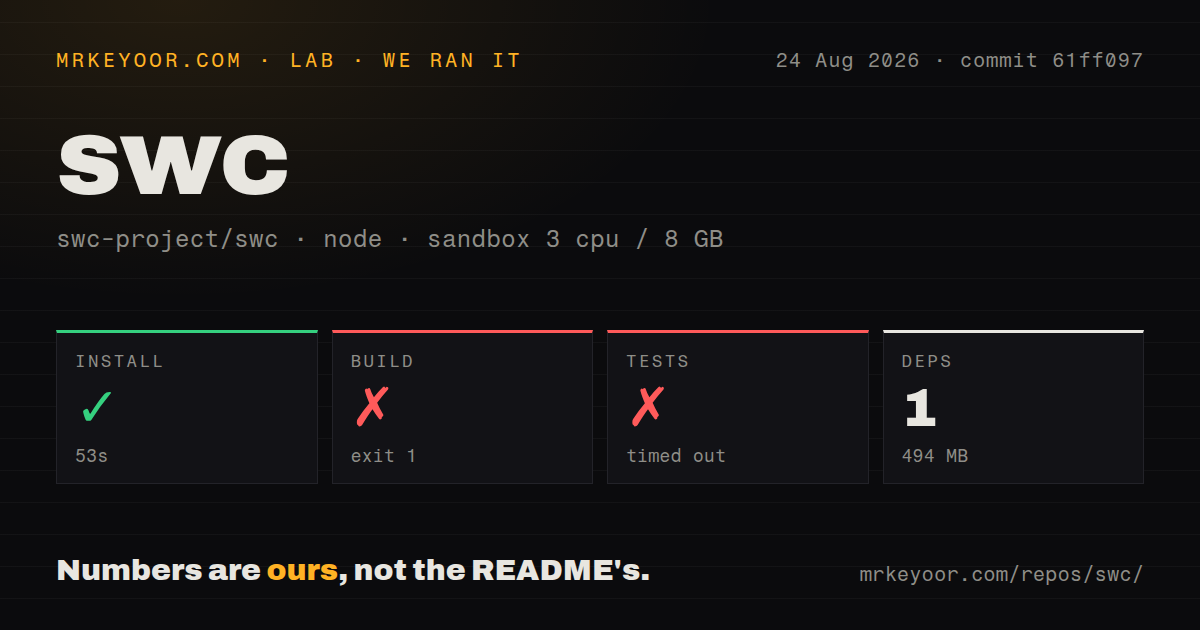
A normal JavaScript trial is light: install @swc/core and optionally @swc/cli, add a .swcrc, and compile a representative directory. The real migration cost is semantic testing, not package installation. Keep tsc --noEmit for type checking, translate target, module, JSX, decorators, class-field, and minifier settings, confirm native binaries install on every CI platform, and compare emitted code and source maps. Rust consumers face a larger dependency surface and should update the related SWC crates together, as the README recommends.

The compiler underneath a lot of modern web development

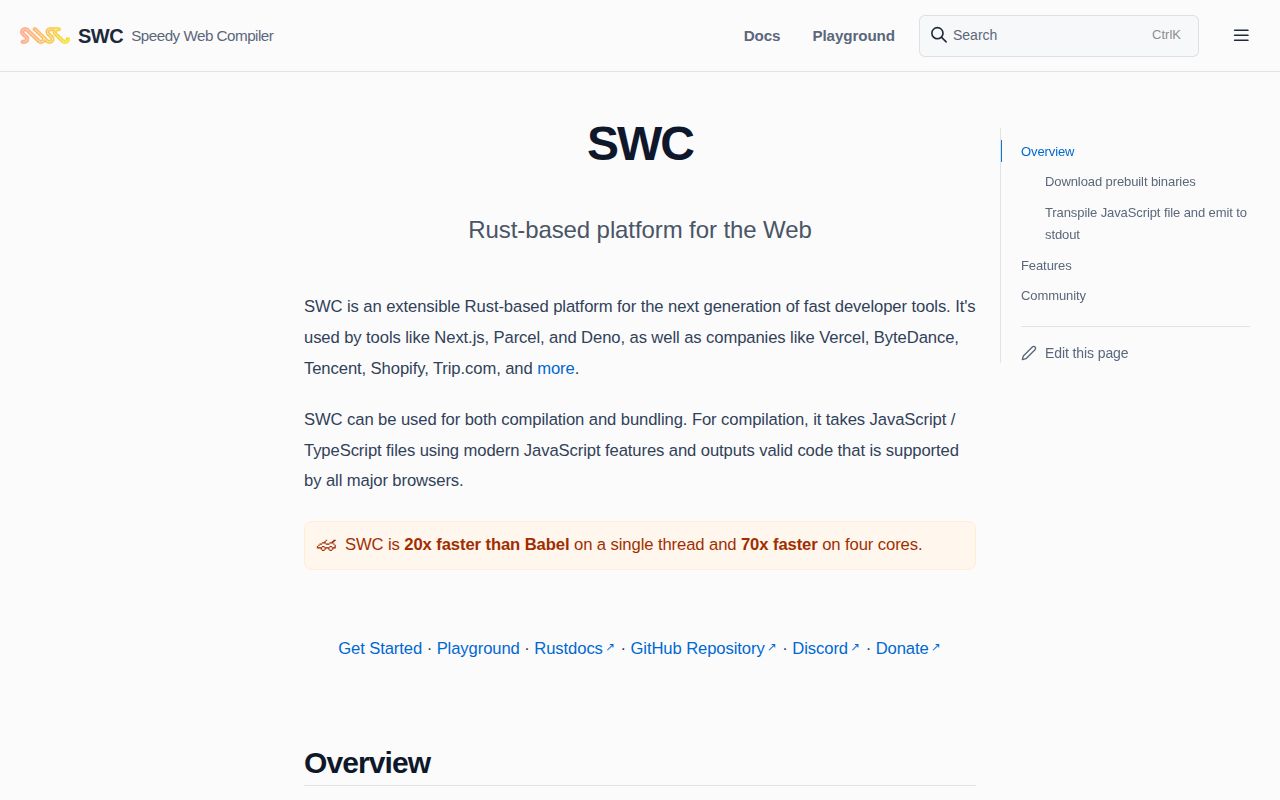
SWC stands for Speedy Web Compiler. Its core job is familiar: parse current JavaScript or TypeScript, apply syntax transforms, and emit code for the runtime targets you support. It can also minify output and expose its parser, syntax tree, transforms, and code generator as libraries. The implementation is Rust, with native Node bindings for most JavaScript users and crates for tools that live in Rust.

That description undersells its position. SWC is used through major frameworks and build systems, so many developers already depend on it without invoking the command-line tool directly. This matters when choosing it for a custom pipeline. You are not adopting an interesting laboratory compiler. You are adopting mature infrastructure with a large compatibility surface, years of production feedback, and the unavoidable bug queue that comes with parsing nearly every strange thing JavaScript permits.

The best reason to choose SWC remains compilation speed. Parsing and transforming large numbers of files is work that benefits from native code and parallelism. Project benchmarks should be repeated on your repository, but the design has proved valuable enough for prominent downstream tools to make SWC part of their normal development path.

It replaces a transpiler, not the TypeScript compiler

The most important purchasing distinction is in SWC's own migration guide. SWC compiles each file independently and does not perform TypeScript type checking. It can erase types and lower TypeScript syntax quickly, but it does not understand the whole program in the way the TypeScript checker does. A responsible setup runs SWC for emitted JavaScript and tsc --noEmit for type errors.

That split is often a win. Local transforms can finish quickly while the checker runs separately or in parallel. It also means a successful SWC build does not prove the application is type safe. Teams that remove tsc after migration are deleting a correctness stage, not merely swapping implementations.

File-by-file compilation creates semantic edges. The guide recommends TypeScript's isolatedModules or newer verbatimModuleSyntax discipline and warns that const enums and namespaces can cause runtime problems when code depends on type-system knowledge. A current issue shows why the warning remains practical: namespace member values used in enum initializers can produce a different runtime shape from tsc. Another report covers a local const string in an enum initializer. These are uncommon patterns, but they are exactly the kind that broad unit tests may miss.

A straightforward start with a serious configuration surface

For JavaScript users, the entry point is @swc/core; @swc/cli adds command-line compilation. A .swcrc selects parser syntax, JSX or TSX handling, output target, module format, transformations, source maps, and minifier behavior. Programmatic callers can transform strings or files and can parse source into an abstract syntax tree. The website documents CLI, core API, Jest, webpack loader, WebAssembly, Flow, compilation, modules, minification, bundling, and plugins.

The first proof of concept is therefore easy. Take a representative slice of source, configure the actual browser or Node targets, compile it, and run the existing tests. Migration gets harder when a Babel configuration has years of presets and custom plugins. SWC aims to cover standard ECMAScript features and common Babel behavior, but a specialized Babel plugin does not become compatible automatically. SWC's plugin route uses Rust compiled to WebAssembly, which is powerful but changes the language, build, publication, and compatibility work for plugin authors.

Native packages are another operational detail. Most users receive a prebuilt binary through their package manager, which is convenient and fast. CI matrices, less common CPU and operating-system combinations, restricted installation environments, and bundlers that mishandle optional native packages deserve an explicit install test. A pure JavaScript dependency has fewer platform-specific failure modes.

Rust users get the lowest-level access and the largest dependency-management task. SWC is divided across parser, syntax tree, common infrastructure, transforms, code generation, and other crates. The README promises that the latest version of each crate should work together and offers a script to update them all, then run a build. That is useful guidance, but it also signals that mixing versions casually is a poor strategy. Pin a coherent set and update it as a unit.

Compatibility is more important than headline throughput

Compiler errors are unusually consequential because valid output can still be wrong. SWC's current issue tracker contains precise examples: TypeScript enum values receiving a different reverse mapping from tsc, decorators being transformed even with an esnext target, unused destructured values surviving minification, and inaccurate source mappings. These do not imply ordinary builds are unreliable. They show why a compiler migration needs output and runtime tests in addition to timing charts.

Source maps deserve special treatment. A faster build is not a good trade if production stack traces point engineers at the wrong line. Exercise transformed classes, async code, JSX, minified bundles, chained input maps, and any custom transform. Open reports involving generated spans and TypeScript input maps provide concrete cases to include in a migration checklist.

An August 2026 regression report says an unterminated template literal can leave the lexer returning the same error token endlessly. Most application builds process trusted source and will stop developers until syntax is fixed. Services that accept user-supplied code, online playgrounds, and analysis systems have a different threat model: malformed input must have timeouts or process isolation until the behavior is fixed in the version they deploy.

Mature, active, and still worth pinning carefully

The repository was pushed on August 8, 2026, and release 1.15.47 arrived on July 29. Issue and pull-request traffic was active in August. The open GitHub count of 413 combines issues and pull requests, so it is not a tally of 413 compiler defects. It reflects a large, active project with JavaScript bindings, many Rust crates, plugins, minification, transforms, and numerous downstream integrations.

Documentation is strong overall. The small repository README sends each audience to the right deeper source: website guides for JavaScript users, rustdoc for crate consumers, a playground for reproductions, and migration pages that disclose semantic differences. Some setup details require hopping among pages, but the material covers much more than a quick start.

Choose SWC when transform time is hurting and standard JavaScript or TypeScript compilation is the job. Keep the type checker, pin versions, test emitted semantics, and compare source maps. With those boundaries, SWC is not merely the fast option. It is one of the safest high-performance compiler choices because its ecosystem and long operating history expose edge cases quickly.

Alternatives

ProjectWhat it isPick it when
BabelThe established JavaScript compiler with a very large plugin and preset ecosystem.pick this instead when compatibility with existing Babel plugins and unusual transforms matters more than maximum compilation speed.
esbuildA fast Go-based bundler, transformer, and minifier with a deliberately compact feature set.pick this instead when you want one simple build tool for bundling and transformation and do not need SWC's Rust compiler APIs.
OxcA Rust collection of high-performance JavaScript parser, linter, formatter, transformer, and minifier tools.pick this instead when you are evaluating a newer integrated Rust toolchain that extends beyond compilation into linting and formatting.

What people are saying

  1. [github-trending] swc-project/swc

Sources

  1. SWC README
  2. SWC getting started documentation
  3. Migrating from tsc
  4. SWC release 1.15.47
  5. Endless lexer loop issue 12103
  6. TypeScript enum namespace issue 12102
  7. TypeScript enum const issue 11715