mrkeyoor.com_
Tue 01 Sept 17:41 UTC
Dev Toolsevaluationupdated 27 Aug 2026

esbuild review

esbuild is a JavaScript, TypeScript, JSX, and CSS bundler and minifier written in Go. It turns source modules into browser or Node.js output through a command line, JavaScript API, or Go API, with short rebuild cycles as its defining goal.

+12stars / 7d
Verdict

Our esbuild checkout installed in 9 seconds, built in 31 seconds, and passed all 16 Go packages in 13 seconds. It is the low-level default I would try first for ordinary web bundling or fast transforms. Keep TypeScript checking separate, pin releases, and test emitted bundles; choose Vite for an application workflow or webpack when a specific loader ecosystem decides the choice.

We ran it

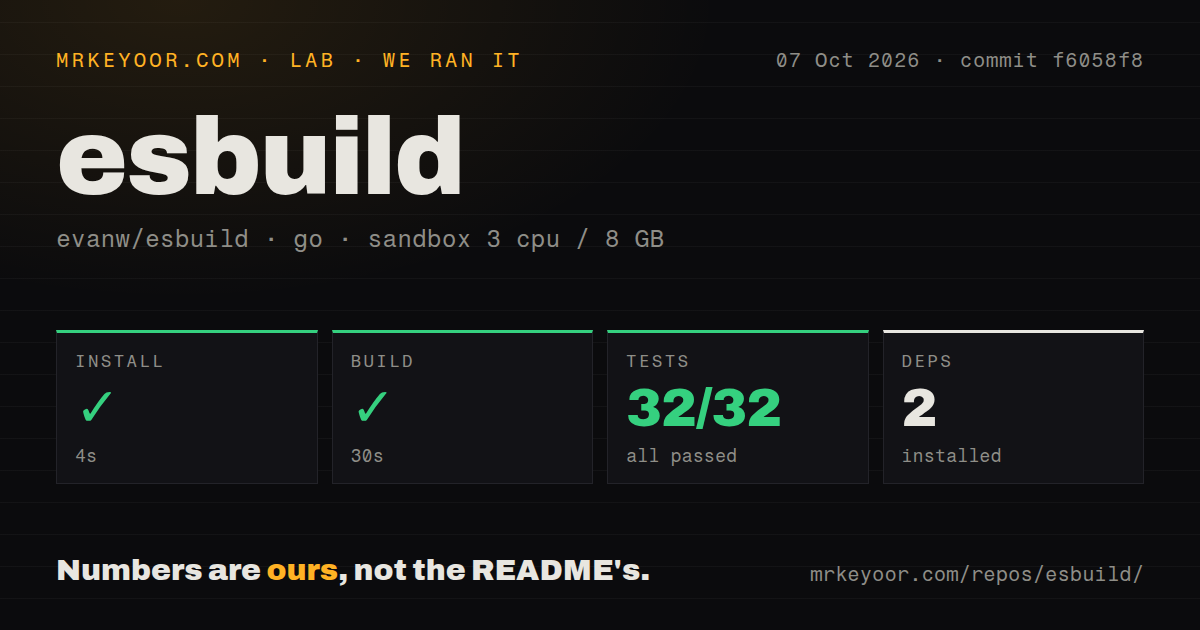
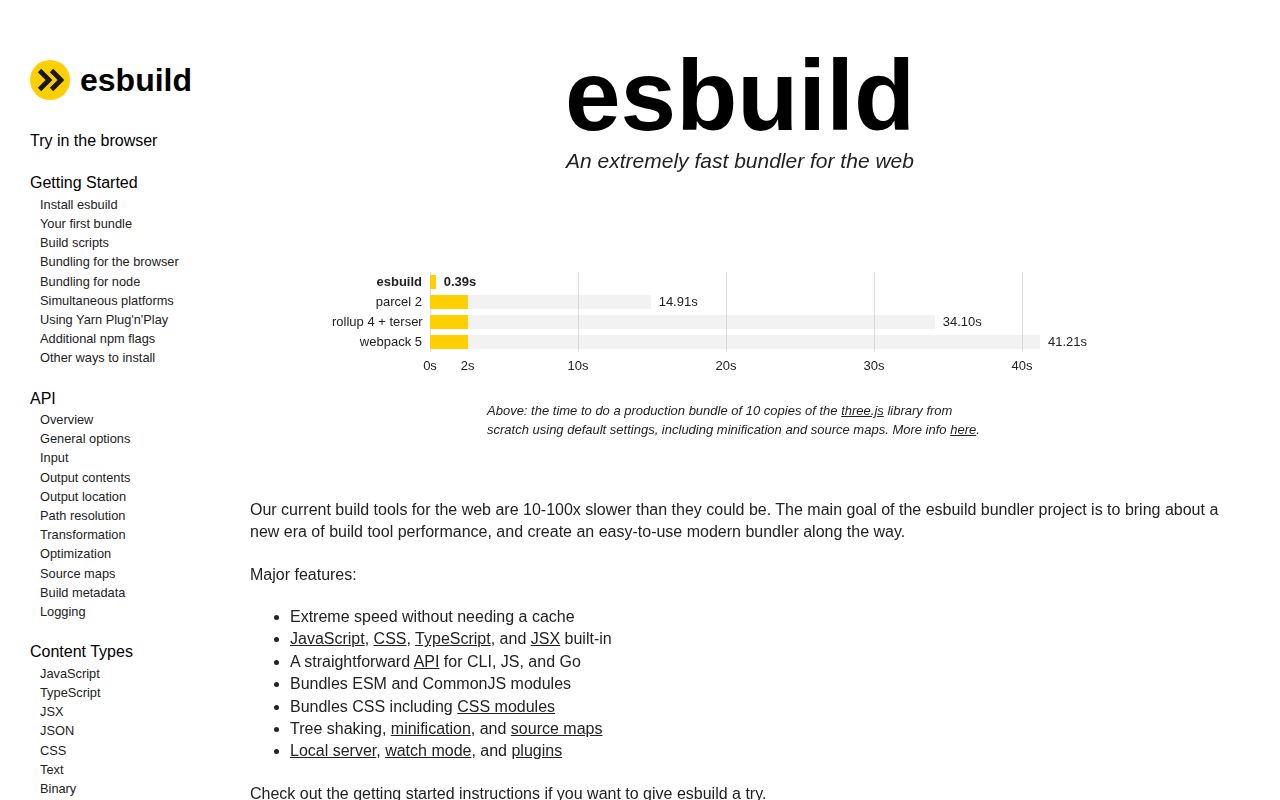
Lab card: what happened when we ran esbuildScreenshot of esbuild (esbuild.github.io)
Install✓ · 9s2 packages
Build✓ · 31s
Tests✓ · 13s16 passed · 0 failed of 16 (go test)
Repo348 files~193,040 lines of source · 9.5 MB · 4 CI workflows

Answers from our run

Does esbuild build from source?

Dependencies installed in 9 seconds (2 packages), and the build succeeded in 31 seconds. We cloned commit f6058f8 into a clean Debian container with 3 CPUs and no project-specific setup.

Do esbuild's tests pass?

Yes: 16 of 16 passed when we ran the project's own test command (go test). Some failures need services or credentials a bare container does not have.

Who should not use esbuild?

TypeScript teams expecting the bundler to type-check code or emit declaration files: the documentation says to run tsc --noEmit separately and does not support .d.ts generation.

What are the alternatives to esbuild?

Rolldown, Vite, webpack. Our esbuild checkout installed in 9 seconds, built in 31 seconds, and passed all 16 Go packages in 13 seconds.

Setup5/5Installed in 9 seconds and built cleanly in our fresh container
Docs5/5Precise API, syntax, plugin, security, and compatibility guidance
Community4/5Current releases and active reports, with one primary maintainer
Maturity5/5Stable core APIs with broad use and disciplined patch releases

Discussed on

  1. hnESbuild – A fast JavaScript bundler and minifier in Go355 points
  2. hnEsbuild 0.9254 points
  3. hnUsing const/let instead of var can make JavaScript code run 10× slower in Webkit237 points
  4. hnEsbuild – a JavaScript bundler that's 100x faster than other bundlers3 points

Who it’s for

Developers who need fast JavaScript or TypeScript transforms and bundling with little configuration.
Tool authors who want a small CLI or programmatic build API inside a larger workflow.
Frontend teams using ESM, CommonJS, CSS modules, source maps, watch mode, or custom plugins.
Go programs that want to call a bundler as a library instead of spawning a JavaScript tool.

Who it’s NOT for

TypeScript teams expecting the bundler to type-check code or emit declaration files: the documentation says to run tsc --noEmit separately and does not support .d.ts generation.
Frameworks that depend on emitDecoratorMetadata: esbuild cannot implement it because type information is discarded.
Services that accept hostile build inputs: the FAQ says files, commands, and plugins are trusted and resource limits must be enforced outside esbuild.
Anyone planning to expose its built-in server to users: the project explicitly says the server is for development and should not run in production.
Teams unwilling to pin and update their compiler: release 0.28.2 fixed incorrect tree shaking, invalid generated code, unsafe CSS minification, and an input-overwrite regression.

Setup reality

At commit f6058f8, installation succeeded in 9 seconds with 2 packages installed. The build succeeded in 31 seconds. Tests completed successfully in 13 seconds, with 16 Go packages passed and none failed. The checkout contained 348 files, about 193,040 lines of source, and used 9.5 MB.

No account, API key, database, or background service is required. npm installs a platform-specific native executable, while the JavaScript API keeps that executable as a child process for repeated calls. The CLI and Go API can use the native binary directly. Plugins and build options live in code or command-line configuration.

TypeScript support strips types but does not check them, so production TypeScript projects still need tsc --noEmit and a separate declaration build when publishing libraries. The development server trusts its files and is not for production. Build commands, plugins, and inputs are also trusted; sandboxing and resource limits belong outside esbuild.

esbuild is a compiler-shaped bundler

esbuild does a focused set of web build jobs: parse JavaScript, TypeScript, JSX, and CSS; resolve modules; combine them; lower syntax for target engines; remove unused code; minify output; and write source maps. It exposes the same engine through a binary, a JavaScript API, and a Go API. Watch mode, a development server, and plugins cover common feedback-loop needs.

The design feels closer to a compiler than a configurable task runner. Many features are built into the native Go executable instead of assembled from JavaScript transforms. That keeps the normal path short. A small project can start with one command, while a tool author can pass structured options and receive output files or metadata in memory.

This narrow shape is a feature until a build depends on a specialized ecosystem. webpack has years of loaders for unusual assets and framework conventions. Vite owns more of the application experience, including HTML entry points and framework-facing development behavior. esbuild works well as the engine inside another tool or as the entire build for projects whose requirements match its built-ins.

The APIs are unusually easy to place

The CLI is suitable for package scripts and direct shell use. The JavaScript API keeps a native child process available and communicates with it over standard streams, avoiding fresh process startup for every request. The Go API embeds the engine into a Go program. All three forms cover core build and transform operations, so adopting a higher-level wrapper does not force every team into Node.js.

Incremental rebuilds, watch mode, and the local server make esbuild useful during development. The server is intentionally small. The FAQ says it was not written for production and must not be exposed as an application server. Files, plugins, and commands are trusted inputs. If users can submit code, the calling service must add process isolation, file boundaries, timeouts, and resource limits itself.

Plugins can intercept path resolution and file loading, attach side effects, and return generated contents. They fill many gaps without turning the core into a general workflow engine. A project that needs a long chain of mature webpack loaders should compare migration effort before choosing esbuild solely for faster builds.

What happened when we ran it

We cloned commit f6058f8 into an unprivileged Debian container with 3 CPUs and 8 GB of RAM. The checkout contained 348 files, about 193,040 lines of source, and occupied 9.5 MB. It is a Go project with four CI workflow files and no top-level tests directory.

Installation succeeded in 9 seconds and installed 2 packages. The build completed successfully in 31 seconds. Tests then finished in 13 seconds, with 16 Go packages passing and zero failing out of 16. This was a clean run across every install, build, and test step measured by our sandbox.

Those results speak to source setup, not application bundle speed. We did not add a synthetic JavaScript project or repeat the project's published performance comparisons. The useful finding is that a fresh Go container could obtain the small dependency set, compile the repository, and complete its package tests without extra services or secrets.

TypeScript support has a clear boundary

esbuild parses TypeScript syntax and discards type annotations. It does not check types. The official guide tells users to run tsc --noEmit in parallel, which should be part of CI rather than an optional local check. Library authors also need TypeScript or another tool to produce declaration files because esbuild does not retain the information required for .d.ts output.

Files are compiled independently. The docs recommend TypeScript's isolatedModules setting to reject patterns that require cross-file type knowledge. They also recommend esModuleInterop for import behavior that agrees with modern ESM expectations. emitDecoratorMetadata is unsupported, a decisive limitation for frameworks that obtain runtime metadata from TypeScript types.

These constraints are well documented and technically coherent. They still surprise teams that read “TypeScript built in” as a replacement for the TypeScript compiler. Treat esbuild as the code generator and bundler, while TypeScript remains the type checker and declaration generator.

Correctness patches deserve prompt upgrades

A bundler can finish successfully and still produce wrong code, so release notes matter more here than they do for a cosmetic developer tool. Version 0.28.2, released August 8, 2026, fixed incorrect tree shaking involving a TypeScript import alias, unsafe CSS minification, missing async wrappers around top-level await cycles, faulty lowering of logical assignments, and an old regression that could overwrite an input despite printing an error.

An open report from August 20 describes a variable collision while lowering object-rest syntax in 0.28.2. The report includes a small playground reproduction and says the output fails at runtime. It is one report, so it does not establish broad breakage. It does justify pinning esbuild, running bundle-level tests, and reviewing patch notes before upgrades. Projects targeting older JavaScript engines exercise more lowering paths and should include those targets in tests.

The latest code push was August 9, one day after 0.28.2, while issue and pull-request activity continued through August 26. GitHub listed 608 open issues and pull requests combined, which is an intake queue rather than a defect total. Current proposed fixes include the object-rest collision and a computed constructor key edge case, so maintenance did not stop with the release. The repository is MIT licensed, its native releases use GitHub trusted publishing, and the FAQ describes reproducible builds for checking published artifacts.

Maintenance is strongly associated with Evan Wallace, even though outside fixes are accepted. That concentration has produced a coherent tool and unusually exact documentation, but organizations should still count it as maintainer concentration. esbuild is mature enough to make the shortlist by default. The sensible adoption plan is small: pin it, pair it with type checking, test the emitted bundle, and use a separate production server.

Alternatives

ProjectWhat it isPick it when
Rolldown gh↗A Rust bundler designed around Rollup-compatible behavior and a modern toolchain core.pick this instead when Rollup plugin compatibility and Vite's emerging bundler path matter more than esbuild's established API.
Vite gh↗A full development and production build tool with a browser dev server and framework integrations.pick this instead when building an application and you want framework conventions, HTML handling, and a richer development server.
webpack gh↗A configurable JavaScript bundler with a large loader and plugin ecosystem.pick this instead when an existing webpack loader, plugin, or unusual asset pipeline is a hard requirement.

What people are saying

  1. [github-trending] evanw/esbuild

Sources

  1. esbuild README
  2. esbuild getting started guide
  3. esbuild TypeScript documentation
  4. esbuild plugins documentation
  5. esbuild FAQ and security boundaries
  6. esbuild 0.28.2 release
  7. Issue 4520: generated variable collision

More dev tools reviews

workmux · v2rayNG · SecLists · hashcat · eslint · fastfetch · the whole board →