A large design system with a public reset
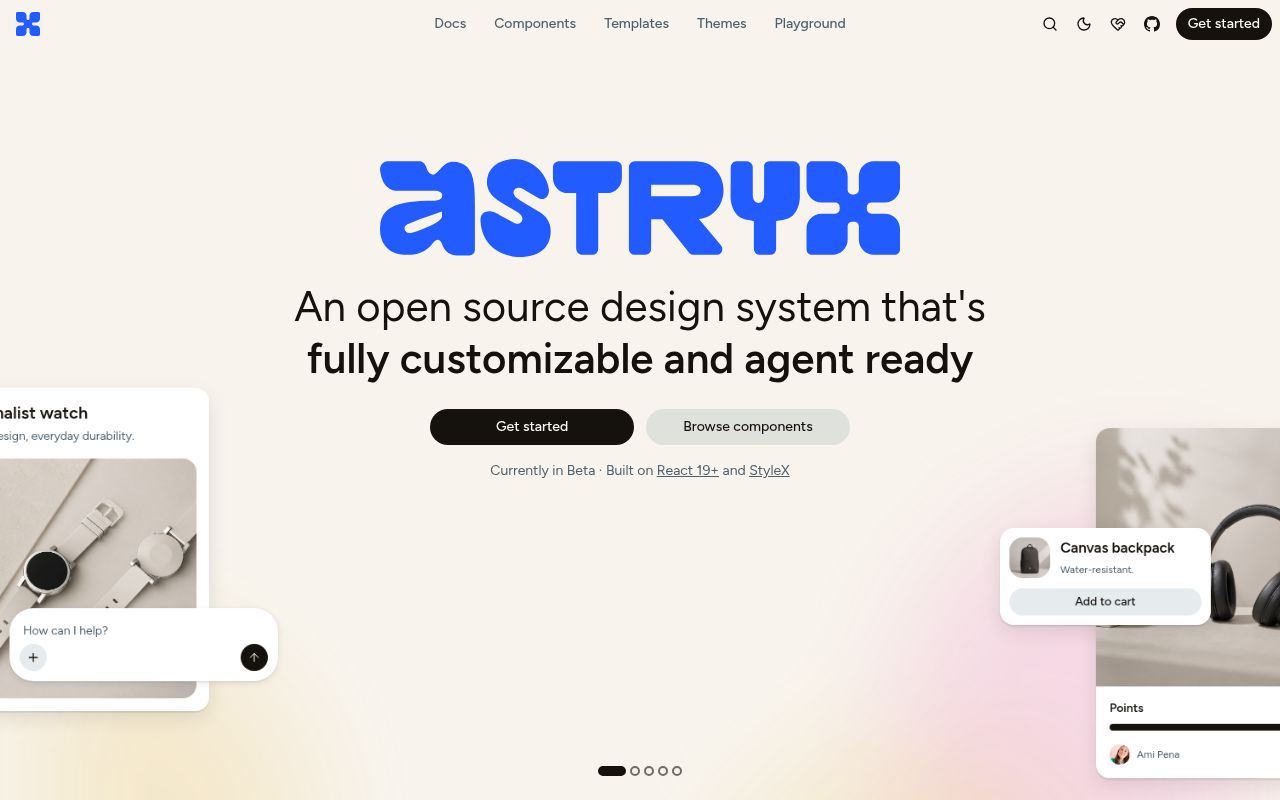
Astryx arrives with an unusual backstory. Meta says the system grew internally for eight years and powers more than 13,000 applications inside the company. The public repository is new enough to carry a beta label, but the component ideas and operating conventions were developed under real internal use. That helps explain why the project covers more than buttons and form fields. It includes page patterns, seven themes, templates, charts in preview, documentation tooling, and migration codemods.
For consumers, the central package exposes more than 150 typed React components. Styles are authored with StyleX but distributed as built CSS, so an application does not need a StyleX build plugin. You can add plain CSS, CSS modules, or Tailwind classes through className. Themes are CSS custom-property overrides, and the supplied choices range from neutral to more opinionated sets such as gothic and y2k.
The component source is not a black box. Astryx exports smaller building blocks, and its swizzle command copies a component into your application when normal composition or styling is insufficient. That escape hatch is attractive for a product team, though copied code becomes your maintenance responsibility.
Consumer setup has a few firm rules
Astryx requires React 19 or later. The basic install includes core, a theme, StyleX, and the React peer dependencies; the CLI is normally added as a development dependency. In a Next.js application, three CSS imports must appear in order: reset, Astryx component styles, then theme overrides. A Theme provider supplies the selected theme, and the documented Next.js example also connects Astryx links to the framework's Link component.
Tailwind users get a bridge that maps Astryx tokens to utilities. Vite and CDN paths are documented too. This is more flexible than adopting a required compiler, but it is still a design-system integration. Existing resets, CSS layers, routing components, portals, and form conventions need testing against your application.
The CLI has one sharp edge worth remembering. Before @astryxdesign/cli is installed, bare npx astryx can resolve to an unrelated package. The project recommends the scoped npx @astryxdesign/cli command for first use, then a package script or local binary after installation.
What happened when we ran it
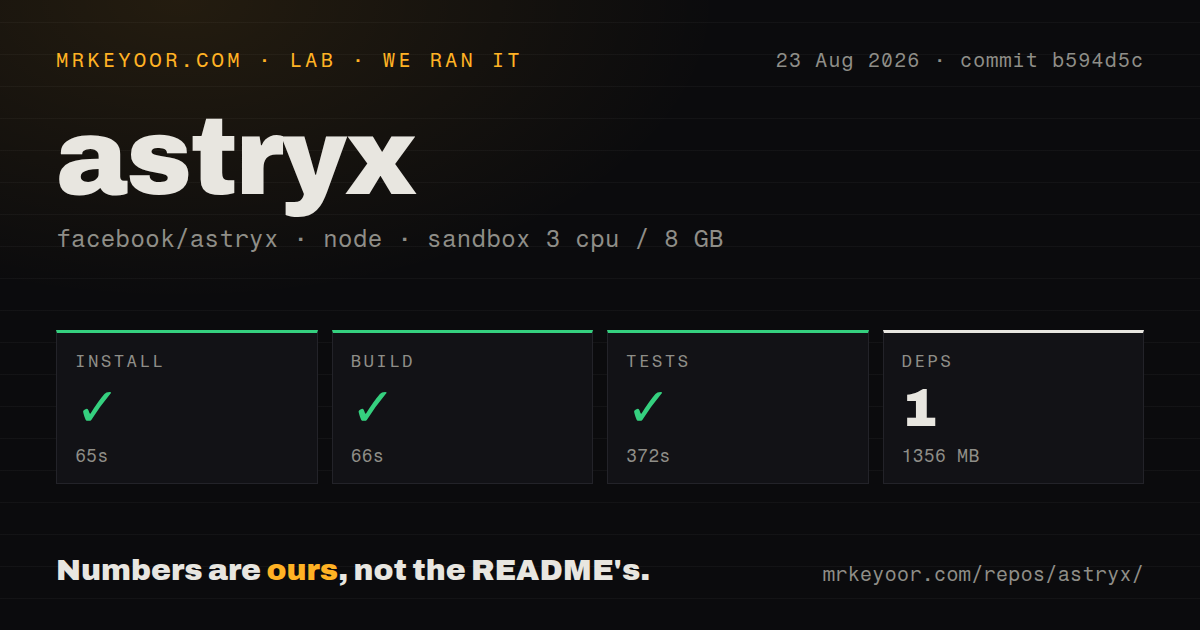
We cloned commit b594d5c into an unprivileged Debian container with Node 22, 3 CPUs, 8 GB of RAM, and no secrets. The repository contained 4,624 files, about 670,496 lines of source, and occupied 282.3 MB before installation.
The pnpm install succeeded in 65 seconds. Our harness recorded 1 installed package and 1,356 MB on disk. The full monorepo build then completed successfully in 66 seconds. Tests also succeeded, taking 372 seconds. The lab output did not provide a test count, so success and elapsed time are the useful claims here.
Those results show that the documented contributor path works in a clean Linux container, but this is not a small library checkout. The repository has monorepo workspaces and 23 CI workflow files. There is no Dockerfile and no top-level tests directory, even though the configured test command ran successfully. Budget several minutes and more than a gigabyte for a clean contributor verification.
The CLI is more than scaffolding
Astryx treats the terminal as a documentation interface. The CLI can search components, hooks, topics, and templates; print a component's props and examples; emit page source; build themes; run upgrade codemods; and diagnose an installation. Every command can return typed JSON, including stable error codes, which gives coding agents a safer target than scraping prose or guessing package exports.
init writes a component index into AGENTS.md or CLAUDE.md. An agent can then discover the available components and request focused documentation. Dense output reduces the text sent to the model. This does not make generated UI trustworthy by itself, but it gives people and tools the same source of package-specific facts.
The template system also goes beyond isolated snippets. Dashboard, settings, form, and detail layouts provide editable source that composes the system's own layout and navigation pieces. Teams with repetitive internal applications may save meaningful design and implementation time here.
Beta means unfinished edges
The README is direct about status. Core and themes are published, the lab package is internal, and the Vega and chart packages have only canary releases. Version 0.4.6 shipped on 2026-08-22 with a long list of fixes across locale handling, overlays, selectors, touch targets, CLI integrations, and codemods. Frequent fixes are healthy project activity, but they also show how much behavior is still settling.
Accessibility deserves specific evaluation. An open report says a busy Button uses native disabled, causing keyboard focus to fall back to the document body. Another describes interactive HoverCard content being exposed as a description instead of a structured popup relationship. Both reports include code-level analysis and proposed checks, which is better than vague complaint traffic. They are still reasons to test the exact components and assistive technologies your product uses.
The repository's 454 open issues and pull requests should not be read as 454 defects. Recent activity includes fixes, dependency updates, documentation changes, and community contributions. The last push was 2026-08-23, and the latest release arrived one day earlier. This is an active project with a busy queue.
The buying decision
Astryx fits teams that want one React system spanning components, tokens, templates, documentation, and agent-facing tools. It is particularly persuasive for a new React 19 application where the team can adopt its providers and CSS layers from the start. The MIT license and source-ejection option reduce lock-in.
A cautious production team should pin versions, run visual and accessibility regression tests, and review each release before upgrading. If stability matters more than the CLI and template workflow, Material UI has a longer public track record. If your designers want to define nearly every visual decision, Radix offers a smaller behavioral base. Astryx is the more ambitious package, but today it asks buyers to participate in the beta.