mrkeyoor.com_
Wed 30 Sept 06:10 UTC
Dev Toolsevaluationupdated 30 Sept 2026

astra-chatgpt-hyperframes review

Astra ChatGPT Hyperframes is the reproducible source package for one 15-second ChatGPT-themed motion-design video. It combines 180 cleaned frames from a credited reference with new JavaScript-rendered text, then uses Hyperframes, Chrome, and FFmpeg to render and verify the result locally.

Verdict

Our install took 22 seconds, added 272 packages, occupied 694 MB, and exposed neither a standard build target nor a test target, while npm audit found 1 high-severity advisory. This is a useful forensic example of reconstructing and checking one browser-rendered motion piece, not a reusable ChatGPT video product. Study its asset hashes, explicit frame pipeline, and attribution notes, then start a new composition with cleared rights if you plan to publish or sell the result.

We ran it

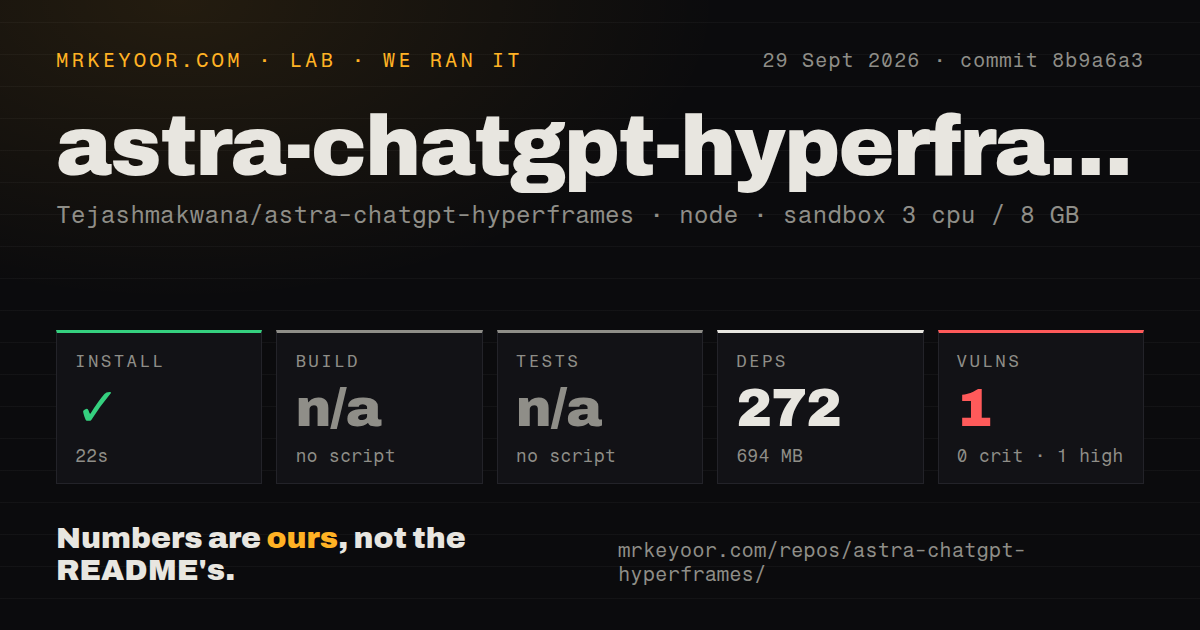
Lab card: what happened when we ran astra-chatgpt-hyperframesScreenshot of astra-chatgpt-hyperframes (github.com/Tejashmakwana/astra-chatgpt-hyperframes)
Install✓ · 22s272 packages · 694 MB
Buildn/ano build script
Testsn/ano test script
Known vulns10 critical · 1 high · 0 moderate · 0 low (npm audit)
Repo205 files~173 lines of source · 25.6 MB · 1 CI workflows

Answers from our run

Does astra-chatgpt-hyperframes build from source?

Dependencies installed in 22 seconds (272 packages), and the project has no separate build step. We cloned commit 8b9a6a3 into a clean Debian container with 3 CPUs and no project-specific setup.

Does astra-chatgpt-hyperframes have tests you can run?

Not through a standard command: the project exposes no test script or target that our harness could run.

Does astra-chatgpt-hyperframes have known vulnerabilities in its dependencies?

npm audit flagged 1 known advisory in the dependency tree at the time of our run.

Who should not use astra-chatgpt-hyperframes?

Anyone seeking a general ChatGPT video generator: this repository contains one fixed composition and no model API integration.

What are the alternatives to astra-chatgpt-hyperframes?

Remotion, Motion Canvas, Manim. Our install took 22 seconds, added 272 packages, occupied 694 MB, and exposed neither a standard build target nor a test target, while npm audit found 1 high-severity advisory.

Setup2/5694 MB install plus Chrome, FFmpeg, font setup, and 1 GB free
Docs4/5Clear render pipeline, source map, verification, and attribution
Community1/5141 stars, no open activity, and no release history
Maturity1/5Single composition published from one day of repository history

Who it’s for

Motion developers who want to inspect how one reference-based video was reconstructed frame by frame.
Hyperframes users looking for a complete HTML and canvas composition with local rendering and verification scripts.
Teams that need a pinned example of browser frames encoded to H.264 with an existing audio track.
Reviewers studying attribution and reproducibility limits in an adapted motion piece.

Who it’s NOT for

Anyone seeking a general ChatGPT video generator: this repository contains one fixed composition and no model API integration.
Creators who need original motion rather than an adaptation: the project says 180 source plates preserve the reference's backgrounds and control animations.
Commercial reuse without a rights review: source-derived media keeps its owners' rights, and the repository declares no standard license through GitHub.
Pipelines that require identical bytes across operating systems: the README warns that browsers, fonts, and FFmpeg builds can change pixels or encoding.
Security gates that allow no high-severity dependency advisory: our npm audit found 1 high-severity vulnerability.

Setup reality

Our sandbox installed commit 8b9a6a3 in 22 seconds, pulling 272 packages and using 694 MB. The 25.6 MB checkout held 205 files but only about 173 lines of source. Our runner found no standard build or test target, so both steps were skipped. npm audit reported 1 known high-severity vulnerability.

Rendering needs Node.js 22 or newer, Chrome, FFmpeg and FFprobe with libx264, and at least 1 GB of free space. Setup also downloads a pinned Switzer font only after you explicitly accept its linked license. No model API, API key, prompt service, or hosted renderer is required.

The committed plates are the baseline. Rebuilding them needs optional Python packages and can change PNG hashes. Browser versions, operating-system font rendering, the system monospace font, and FFmpeg builds can prevent byte-identical output across machines.

This repository reproduces one video, not a video product

Astra ChatGPT Hyperframes contains the source and assets for a single ChatGPT-themed motion response. The original motion belongs to Rajmoni, whose public reference is linked in the README. The adaptation keeps the reference's backgrounds and control movement in 180 cleaned source plates, then draws replacement typography with JavaScript. The project is candid about that boundary: it did not invent the motion from scratch.

The final piece is 15 seconds long and repeats the same 7.5-second visual loop twice while the original audio continues slightly longer. Hyperframes renders 360 lossless PNG frames at 1,920 by 1,080 and 24 frames per second. FFmpeg converts them to H.264 with an explicit BT.709 path, copies the existing AAC packets, and writes validation details. That pipeline is the repository's subject, not ChatGPT itself.

What happened when we ran it

Our unprivileged Debian sandbox installed commit 8b9a6a3 in 22 seconds. npm pulled 272 packages, and the installed tree occupied 694 MB. Before dependencies, the repository used 25.6 MB across 205 files and about 173 lines of source. One CI workflow was present, but there was no Dockerfile and no tests directory.

Our runner found no standard build script or target and skipped the build. It also found no standard tests script or target, so tests were skipped. npm audit reported 1 known vulnerability rated high, with no critical, moderate, or low findings. The repository has its own check, render, and compare commands, but those are not results from our lab block. We cannot claim that this container reproduced or validated the MP4.

Rendering needs Chrome, FFmpeg, and a separately licensed font

The documented path starts with Node.js 22 or newer, Chrome, FFmpeg and FFprobe with libx264, plus at least 1 GB of free space. After npm ci --ignore-scripts, setup pauses for explicit acceptance of the Switzer font license and downloads a pinned font from its official CDN. Rendering stays local and needs no AI model, API key, private prompt, or agent service.

Chrome can be installed through Hyperframes or selected through HYPERFRAMES_BROWSER_PATH. FFmpeg and FFprobe must already be on the system path. The project also supplies a GitHub Actions render workflow, but the user must accept the font license before running it. These dependencies are reasonable for browser video work, yet they make the 173 lines of source a misleading guide to total setup. Our installed JavaScript tree alone reached 694 MB.

Hashes make drift visible without promising universal identity

The render scripts verify hashes for the 180 plates, audio, raw reference, comparison video, and downloaded font. A verification report records the decoded output, frame count, and audio hash. The project reports that a fresh install on its recorded macOS environment produced a byte-for-byte identical MP4. It also says the included delivered video is only a comparison artifact and never becomes render input.

That is a credible reproducibility method with a bounded claim. Browser versions, operating-system font rasterization, the system monospace font used in the opening prompt, and FFmpeg builds may change individual pixels or encoded bytes. Linux can render the same composition without guaranteeing the same file hash. The comparison command is therefore more useful than a blanket assertion: it gives you a way to locate drift on the machine you actually use.

The editable layer is small because the motion lives in plates

film.js owns the title, prompt, result typography, and frame seeking. index.html defines the composition, dimensions, and audio. Measured positions live in assets/tracks.js, while the backgrounds and controls are committed PNG plates. A Python script documents the cleanup and tracking work that produced those plates, though rebuilding them with different image-library versions may change their hashes.

This structure makes text edits approachable, but it is not a flexible scene system. Much of the visual motion is baked into source-derived frames. Changing the timing, camera movement, interface choreography, or art direction means more than replacing a string. If your goal is an original series with reusable scenes, a framework such as Remotion or Motion Canvas gives you a cleaner starting abstraction than adapting this one composition.

Attribution does not grant reuse rights

The README credits Rajmoni for the motion reference, identifies the font designer and distributor, and labels ChatGPT and OpenAI names as their owners' trademarks. It also states that media and source-derived plates retain their owners' rights and that attribution does not create a new license. GitHub's API reported no asserted repository license when checked. Those facts should stop a casual copy-and-publish workflow.

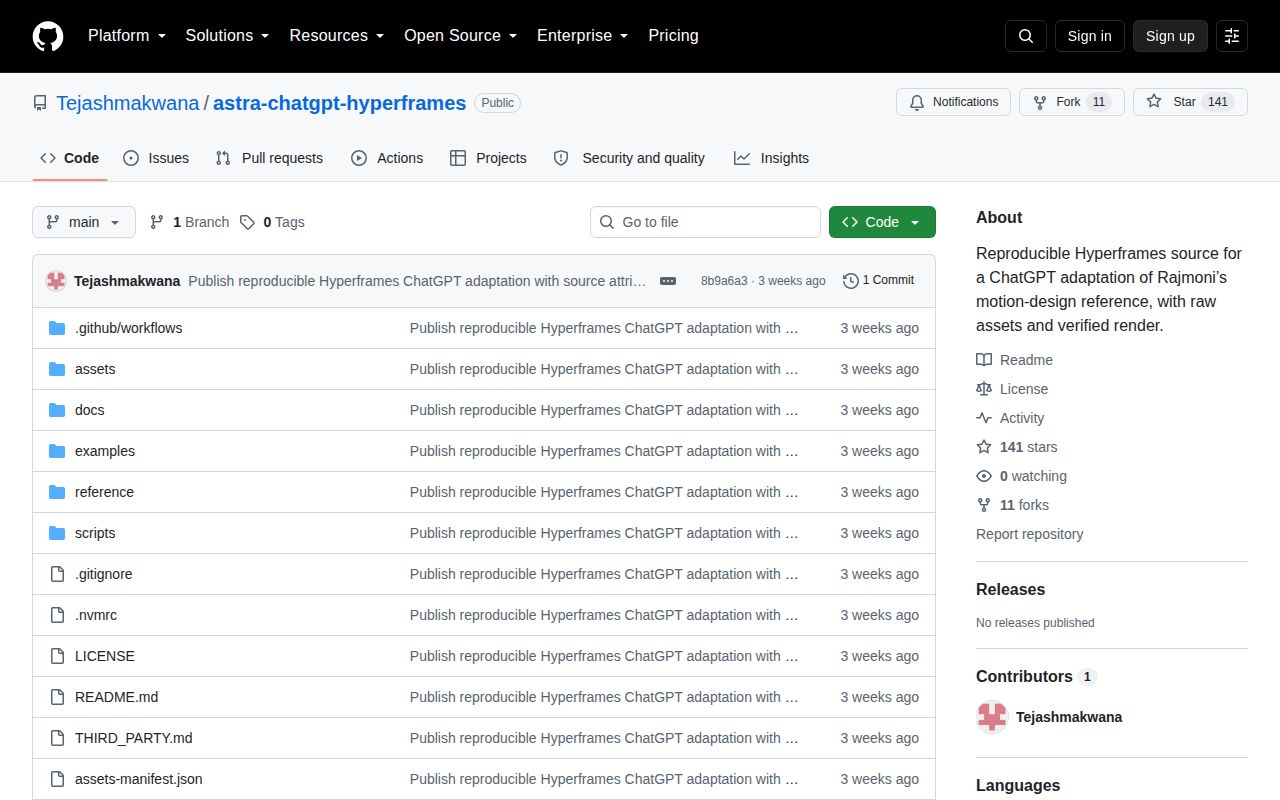
GitHub showed 141 stars, 11 forks, and 0 combined open issues and pull requests on September 30, 2026. The repository was created and last pushed on September 6, with no published release. This looks like a preserved production artifact, not an evolving library. That is fine for study. For distribution, replace the protected identity and source-derived material, establish a license for every asset, and build motion you can clearly claim as your own.

Alternatives

ProjectWhat it isPick it when
Remotion gh↗A React framework and rendering toolchain for programmatic video projects.pick this instead when you are building an original reusable video system rather than reproducing one supplied reference.
Motion CanvasA TypeScript animation framework with a live editor and generator-based timelines.pick this instead when interactive timeline authoring and reusable scenes matter more than exact reference reconstruction.
Manim gh↗A Python engine for precise programmatic animations, especially technical and mathematical scenes.pick this instead when Python-authored vector animation fits the subject better than HTML and canvas.

What people are saying

  1. [velocity-scout] Tejashmakwana/astra-chatgpt-hyperframes

Sources

  1. Astra ChatGPT Hyperframes README
  2. Astra ChatGPT Hyperframes repository
  3. Frame analysis
  4. Reproduction verification
  5. Third-party rights notes

More dev tools reviews

swiftui-logo-draw · RTX40MFG-Unlock · booking-microservices · macos-sysdata · NoGraphicsAPI · codenotch · the whole board →