ASP.NET Core is a platform choice, not a thin HTTP library
ASP.NET Core covers far more than routing requests to functions. The repository contains the web framework, Razor and Blazor pieces, SignalR, hosting, security components, and infrastructure used across the .NET web stack. Applications run on Windows, macOS, and Linux. That breadth is the main reason to choose it: a C# team can build an API, render HTML, add interactive UI, and operate real-time connections without assembling unrelated server frameworks.
The same breadth creates commitment. This checkout contained 17,983 files, roughly 2,038,575 lines of source, and 111.8 MB before dependencies. A small API does not use every part, but engineers still adopt .NET conventions, release support policies, dependency injection, configuration, and hosting behavior. Fastify is easier to justify for a TypeScript team that needs a compact HTTP layer. Spring Boot is a closer comparison for a company already committed to a managed runtime and a large server ecosystem.
Released SDKs are the sensible starting point
The README sends application developers to Microsoft's getting-started material and released .NET downloads. Install a supported SDK, create an application, and let the framework packages arrive through normal .NET tooling. The nightly table is for current development builds, with separate artifacts for Windows, macOS, glibc Linux, and musl Linux across several processor architectures. It should not be the default for production.
The table currently points at daily .NET 11 builds, while the latest GitHub release was .NET 10.0.11 on August 11, 2026. Those channels serve different buyers. A stable application should follow the supported release channel and its servicing updates. A framework contributor or engineer verifying an upcoming fix may need a daily build. Mixing the two makes incident response harder because a nightly artifact does not carry the same expectation as a serviced release.
What happened when we ran it
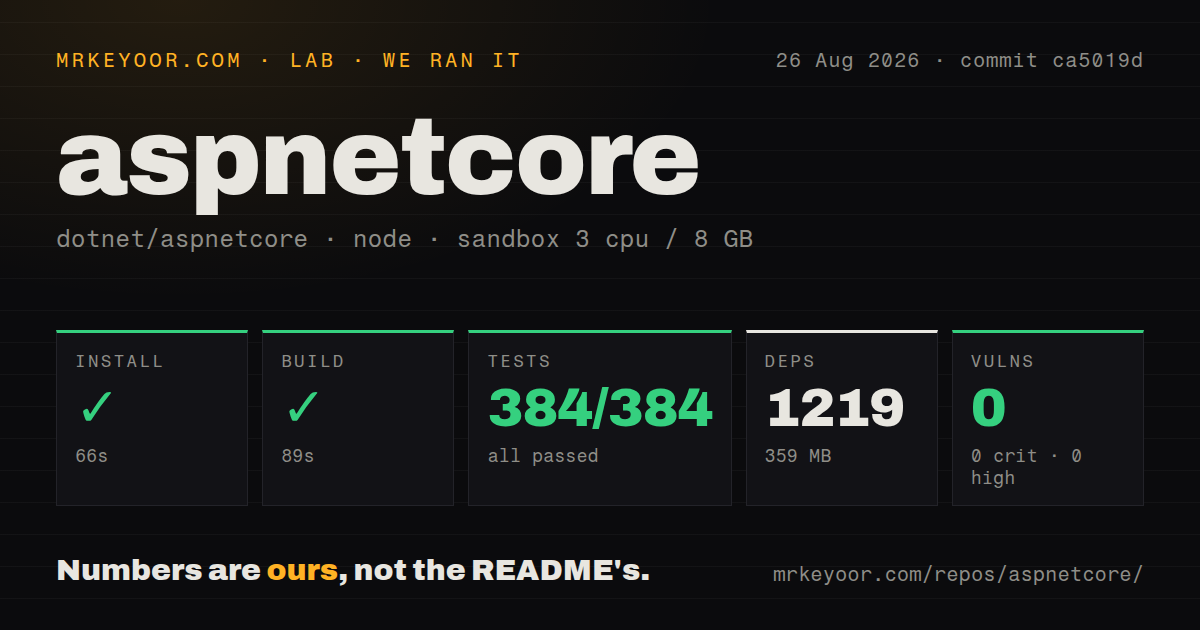
Our sandbox exercised the npm portion of commit ca5019d. Installation took 66 seconds, pulled 1,219 packages, and occupied 359 MB. The measured build succeeded in 89 seconds. Jest then passed 384 of 384 tests in 34 seconds, and npm audit reported 0 known vulnerabilities across critical, high, moderate, and low severities. For the JavaScript assets and tests reached by that command, this was a clean result.
It was not a complete ASP.NET Core source build. The repository's primary language is C#, while our supplied environment was a Node 22 Debian container. We did not run the managed, native, browser integration, SignalR Java, installer, or complete framework test suites. The 384 Jest passes answer a narrow question: the measured JavaScript workspace installed, built, and tested successfully at that commit. They cannot support a claim that every ASP.NET Core component passed.
The checkout had 21 CI workflow files, monorepo workspaces, no root Dockerfile, and no top-level tests directory in our scan. Those signals fit a repository whose tests and build entry points are distributed among project areas. They explain why a newcomer should follow the documented scripts instead of guessing that one root npm command represents the product.
Contributors should build one project area at a time
The source guide tells contributors to clone recursively because the repository uses submodules. Its restore scripts install the local .NET dependencies, after which contributors activate that SDK and run the build script inside a project directory. The maintainers explicitly discourage routine top-level builds. Even Visual Studio struggles with a solution of this scale, so the repository supplies solution filters for related projects rather than expecting everyone to load the full tree.
Windows has the heaviest prerequisite. The guide requires Visual Studio and its C++ components even if the contributor plans to edit in another program, and it currently calls for the preview channel used by the repository's SDK. Linux and macOS contributors use restore.sh and activate.sh. Optional areas add Selenium, Playwright, Chrome, Java 11 or newer for the SignalR client, and WiX for Windows installers. That is normal for framework engineering, but excessive for someone who merely wants to ship an application.
The issue count describes a framework-sized queue
GitHub listed 4,120 open issues and pull requests when fetched, not 4,120 confirmed bugs. Recent activity on August 26, 2026 included automated branch synchronization, dependency work, a hosting contribution, a performance report, and known build-error issues across Blazor, SignalR, HTTP/3, and infrastructure. The last push landed that same day. This is an actively triaged queue spread across many subsystems, and the README links its triage process.
Large activity numbers cut both ways. Another team may have discussed an edge case involving hosting, authentication, UI, or networking. There is also more issue traffic to search, and fixes may belong to a release branch different from main. Teams should match an issue and its resolution to the exact supported .NET line they run rather than treating any merged framework change as immediately available.
Microsoft support and MIT licensing reduce adoption risk
The code uses the MIT license, and the repository gives a private route to the Microsoft Security Response Center for security reports. It also links the .NET bounty program, roadmap, weekly community standup, contribution guidance, and separate documentation sources. These are concrete maintenance structures, not a substitute for an application's own threat model. Authentication choices, secret storage, proxy configuration, patch cadence, and deployment isolation remain the operator's responsibility.
ASP.NET Core is the practical default for a team building web software in modern C#. Our 89-second JavaScript build and 384 passing Jest tests add useful evidence about one part of the tree. The stronger case comes from cross-platform SDK releases, active servicing, documented source workflows, and a framework broad enough to prevent needless glue between server features. Choose it for that integration, then keep application development separate from building the framework itself.