Gin sits between Go's HTTP server and your handlers
Gin gives a Go service a router, request context, middleware chain, input binding, validation hooks, and response renderers. Routes can be grouped under a shared path and middleware, while handlers return JSON, XML, HTML, files, or other formats through the same context. gin.Default() also installs logging and panic recovery. The framework saves routine HTTP wiring without deciding how your business layer or database should look.
That scope is useful. A small API can define a router, register GET or POST handlers, and listen on port 8080 with little ceremony. A larger service can split routes into groups and attach authentication, metrics, or request policy at the appropriate branch. Gin's context also collects handler errors and parsed parameters, which keeps transport work out of domain functions when a team maintains that boundary.
The defaults should not be mistaken for an application architecture. Authentication appears through your own middleware or community packages. Database queries, migrations, queues, caching, schema ownership, and authorization policy remain outside Gin. Teams wanting a full stack will assemble those parts. Teams already opinionated about them may prefer that the framework stays focused on HTTP.
Binding and rendering cover common API formats
Gin can bind query strings, forms, JSON, XML, YAML, TOML, Protocol Buffers, BSON, and other request shapes into Go values. Validation can run during binding, and content negotiation can select a response representation. Version 1.12.0 added Protocol Buffers to content negotiation and support for encoding.UnmarshalText in URI and query binding, among other changes.
Convenience changes failure behavior, so handlers need deliberate choices. Methods prefixed with MustBind can write a 400 response and abort when parsing fails, while ShouldBind variants return the error for application handling. Uploaded filenames must be cleaned rather than trusted. The guide also exposes a multipart-memory setting. Read the exact binder path used by each public endpoint instead of assuming all formats share one decoder and one limit.
What happened when we ran it
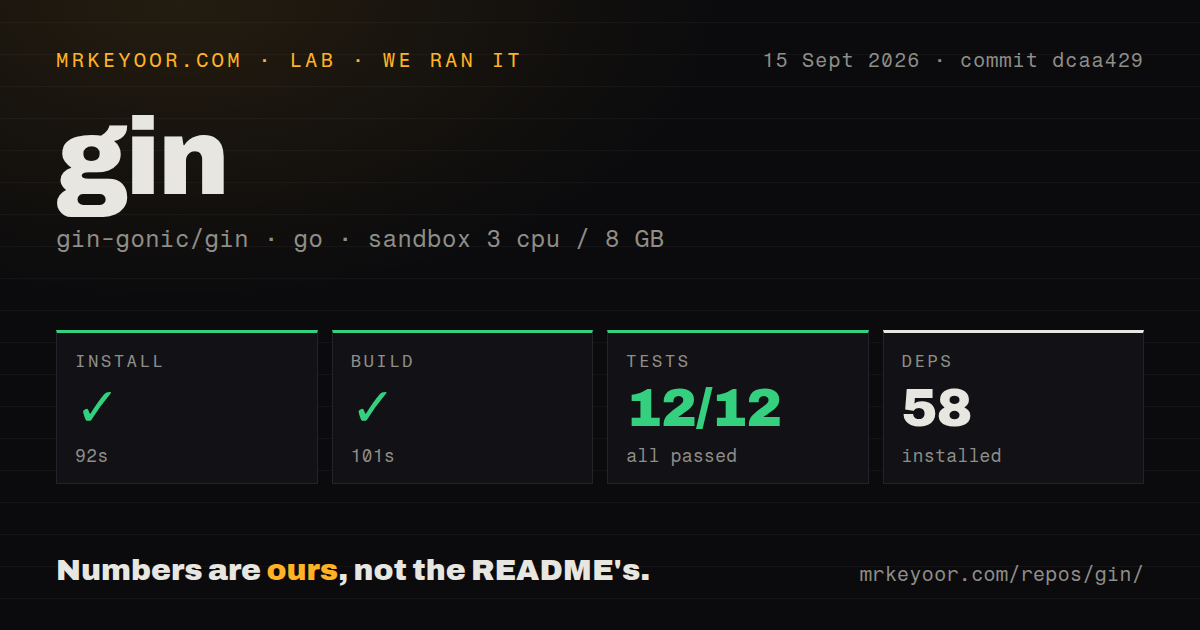
Our sandbox fetched Gin's dependencies at commit dcaa429 in 92 seconds. Go installed 58 packages for the measured checkout. The repository itself was compact at 0.9 MB, with 130 files and about 24,198 source lines. We found 4 CI workflow files and no Dockerfile, which is unsurprising for a library imported into someone else's service.
The build succeeded in 101 seconds. Tests then completed in 13 seconds with 12 passed and 0 failed out of 12. Go tests commonly sit beside source as _test.go files, so the absence of a separate tests directory does not conflict with the passing test command. Nothing in our supplied run reported a compiler error or a failing case.
These results establish that the measured commit resolved, compiled, and passed its available suite in our unprivileged Debian container with 3 CPUs and 8 GB of RAM. They do not measure requests per second, allocations per route, tail latency, or performance against Chi, Echo, Fiber, or net/http. The README carries its own benchmark table, but selecting a server on that table alone would ignore middleware and application work that dominate many real endpoints.
The short Run helper leaves all server timeouts unset
Gin's first example ends with r.Run(), which is fine for seeing a response quickly. Open issue 4760 points out that this path creates an http.Server without read, write, read-header, or idle timeouts. A slow client can therefore hold a partial request open unless another layer imposes a deadline. The issue remains a reason to avoid the helper on an exposed production listener.
The project guide already shows the better building block: create your own http.Server, use the Gin engine as its handler, and configure limits. Add graceful shutdown so deploys stop accepting new requests and give active handlers a deadline to finish. The correct values depend on uploads, streaming, and upstream latency. Gin cannot choose them safely for every service, but production documentation should keep them close to the main server example.
Trusted proxies and body caps need explicit choices
Gin's guide says all proxies are trusted by default until the application calls SetTrustedProxies. That is unsafe when code uses ClientIP() for audit records, access rules, or rate limits, because forwarding headers should only be accepted from known hops. Set exact addresses or CIDRs for your proxy chain, or disable proxy trust when clients connect directly.
Issue 4759 documents another boundary: BSON and Protobuf binders read an entire request body before parsing it, with no built-in maximum in the reported code. An application or reverse proxy should reject oversized bodies before those binders consume them. Even JSON endpoints benefit from explicit request limits. A framework-level decoder is not a substitute for the service deciding how large an authenticated or anonymous request may be.
These are ordinary responsibilities for experienced Go teams, and easy omissions for someone copying a tiny tutorial. Before launch, test malformed content types, oversized payloads, disconnects, panics, spoofed forwarding headers, and shutdown while requests are active. Gin supplies recovery and parsing tools. Your server configuration determines whether those tools sit inside a bounded system.
Version 1.12.0 is mature while master now asks for Go 1.25
Gin v1.12.0 was released on February 28, 2026, and GitHub recorded the last push on August 15. The repository had 89,223 stars and 771 combined open issues and pull requests when fetched. Pull request and issue activity continued into September, including work on newer HTTP methods, Unicode rendering, response status behavior, and request hardening.
The current README requires Go 1.25 or newer. Our commit dcaa429 built with the supplied Go 1.24 image, so teams should distinguish the measured revision from current master requirements. Gin remains the safe conventional shortlist for a Go API because its core is small, documented, and widely exercised. The adoption decision still belongs to your server: pin the module, run your handlers under race and integration tests, and configure the limits that the one-line demo leaves open.