mrkeyoor.com_
Tue 01 Sept 17:40 UTC
Webevaluationupdated 26 Aug 2026

spring-boot review

Spring Boot is a Java framework for building stand-alone Spring applications with an embedded server, external configuration, health checks, metrics, and dependency defaults already wired. It cuts the amount of Spring setup needed before an application can accept a request, while still letting experienced teams replace its defaults.

+24stars / 7d
Verdict

Our run installed Spring Boot's 251-package Antora workspace in 13 seconds, then found no build or test target, so it says nothing about whether the 856,884-line Java codebase passes. Use Spring Boot when your team values Spring compatibility, maintained production conventions, and a deep integration catalog enough to accept its size and upgrade work. For a small service where startup footprint or explicit wiring is the main concern, compare Quarkus or Micronaut before committing.

We ran it

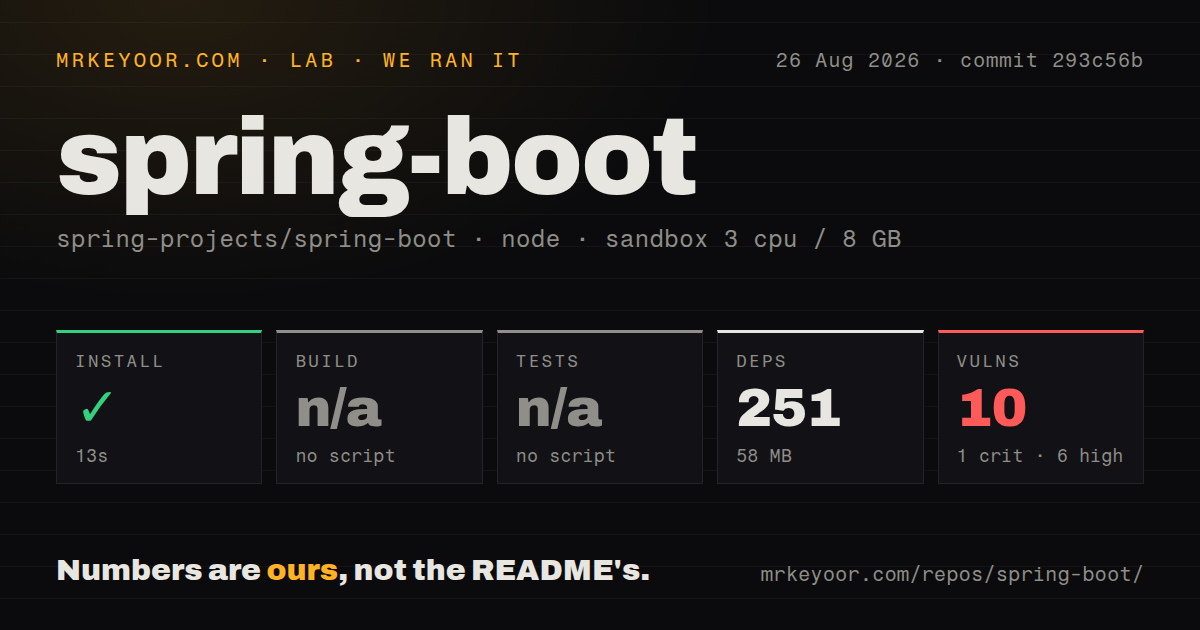
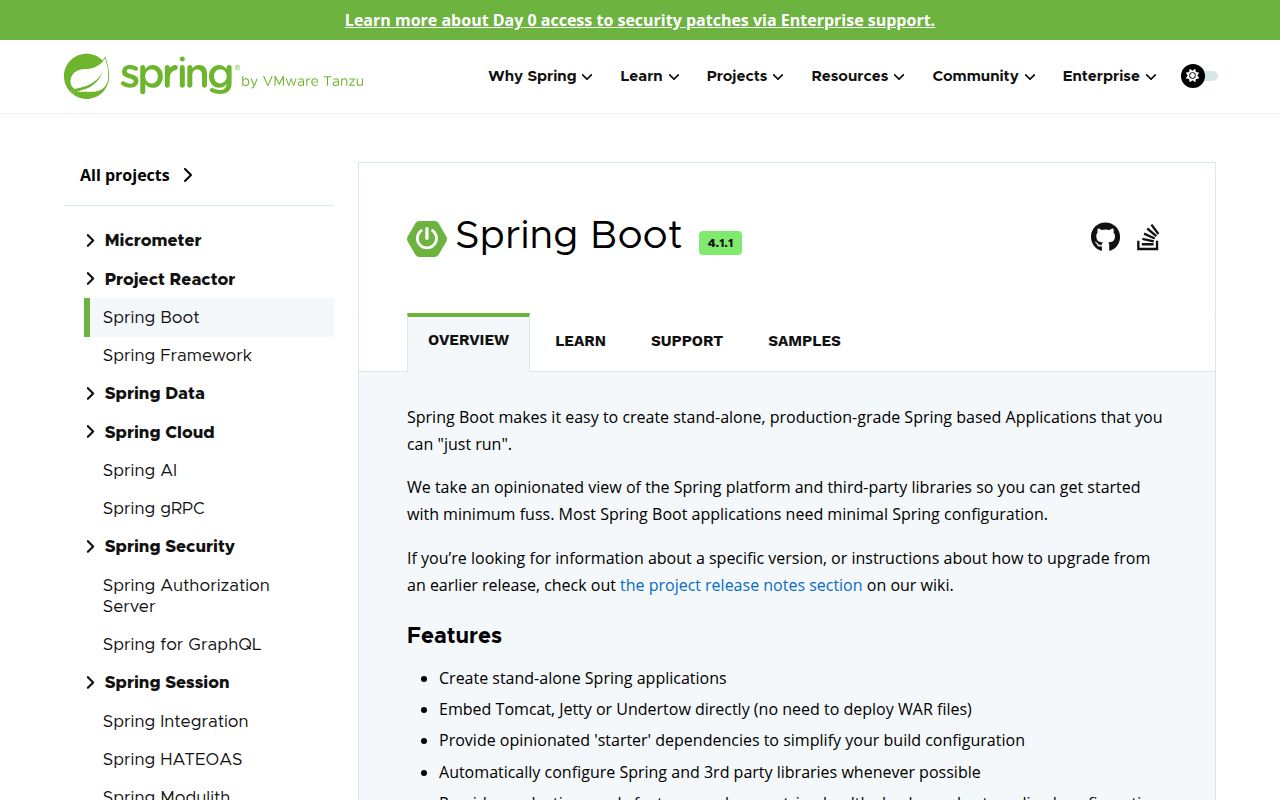
Lab card: what happened when we ran spring-bootScreenshot of spring-boot (spring.io/projects/spring-boot)
Install✓ · 13s251 packages · 58 MB
Buildn/ano build script
Testsn/ano test script
Known vulns101 critical · 6 high · 3 moderate · 0 low (npm audit)
Repo11008 files~856,884 lines of source · 37.9 MB · 10 CI workflows

Answers from our run

Does spring-boot build from source?

Dependencies installed in 13 seconds (251 packages), and the project has no separate build step. We cloned commit 293c56b into a clean Debian container with 3 CPUs and no project-specific setup.

Does spring-boot have tests you can run?

Not through a standard command: the project exposes no test script or target that our harness could run.

Does spring-boot have known vulnerabilities in its dependencies?

npm audit flagged 10 known advisories in the dependency tree, including 1 critical at the time of our run.

Who should not use spring-boot?

Developers looking for a small framework they can understand from one repository tour: our checkout contained 11,008 files and about 856,884 source lines.

What are the alternatives to spring-boot?

Quarkus, Micronaut, Helidon. Our run installed Spring Boot's 251-package Antora workspace in 13 seconds, then found no build or test target, so it says nothing about whether the 856,884-line Java codebase passes.

Setup4/5App guides are easy; source contributors need JDK 25 and Gradle
Docs5/5Reference docs, tutorials, how-to guides, and upgrade notes are extensive
Community5/5Pushed August 2026 with active issue triage and frequent releases
Maturity5/5Established release process and broad production integration coverage

Discussed on

  1. hnAI PR adds auto generated comments to whole Spring Boot Project38 points
  2. hnAI commented the entire Spring Boot codebase21 points

Who it’s for

Java teams that want Spring's ecosystem without assembling every server, dependency version, and configuration layer themselves.
Organizations that need conventional HTTP services with health, metrics, security integration, and external configuration.
Existing Spring users who want executable JAR or WAR deployment and maintained upgrade guidance.
Teams prepared to follow a release line, test upgrades, and understand which auto-configuration each starter adds.

Who it’s NOT for

Developers looking for a small framework they can understand from one repository tour: our checkout contained 11,008 files and about 856,884 source lines.
Teams unable to budget for framework upgrades: the v4.1.1 release changed automatic gRPC plugin behavior and lists many dependency updates and fixes.
Projects that need every runtime choice to stay explicit: Spring Boot deliberately applies defaults based on dependencies and configuration, which can obscure why a bean exists until you inspect auto-configuration.
Contributors expecting the README's source build to work on an ordinary Java baseline: it requires JDK 25 and points to the Gradle wrapper.
Buyers who would treat our npm result as proof of Java readiness: the measured project was the Antora documentation workspace, where no build or test target was available.

Setup reality

Our sandbox entered ./antora/ and installed 251 npm packages in 13 seconds, using 58 MB. That workspace had no build script and no test script, so both steps were skipped. Npm audit reported 10 known vulnerabilities: 1 critical, 6 high, and 3 moderate.

That result covers the documentation toolchain, not a Spring Boot application or the Java source build. The README says normal users should start through the published documentation; contributors building the repository need JDK 25 and the included Gradle wrapper.

A real application still needs a chosen Java runtime, starters, configuration, and backing services such as a database or broker. Production work also includes dependency-line upgrades and checking which auto-configuration each starter activates.

Spring Boot trades explicit wiring for maintained defaults

A basic Spring Boot application can fit in one Java class: annotate it, add a controller, and call SpringApplication.run. The framework supplies an embedded server and configures components according to the dependencies on the classpath. Its larger promise is operational. The README names security, metrics, health checks, and external configuration as common needs that Boot handles without XML or generated application code.

Those defaults save time when a team already wants Spring. They also create a learning requirement. A starter can activate beans, dependency versions, and runtime behavior that never appear in your application code. Spring Boot lets you replace those choices, but first you must know which auto-configuration made them. For a small service, that can feel like investigating the framework to explain your own process.

The 11,008-file checkout is a platform, not a starter project

Our checkout at commit 293c56b contained 11,008 files, about 856,884 lines of source, and occupied 37.9 MB before installation. That scale matches what Spring Boot has become: framework modules, build plugins, test support, Actuator, loaders, documentation, and integration code maintained together. Teams get one coordinated release train, while contributors face a codebase that takes deliberate navigation.

Most users should not build this repository. The README explicitly sends application developers to the reference documentation and first-application tutorial. Building from source is for contributors or people testing current development code. That path requires JDK 25 and the Gradle wrapper; publishToMavenLocal publishes modules without tests, while the separate build task is the full source command described by the project.

What happened when we ran it

Our sandbox found the Node project in ./antora/, Spring Boot's documentation workspace. Npm installed 251 packages in 13 seconds and used 58 MB on disk. There was no build script or target and no test script or target, so the harness skipped both steps. This is a successful documentation dependency install, not a Java build result.

Npm audit reported 10 known vulnerabilities in that installed tree: 1 critical, 6 high, and 3 moderate. The measurement does not identify an affected Spring Boot runtime dependency because it covers Antora tooling. It does mean anyone developing or publishing the documentation should inspect and update that tree rather than assuming documentation dependencies are harmless.

The repository scan found 10 CI workflow files, no Dockerfile, and no top-level tests directory. Those signals should be read with the workspace result in mind. Spring Boot documents Gradle as its source build, and the absence of a directory literally named tests does not prove that Java tests are absent. Our supplied measurement records no Java test count, so we make no claim about one.

Version management is part of the product

Spring Boot's dependency management is one reason to adopt it. A release selects compatible versions across a large Java stack, which saves each application team from reconciling every library independently. The v4.1.1 notes from August 20, 2026 list fixes across Kafka, logging, metrics, data binding, Actuator, OAuth, GraphQL, Redis, native images, and other integrations, followed by a long dependency-upgrade section.

That same coordination makes upgrades real engineering work. Version 4.1.1 changed how the Gradle plugin configures gRPC when the Protobuf plugin is present; users who want the prior behavior must opt in through the protobuf extension. This is exactly the sort of release note a competent team must read before updating. The framework reduces dependency assembly, but it cannot remove migration testing from an application with many integrations.

Active issue triage gives problems somewhere to go

GitHub showed 81,367 stars and 487 combined open issues and pull requests when fetched. The last push was August 26, 2026, and recently updated entries included a labeled regression involving unwanted reactive OAuth2 resource-server beans in a WebMVC application. The number is not a bug count, but the same-day push and issue discussion show an actively maintained project rather than a large queue left untouched.

The support boundaries are also clear. The README directs usage questions to Spring's guides, reference material, and Stack Overflow, while GitHub is for bugs and feature requests with versions, operating-system details, JVM information, and ideally a reproducer. That division may feel formal to a developer expecting casual maintainer support. For production teams, it produces better reports and a searchable record.

Choose Spring compatibility before choosing convenience

Spring Boot is the sensible default when an organization already uses Spring libraries, needs several supported integrations, and wants application teams to share one way of packaging and operating Java services. The Apache-2.0 license permits commercial use, and executable JAR plus traditional WAR deployment covers both modern and older hosting models.

It is a poor default chosen only because the first tutorial is short. The 13-second npm result measured Antora, while the actual Java platform spans 856,884 source lines and a busy release train. Evaluate one representative service with its database, security rules, observability, and deployment target. If Spring's conventions remove more code than they hide, Boot earns its place. If the team keeps disabling defaults, a smaller framework is likely the cleaner choice.

Alternatives

ProjectWhat it isPick it when
QuarkusA Java framework focused on containers, fast startup, and native executables.pick this instead when container density or GraalVM native deployment matters more than Spring compatibility.
MicronautA JVM framework that performs dependency injection work at compile time.pick this instead when you want a smaller runtime model and accept a different framework ecosystem.
HelidonOracle's collection of Java libraries and services for cloud applications.pick this instead when you prefer a lighter set of composable Java services over Spring conventions.

What people are saying

  1. [velocity-scout] spring-projects/spring-boot

Sources

  1. Spring Boot README
  2. Spring Boot repository
  3. Spring Boot v4.1.1 release
  4. Reactive OAuth2 WebMVC regression issue
  5. Spring Boot reference documentation

More web reviews

axios · super-productivity · Graphite · fastify · tabler · go-zero · the whole board →