Archon makes the coding process the product
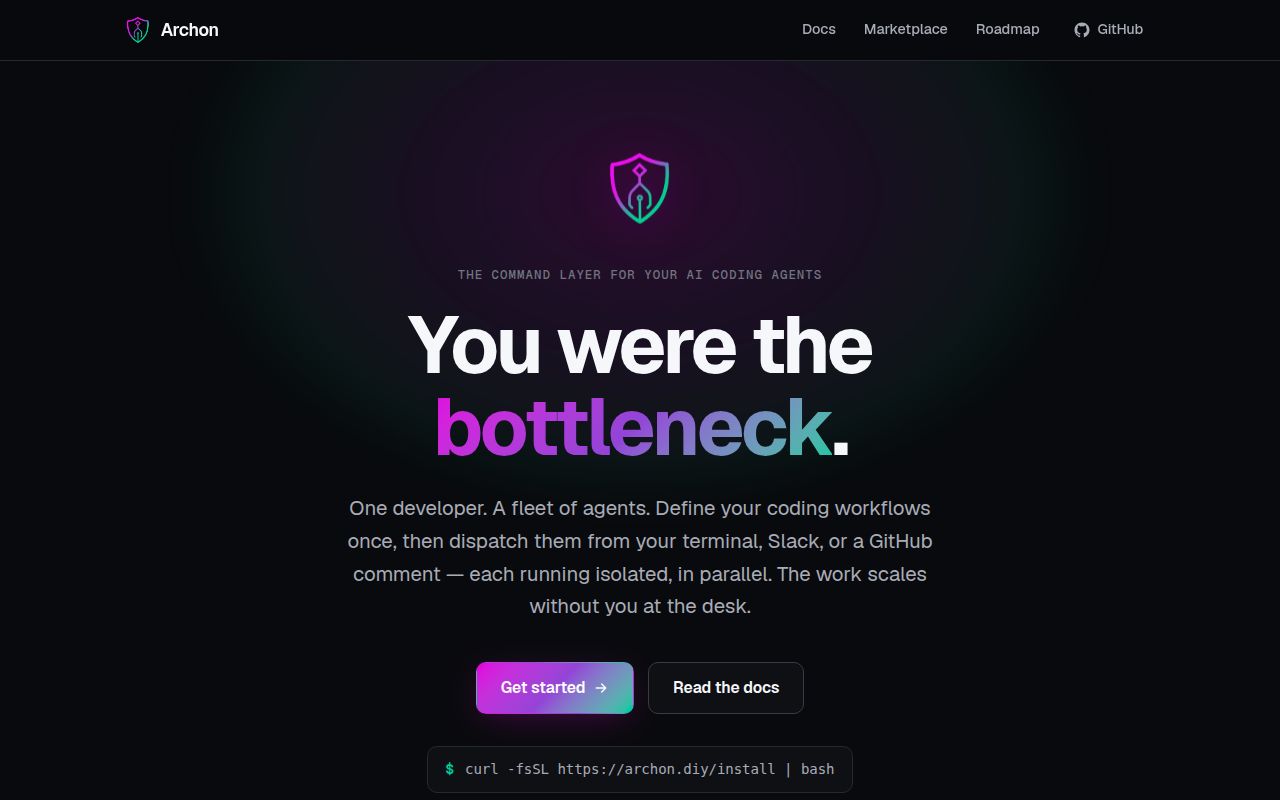
Archon is a workflow engine for AI coding agents, built around the argument that planning, implementation, validation, review, approval, and pull-request creation should be explicit steps. Teams describe those steps in YAML, commit them under .archon/workflows/, and let the agent supply judgment where needed. The value is not a promise that AI will always be right, but a way to stop every coding request from becoming a new, improvised process.
The repository is young but unusually visible, with 23,292 GitHub stars, an MIT license, and a latest release of v0.9.0 dated August 17, 2026. It preserves the earlier Python task-management and RAG product on a separate branch; current Archon is a TypeScript workflow system. Its scope is specific: coordinating software-development work performed by an AI coding agent.
What happened when we ran it
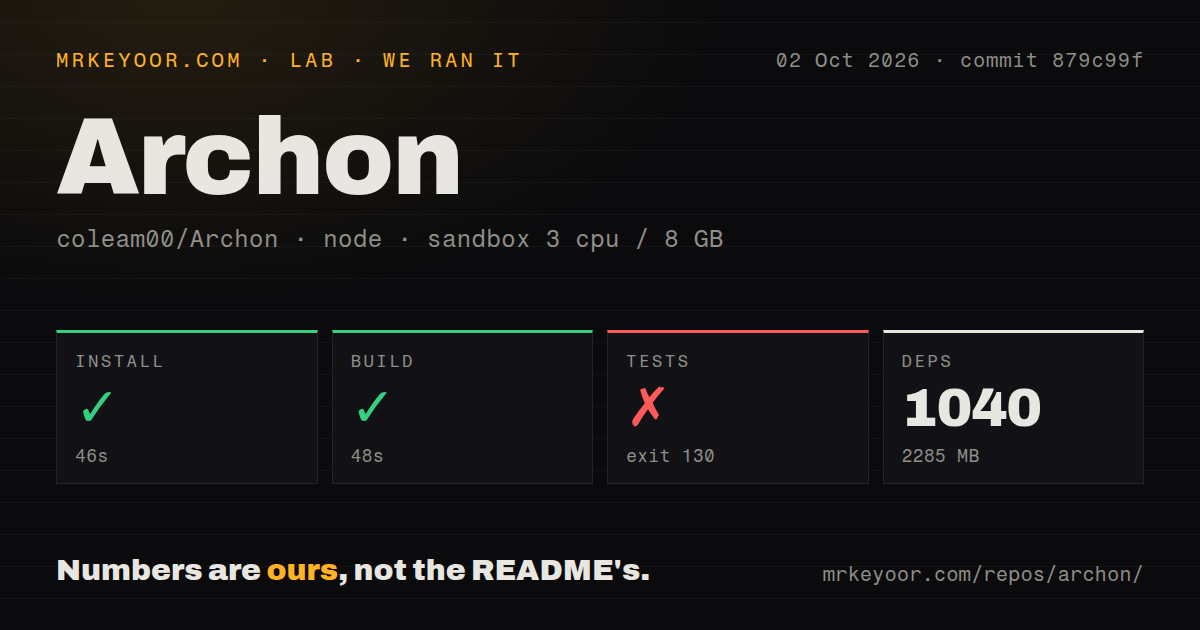
We cloned commit 4101256 into an unprivileged Debian container with 3 CPUs, 8 GB of RAM, Node 22 tooling, and no secrets. The checkout contained 1,486 files, roughly 345,346 lines of source, and occupied 18.3 MB before dependencies. Installation succeeded in 110 seconds, installing 1,286 packages and consuming 2,321 MB on disk. The build also succeeded in 59 seconds. The monorepo can install and compile in a clean environment, but its dependency footprint is substantial.
Tests were the break in the chain. Our run exited with status 1 after 353 seconds, and the reported failure came from @archon/core: 26 tests failed among 546 tests across 21 files. Other packages completed groups such as 91, 94, and 32 tests, but the log tail does not identify why core failed. We cannot fairly blame missing packages, sandbox restrictions, or a product defect. On our box, the repository built but did not achieve a clean test run.
Deterministic structure is the strongest feature
The YAML example makes Archon's appeal concrete. A plan node can feed an implementation loop, a deterministic Bash test can block review, and an interactive approval loop can hold PR creation until a person accepts the result. Dependencies make the order readable, while loop conditions and fresh contexts turn a vague instruction into a controlled sequence. This is more reviewable than a large prompt containing informal reminders to run tests or follow a PR template.
Isolation is another meaningful choice: every run gets its own Git worktree, and the README says 5 fixes can run in parallel without sharing one. Archon separates deterministic scripts, tests, and Git operations from AI nodes used for planning or code generation. That boundary can reduce unnecessary model involvement and makes failures easier to place. Workflows run through the CLI, Web UI, Slack, Telegram, and GitHub according to the documentation, so the process is not tied to one front end.
Setup is guided, not truly lightweight
The README offers a full setup described as 5 minutes and a quick install labeled 30 seconds. The guided route expects Bun, Claude Code, and GitHub CLI, then asks the user to launch Claude Code and request setup. The binary route is shorter, but compiled binaries require a separately installed Claude Code executable and may need CLAUDE_BIN_PATH. On x64, quick installation also requires AVX2; older hardware and virtual machines that mask it must use the source route.
Archon is therefore approachable for its intended audience, but not self-contained. Our source installation used 2,321 MB, and the failed 353-second test run creates a verification chore before trusting automated PR creation. Credentials and integrations add work beyond installing a command. The docs are candid about prerequisites and offer Docker, Homebrew, source, and binary paths, yet “fire and forget” should describe execution only after configuration and safety controls are proven.
Active development comes with visible backlog
The repository was pushed on August 27, 2026, the day of our evaluation and only 10 days after v0.9.0. Eight CI workflow files, a Dockerfile, a Compose file, and monorepo workspaces suggest deliberate engineering infrastructure. Community tracking showed about 23,285 stars shortly before the supplied count reached 23,292. This does not prove reliability, but it shows an active project rather than an abandoned release tag.
The caution is 278 open issues. Without issue age, response time, or closure data, that number cannot show whether maintainers are overwhelmed or handling high adoption. Combined with v0.9.0 and our 26 failed core tests, it argues for treating Archon as pre-1.0 infrastructure that deserves a controlled trial. Teams should inspect relevant issues, pin a version or commit, and require approval plus deterministic validation before granting credentials that can push branches or open pull requests.
It belongs between the developer request and existing CI
Archon fits best as an orchestration layer in front of repository controls, not as their replacement. Let it turn an issue into a plan, work in an isolated tree, iterate locally, and prepare a reviewable change. Keep protected branches, required CI, code-owner review, secret boundaries, and deployment gates outside the agent workflow. A workflow test command helps, but independent server-side CI remains the final authority when 1 failed command can invalidate an automated run.
For an individual, Aider is simpler for interactive pair programming. OpenHands or Goose may suit users seeking a broader autonomous platform. Archon is more interesting when the process must be versioned, repeated, and shared across entry points. Its core idea is credible, but the measured test failure makes a sandboxed pilot, a pinned v0.9.0-era baseline, and human approval before external Git action the sensible adoption path.