Version 1.1.4 manages several coding agents from one desktop app
AI Toolbox v1.1.4 is a Tauri application for Windows, macOS, and Linux. It edits provider, model, prompt, plugin, and session settings for OpenCode, Claude Code, Codex, Gemini CLI, OpenClaw, and Pi, with newer Kimi Code support in the latest release. The same interface manages MCP servers and agent skills, then exposes quick switches from the system tray. For someone juggling several assistants, that is a concrete reduction in duplicated configuration work.
The breadth comes with physical size. Our checkout contained 1,198 files and about 359,607 source lines in 22.7 MB before dependencies. The React frontend covers separate modules for each assistant, the local gateway, images, sessions, SSH, WSL, and settings. Rust code behind the Tauri shell handles file access and native integrations. This is a control plane for a developer workstation, not a small tray switcher that only swaps one API key.
What happened when we ran it
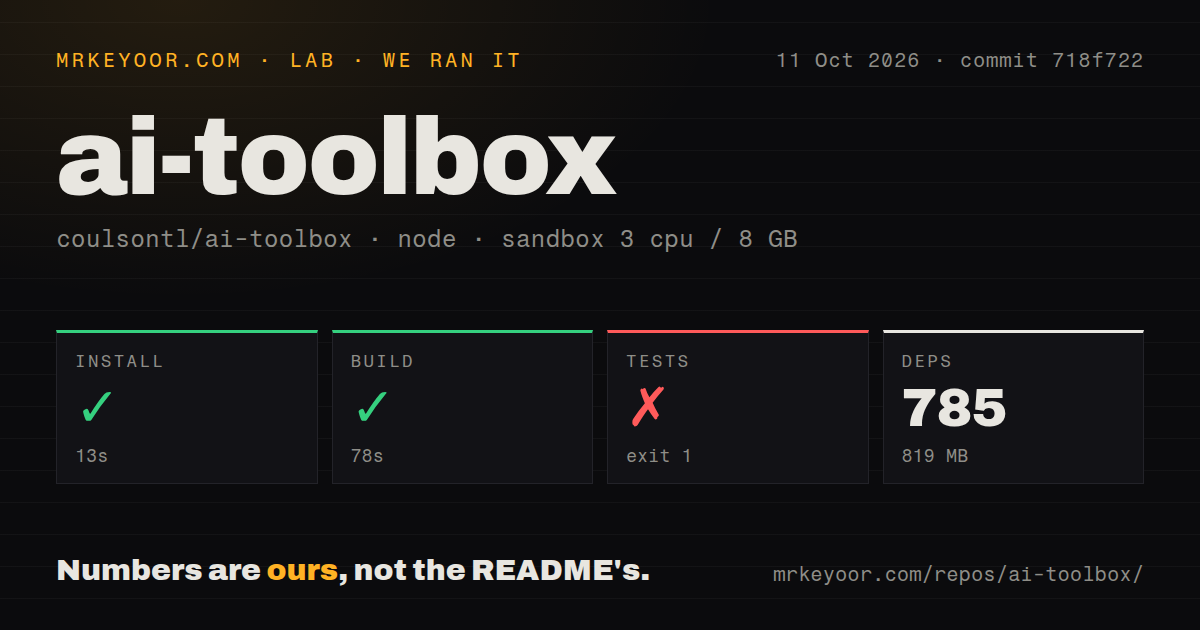
Our sandbox installed AI Toolbox in 37 seconds, pulling 785 pnpm packages and using 818 MB on disk. The build succeeded in 71 seconds. The available test command also succeeded in 21 seconds. We ran commit 03b8a09 in a fresh unprivileged Debian container with 3 CPUs, 8 GB of RAM, Node 22 as the base image, and no secrets. The measurement supplied no individual test count, so a pass total cannot be stated.
The repository scan found 1 CI workflow file, no Dockerfile, and no top-level tests directory. Those signals do not contradict the successful 21-second test command, because tests can live elsewhere or run through a script. Our harness checked repository install, build, and the available test target. It did not launch a packaged Tauri application, connect a provider, modify real agent configuration, use WSL or SSH, or restore a backup. The 71-second build is evidence about the command we ran, not every release artifact.
Local SQLite storage still gives the app wide write access
AI Toolbox calls itself local first and stores its main data in SQLite with JSONB records. The documented tables include provider settings, prompts, official-account records, sessions, MCP preferences, skills, gateway settings, image jobs, and remote-sync mappings. The app can also browse, rename, import, export, or delete sessions for supported assistants. A personal database is convenient, yet the application can change files and state that directly affect how several coding agents authenticate and behave.
Backup choices include a local ZIP, WebDAV, and S3-compatible storage, with automatic jobs, selectable items, and sensitive-file filters. WSL synchronization copies CLI, MCP, and skill configuration into Linux paths; SSH synchronization sends selected state to remote hosts. Those features require matching credentials and careful path mapping. The 818 MB dependency install does not assess secret handling or backup correctness. Before adoption, use a test profile, inspect the exported archive, and verify restore behavior without risking the only working agent configuration.
The gateway converts protocols, while per-model routing remains requested
The local proxy gateway can take over Claude Code, Codex, and Gemini CLI traffic, convert between provider protocols, fail over, log requests, track usage, and apply model prices. Its provider-compatibility document is detailed about OpenAI Responses, Chat, Anthropic Messages, Gemini formats, streaming termination, tool calls, images, and retry rules. That specificity helps an operator understand when conversion may lose information. It also shows how much application behavior sits between a coding agent and its upstream provider.
Two open issues mark current boundaries. Issue 321 asks for requests for one model to be routed to a user-selected replacement, so that policy should not be assumed available. Issue 305 reports that a Codex model cannot be mapped back to itself after mapping and that the generated catalog lacks all 6 reasoning-effort choices. Our 21-second test step passed, but it did not use a real provider channel. Test the exact agent, model, streaming mode, and tool-calling path before enabling gateway takeover.
The v1.1.4 database upgrade makes backup part of installation
Release v1.1.4 added Kimi Code CLI support, expanded skill labels and grouping, improved MCP controls, and fixed several Claude Desktop, Claude Code, OMO, and Codex configuration problems. The same release includes a database-schema warning. It says an older version may fail to start after the upgrade because its database version no longer matches. The documented rollback restores the automatically created pre-upgrade .db file, and any changes made after upgrading can be lost with that replacement.
Release users can download MSI or EXE files for Windows, DMG for macOS, and DEB or AppImage for Linux. macOS also has a repository-hosted Homebrew cask, with a quarantine-removal command in the README. Source developers need Node 18+, pnpm 9+, Rust 1.86+, and Tauri prerequisites. Our 37-second pnpm install and 71-second build do not include testing each installer, automatic update, migration, or platform integration. Keep a known-good database copy outside the app's migration path before upgrading.
September activity is strong, and most support happens in Chinese
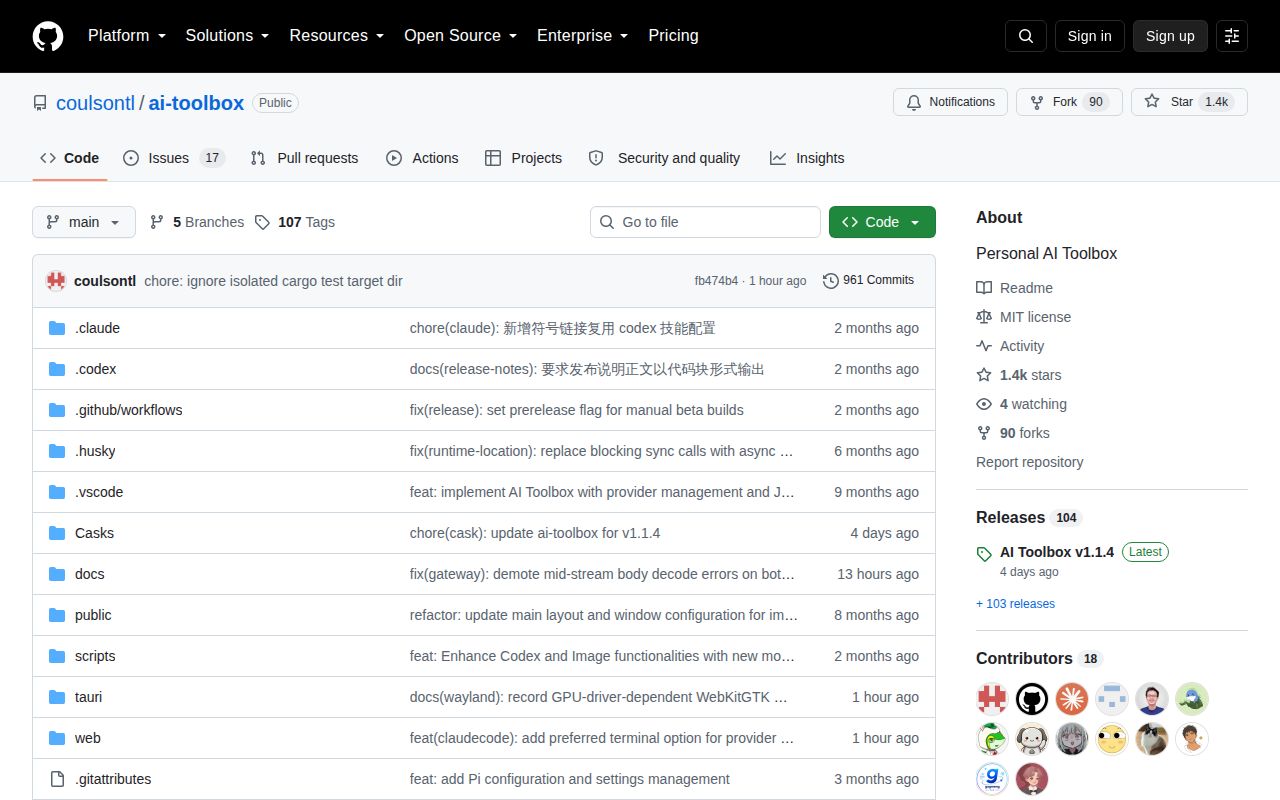
GitHub showed 1,379 stars, 17 combined issues and pull requests, a last push on September 5, 2026, and v1.1.4 released on September 2. Current tickets received updates through September 5, including quick closures and merged fixes around skills, Claude Code discovery, Kimi, and gateway configuration. That pairing of recent code and issue work indicates active maintenance. The combined open count includes pull requests and should not be read as 17 confirmed bugs.
Language is the practical community limit. The primary README, release notes, detailed gateway documents, and most current issues are Chinese. The app itself lists Chinese and English interfaces, and commands or file paths remain readable, but there is no separate English README in the repository tree we checked. Our successful 785-package install and test step reduce source uncertainty; they do not translate operational guidance. Choose AI Toolbox when its broad desktop authority saves one informed user time. Choose CC Switch, Skills Hub, or AxonHub when one narrower job matters more.