
Start with a product problem you can show to someone
Easy-Vibe's beginner path moves from finding a problem and understanding users to building a prototype with AI tools. That makes it a reasonable choice for a teacher with a classroom task or a product manager trying to explain an idea. The useful outcome to aim for is small: a working interaction another person can try and criticize.
English lessons and an English README are available alongside Chinese and other translations. The course map separates prototype work, fuller applications, and advanced agent workflows. You can choose the part matching your current problem. A beginner trying to build a simple page does not need to begin with the advanced MCP material.
What happened when we ran it
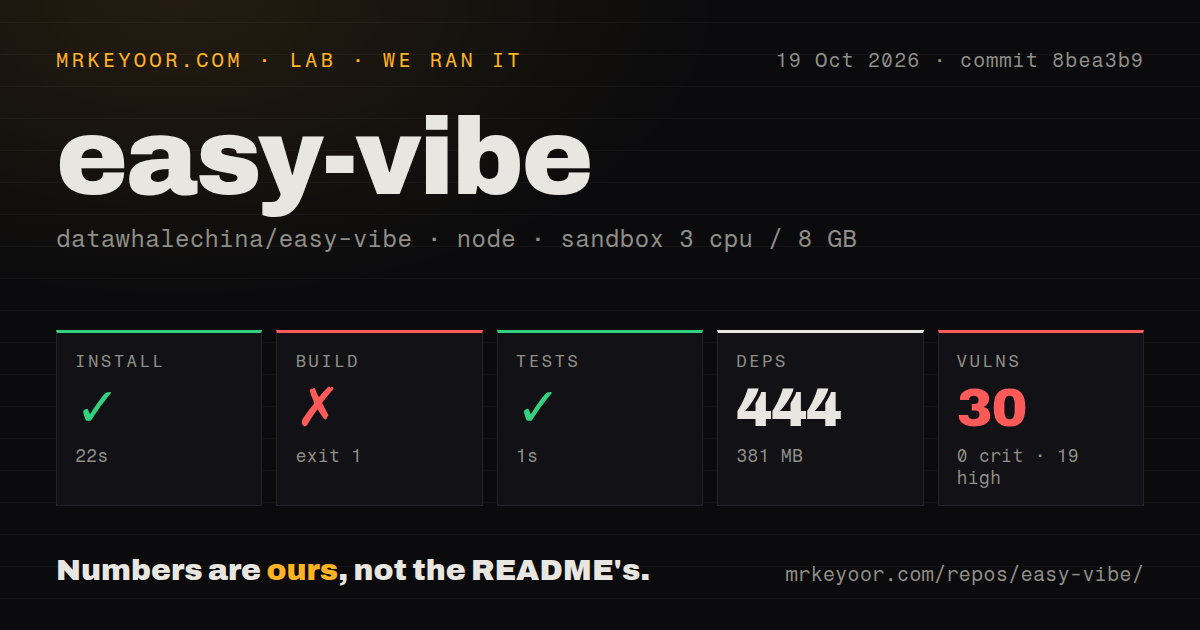
Our sandbox installed commit 8bea3b9 in 22 seconds, recording 444 dependencies and 381 MB on disk. The build failed with exit 1 after 17 seconds. The test step succeeded in 1 second, but the supplied record contains no count or coverage detail. A successful test command therefore does not settle whether the documentation site can be built.
The October 19, 2026 run used a sandbox configured with 3 CPUs and 8 GB RAM. The checkout contained 4,247 files, about 264,336 source lines, and occupied 597.3 MB. These are repository measurements, not the size of a student's eventual application. They also show why cloning the whole teaching site is a different commitment from opening a lesson.
The build tail first warns that gitignore syntax highlighting is unavailable and falls back to plain text. It then reports [vite:vue] crypto.hash is not a function while processing docs/index.md. The stack names getHash and createDescriptor in @vitejs/plugin-vue. That locates the failed operation. It does not establish that the highlighting warning caused it, identify the actual Node version, or support a particular runtime upgrade as the fix.
npm audit reported 30 known vulnerabilities: 0 critical, 19 high, 9 moderate, and 2 low. The summary does not name the affected dependencies or establish which paths expose them. Our scan recorded 2 CI workflow files and a Dockerfile, without a tests directory. Those signals cannot turn the failed build into a verified local setup or establish that every exercise was checked.
The books leave out the interactive appendix
The v0.4.0 release provides PDF and EPUB editions containing the core stages, with appendices omitted. Website-only interactive Vue components become static notes pointing to the online version. That is a consequential format choice for a class with intermittent connectivity: the book can carry the reading, while some demonstrations still require the site.
For ordinary study, start with an existing reading route before making the local build your first assignment. Maintaining a translated teaching site and learning to make an application are separate jobs. An instructor who needs to customize or host the material should resolve the build failure independently, keeping the failing revision and full toolchain logs available for diagnosis.
The projects bring service choices beyond the lesson page
The curriculum links work involving Supabase, deployment hosting, and Stripe, then moves into Claude Code and MCP workflows. A lesson page can explain that route without supplying access to the services it uses. Before assigning a project, check which accounts the chosen exercise needs and whether your learners can use them in their country and institution.
The README identifies the material as Creative Commons Attribution-NonCommercial-ShareAlike 4.0 International. If you need course material under a permissive software license, that label is enough reason to check reuse terms before adopting it. A public GitHub repository does not by itself establish the reuse permissions your training product requires.
Issue 152 asks for a requirements template before prototyping
The last push was October 19, 2026. The issue feed showed issue 152 requesting a one-page requirements template between problem discovery and prototype instructions. The linked open pull request 153 proposed that addition in the Chinese prototype chapter. It is a relevant discussion about a learner getting lost between steps, not evidence that every translation already includes the change.
The latest published release was the August 7 textbook edition. Its date describes that packaged reading format, while the recent push and issue discussion show continuing repository work. Neither date measures teaching effectiveness. We did not complete a course project or compare learner outcomes, so claims about how quickly someone becomes employable or ships a business would exceed this evidence.
Choose a fundamentals course when understanding the code comes first
Web Development for Beginners centers its projects on JavaScript, CSS, and HTML. Prefer that sequence if understanding browser code is your immediate goal. Generative AI for Beginners pairs AI concepts with Python and TypeScript examples and says basic knowledge of either language helps. It fits a reader who wants to work through AI application concepts directly in code.
For Easy-Vibe, choose one prototype exercise and decide what you want to learn from the person who tries it. Keep the first version narrow enough that you can explain its data and behavior. When the AI produces code you cannot account for, use that gap to choose the next lesson rather than adding another feature.