AxonHub consolidates an increasingly messy AI access layer
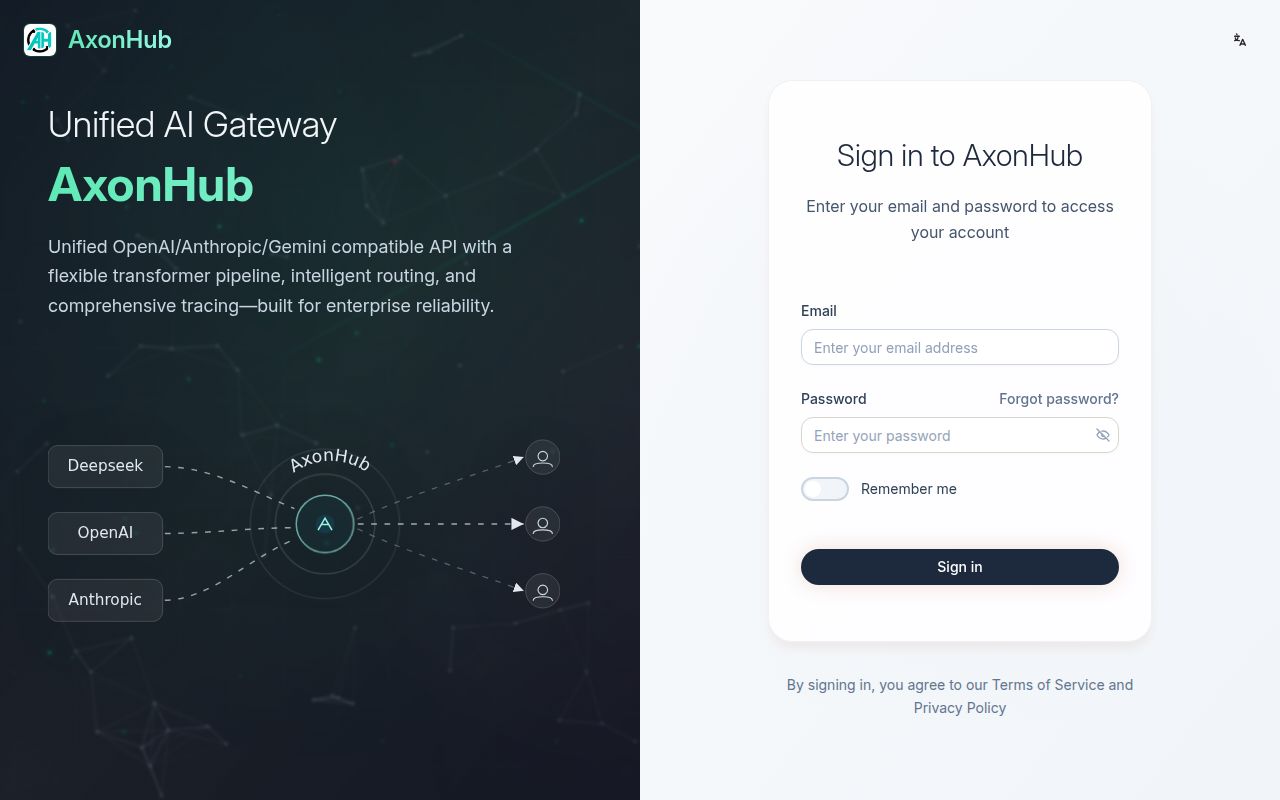
AxonHub is an open-source AI gateway written in Go. Its pitch is practical: keep an application's existing OpenAI or Anthropic SDK, point it at AxonHub, and let the gateway translate requests for supported providers. That is useful when an organization has accumulated separate integrations, credentials, dashboards, and failure behavior for each vendor. Instead of making every application team solve those concerns, AxonHub puts them in a shared service.
The repository is substantial, not a weekend proxy: our checkout contained 2,480 files and roughly 640,214 lines of source. The primary README is Chinese, with linked English and Japanese versions, so international teams have an entry point even though the project's center of gravity is clearly Chinese-speaking. The public description promises compatibility across more than 10 providers, while the feature table emphasizes SDK translation rather than forcing a new application API.
The useful part is control, not just request translation
Protocol conversion is only the opening act. AxonHub documents thread-level request tracing, fine-grained role-based access control, usage quotas, data isolation, health-aware load balancing, and per-request cost records. Those features address the operational questions that appear after a proxy works: who can use which route, what did a request cost, where did it fail, and whether a team has exceeded its budget.
The README also claims automatic failover in under 100 ms and tracking for input, output, and cached tokens. We did not benchmark those claims, so treat them as capabilities to verify, not measured guarantees. Still, their inclusion shows sensible product scope. A gateway becomes valuable when it can enforce policy and explain behavior, not merely forward JSON from one endpoint to another.
What happened when we ran it
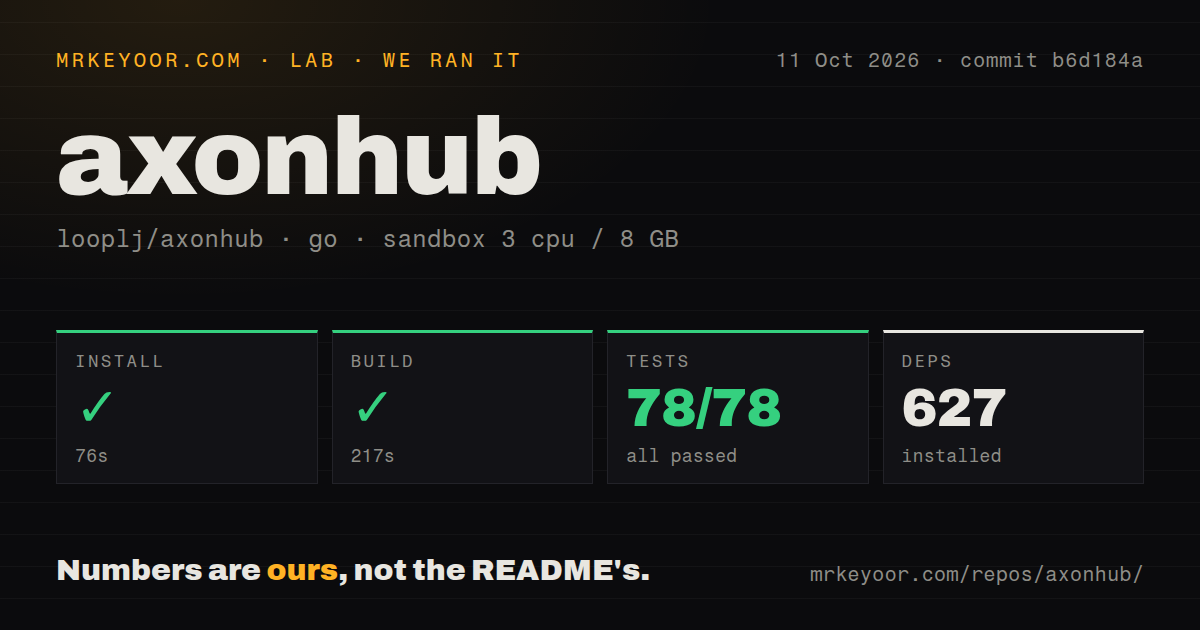
Our clean Debian sandbox had 3 CPUs and 8 GB of RAM, used the golang:1.24-bookworm image, and provided no secrets. Installation succeeded in 89 seconds and installed 627 packages. The build then completed successfully in 183 seconds. That is a reassuring baseline because the repository is large and the environment was unprivileged, although it says nothing about configuring real provider accounts or production storage.
Tests also finished cleanly: 78 passed, 0 failed, in 81 seconds. We found 9 CI workflow files, a Dockerfile, and a Compose file, all of which should make repeatable verification and container deployment easier. There was no dedicated tests directory, but go test did find and execute the 78 tests. On our box, the full install, build, and test path worked without hidden system-package failures.
That result deserves weight, but it is not a production benchmark. We did not supply provider credentials, send billed model traffic, measure the claimed failover latency, or test high concurrency. A successful compilation and unit-test run proves the checked-out commit was internally buildable on September 5, 2026. It does not prove correct token accounting, permission isolation, routing under partial outages, or recovery after database trouble.
Beta status and licensing are the main cautions
The latest release is v1.0.0-beta9, published September 3, 2026. Beta labeling is not automatically bad, but it matters for a component that can sit on every model request and cost record. Before production adoption, pin a version, review release notes, create rollback steps, and replay representative requests through both primary and failure routes. Translation edge cases around tools, streaming, files, images, or provider-specific fields can become application incidents even when basic chat requests work.
The repository reports 5,165 stars and 120 open issues. Those numbers show attention and a meaningful user base, but issue count alone cannot tell us response quality or maintainer capacity. The stronger health signal is recency: v1.0.0-beta9 arrived 2 days before this review, and the repository was pushed on September 5, the review date. This looks actively developed, not abandoned, while the issue backlog suggests adopters should inspect bugs affecting their exact providers and SDK paths.
The license field is NOASSERTION, which is a concrete procurement problem. An organization should inspect the repository's actual license files and obtain internal approval before redistribution or commercial deployment. Documentation is broad enough to earn confidence, with linked guides for APIs, tracing, permissions, load balancing, and cost tracking, but the sponsor-heavy opening and Chinese-first presentation make the initial evaluation less direct for some English-speaking teams.
It fits between applications and providers as shared infrastructure
In a real stack, AxonHub belongs behind internal applications and agents, and in front of provider APIs. Applications keep a supported SDK, while the platform team owns gateway configuration, credentials, quotas, health rules, and telemetry. Centralization can reduce duplicated integrations across 10 or more provider routes, but it also creates a critical dependency. Run more than one instance, protect the administrative plane, restrict outbound destinations, and export logs and metrics to systems operators already watch.
The best candidates are teams already feeling multi-provider pain. If one small service calls one provider, direct integration is easier to understand and operate. If many teams need controlled access to OpenAI, Anthropic, or Gemini-compatible services, AxonHub's combined translation and governance can justify the extra hop. Compare it with LiteLLM for provider breadth, Portkey's gateway for routing controls, and Helicone when observability dominates.
A staging trial is justified, a blind production switch is not
AxonHub earned a serious evaluation because our 183-second build succeeded and all 78 tests passed. Its feature set targets real platform problems, and the September 2026 activity suggests maintainers are still shipping quickly. The sensible next step is a staging proof using your actual SDK calls, including streaming, errors, quota boundaries, provider failover, and cost reconciliation. Adopt it only after those results match your requirements and the licensing question is resolved.