Agents pass events through a graph you control
Huginn breaks automation into agents. One agent watches a feed, page, mailbox, webhook, or service; another filters or reshapes the resulting event; a final agent sends a message or calls another system. The browser shows those links as a directed graph. That model is a good match for monitoring because each step has a narrow job and the intermediate events remain visible on your own server.
The README gives concrete uses: scrape pages for changes, send digest email, receive webhooks, watch RSS, query weather, and call services such as Slack, Twilio, MQTT, IMAP, and JIRA. It also lists older names, including HipChat, which is a warning to verify any connector you need. Huginn began in 2013, and a connector catalog accumulated over that span can contain both useful survivors and integrations tied to retired APIs.
Self-hosting keeps event data with you and gives you the maintenance bill
Huginn's appeal is control. Incoming payloads, scraped content, credentials, schedules, and event history can stay in infrastructure you administer. Agents can run custom JavaScript, and developers can package specialized agents as external gems through ADDITIONAL_GEMS. That is more adaptable than a closed automation menu when a workflow has an odd parser or an internal endpoint.
The cost is a Rails service plus state. A source installation needs MySQL or PostgreSQL, an APP_SECRET_TOKEN, database creation, migrations, seeded records, and Foreman. The documented development login is admin with password password, so a real deployment must replace those defaults. Email delivery needs SMTP configuration, the WeatherAgent needs a Pirate Weather key, and every service agent brings another credential and API lifecycle.
What happened when we ran it
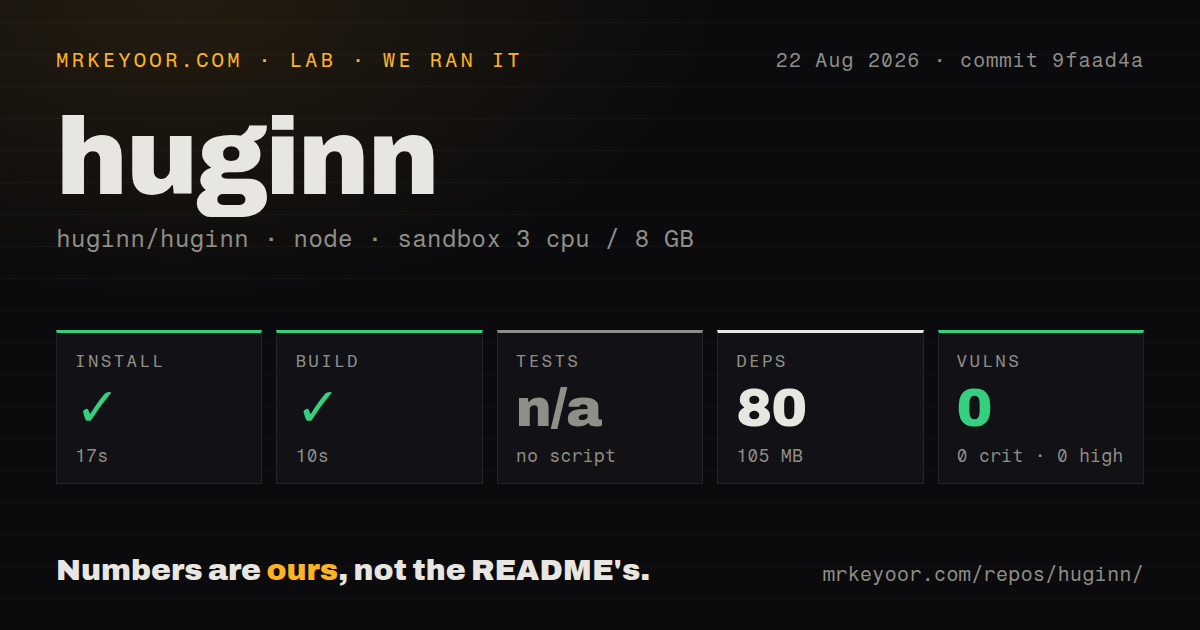
Our sandbox cloned commit 9faad4a with 3 CPUs and 8 GB of RAM. The npm install completed in 17 seconds, adding 80 packages and occupying 105 MB. The build then succeeded in 10 seconds. Npm audit found 0 known vulnerabilities across critical, high, moderate, and low severities. Those figures describe the Node target our harness detected, not a complete production deployment of the Rails service.
Tests were skipped because the measured target had no test script. That matters because the repository does contain a tests directory, and its README describes RSpec plus browser acceptance specs that require Chrome and ChromeDriver. We cannot turn the missing npm target into a claim that Huginn's own suite passes. The fair reading is narrower: install and build worked at commit 9faad4a, while application test health remained unmeasured in this run.
The checkout contained 744 files, about 53,412 lines of source, and used 5.2 MB before installed dependencies. Our scan found 2 CI workflow files and no Dockerfile at the detected root. The project nevertheless documents official container images and a Docker-based test environment. Repository signals and published deployment artifacts are different things, so an operator should inspect the image source and pin a digest before treating the quick-start command as a production recipe.
Docker gets a trial running, while production still needs state
The shortest documented trial maps port 3000 and starts ghcr.io/huginn/huginn. That is enough to open the interface and see seeded agents. The container reads configuration from environment variables rather than a local .env file. Huginn also publishes a single-process image so web and background roles can run separately and scale independently. This is useful once polling and event handling compete with browser traffic.
A container does not remove the database or upgrade work. Production needs durable MySQL or PostgreSQL storage, backups, SSL, secret rotation, and monitoring for agents that stop producing events. The README recommends its Docker container or a paid 1 GB Heroku plan for nonexperimental use. That memory recommendation comes from the project documentation, not our Node build measurement, and buyers should size from their own agent count and payload volume.
A 2022 release tag does not mean the repository stopped moving
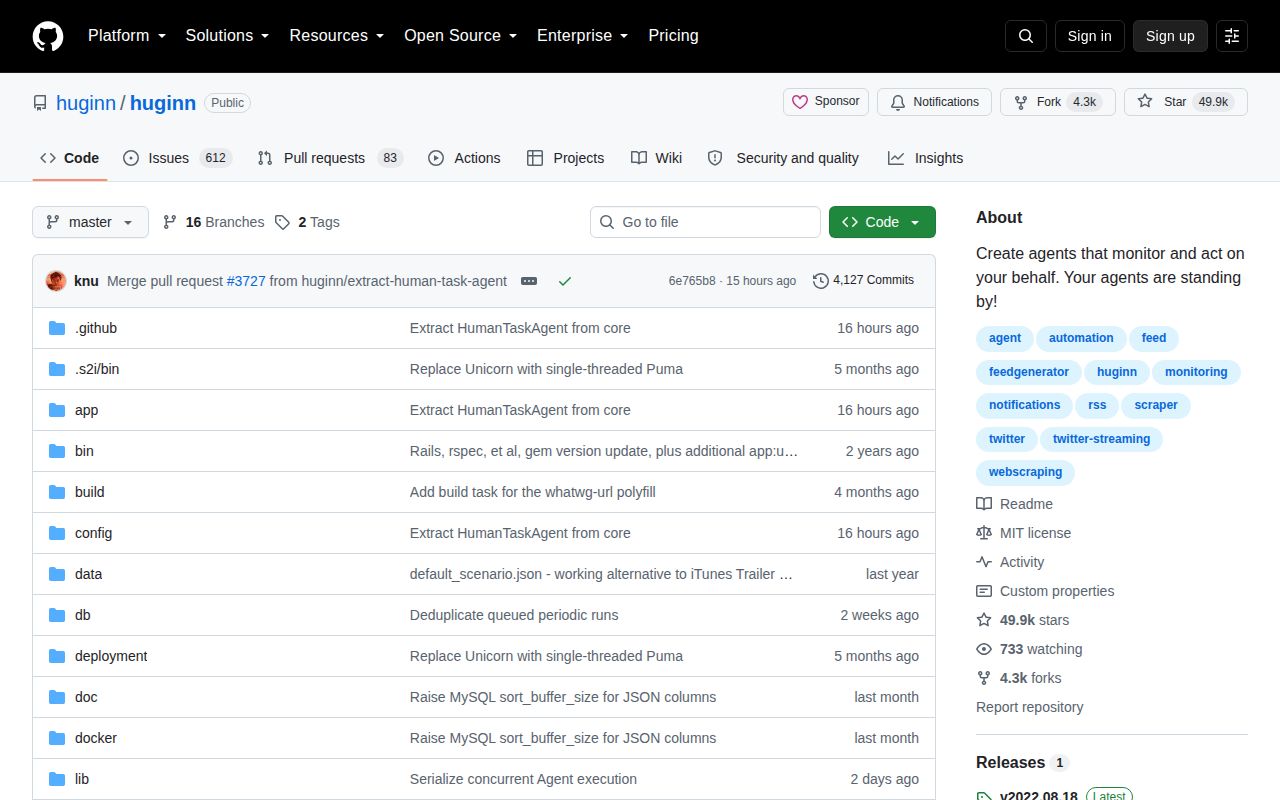
GitHub showed 49,858 stars, 695 combined issues and pull requests, and a last push on August 26, 2026. The latest GitHub release remains v2022.08.18, published on August 18, 2022. Current repository activity therefore contradicts a simple abandonment claim, while the old tag still makes version selection and changelog reading less convenient for operators who deploy releases rather than branch commits.
Recent activity includes dependency tracking and proposed service agents. The open queue also contains pull requests that are years old, so its size says little about current defect volume. Check the exact agent you plan to use: confirm its latest code, API assumptions, open reports, and credential model. Huginn's architecture can remain sound while a single integration quietly becomes the weak link.
Huginn suits monitoring better than broad business automation
The graph and event model are clearest when inputs arrive repeatedly and rules decide whether to act. Website-change alerts, feed routing, webhook processing, and scheduled digests fit naturally. A developer can inspect emitted events and write a custom agent when parsing gets specific. MIT licensing also gives teams room to modify and redistribute the system without adopting a source-available commercial license.
For a sales or operations department seeking hundreds of maintained SaaS connectors, Huginn asks too much. The 17-second install does not account for Rails, database operations, secrets, or connector upkeep. N8n and Activepieces put more effort into current visual automation, while Windmill is a better fit when scripts are the primary unit. Pick Huginn because you want its self-hosted agent graph, not because it looks like a free copy of every hosted automation product.