The 10-step workflow makes the agent inspect its own scene
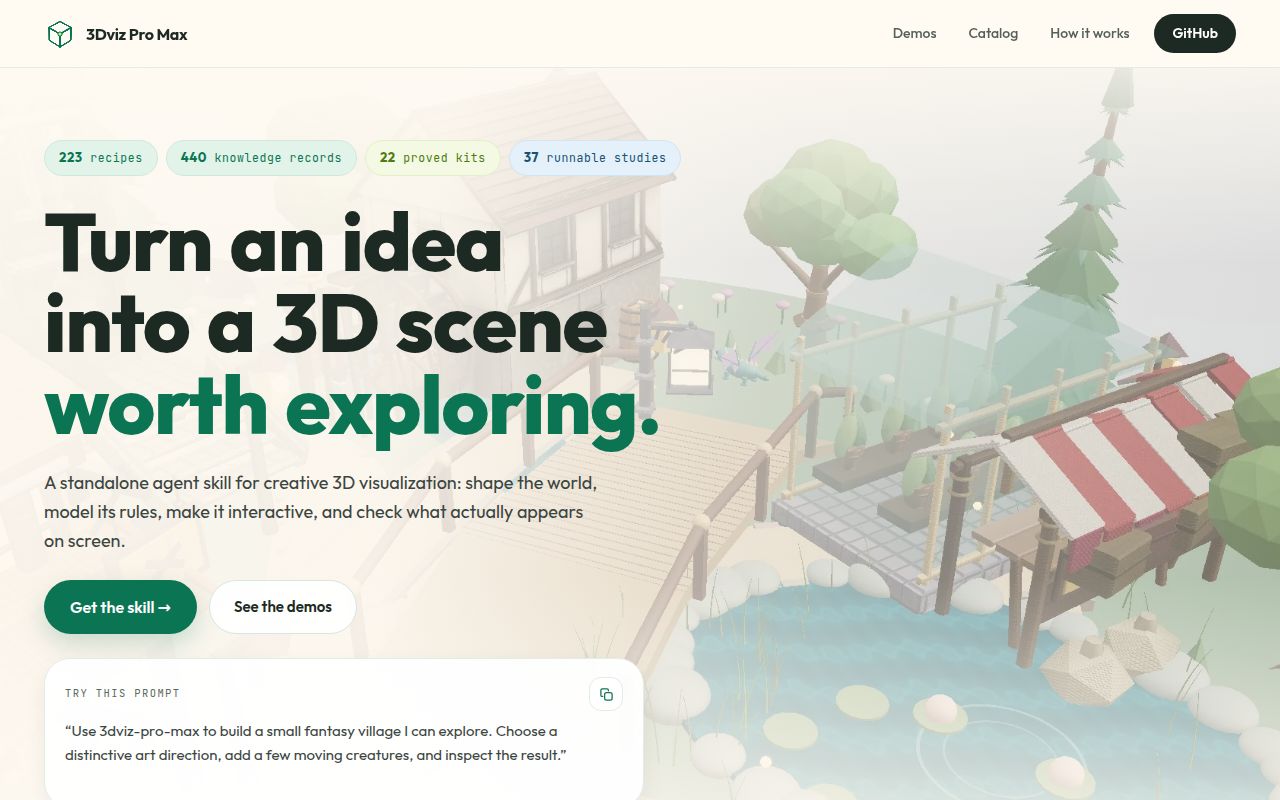
3Dviz Pro Max is an instruction and resource package for coding agents. Its 10-step process starts with intent and object reasoning, moves through construction and meaningful behavior, then requires the agent to run the artifact and inspect real views. The strongest rule is simple: never describe an unobserved frame. That makes this useful for 3D work, where valid source code can still produce a blank canvas, hidden controls, or a camera pointed at nothing.
The skill leaves the renderer choice to the project. Three.js handles procedural geometry, interaction, and browser output; Blender can handle modeling, rigging, UV work, or baked assets when it fits. The agent is told to preserve the existing stack, research technical claims, and separate a moving illustration from a physical simulation. This is closer to an experienced review checklist with reusable parts than an automatic scene generator.
What happened when we ran it
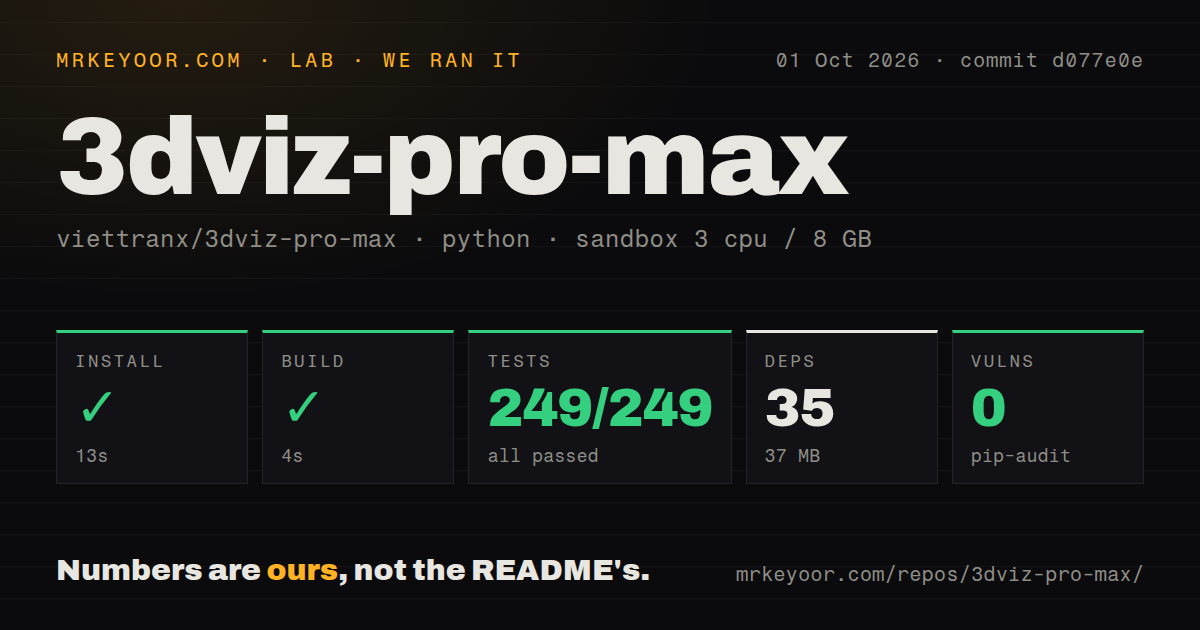
Our fresh Debian sandbox installed commit d077e0e in 13 seconds, adding 35 packages and consuming 37 MB on disk. The build succeeded in another 4 seconds. Pip-audit found 0 known vulnerabilities. The checkout contained 2,112 files, about 41,682 lines of source, and occupied 85.7 MB before installation. Two CI workflow files and a tests directory were present; there was no Dockerfile.
Pytest completed in 152 seconds with 249 passed, 0 failed, and 12 skipped. That is the cleanest test result in this batch, and it covers repository helpers for capture, packaging, search, kit records, tiers, evidence, and validation. It does not score artistic quality or prove that a generated scene works in your agent host. The project itself draws that boundary, which is more reassuring than pretending structural tests can judge composition.
The catalog supplies 223 recipes and 22 kit blueprints
The repository reports 223 recipes, 440 knowledge records, 22 kit blueprints, and 37 runnable studies. Those numbers matter because an agent can retrieve a relevant starting point for a gear pair, heart cutaway, pathfinding diagram, architectural scene, or lighting study instead of improvising every convention. The kit blueprints pair records with modules and captured views, while style profiles carry concrete starting values for cameras, lighting, materials, motion, and post-processing.
Coverage is broad, but the README is unusually direct about what the catalog does not prove. A recipe can explain how to model a subject without having been rendered. Knowledge records are editorial guidance rather than runtime observations. Of the 22 kits, 18 reached the T2 browser-material tier, two shipped T3 Blender bakes, and none shipped T4. That accounting helps you choose a starting point without mistaking a folder name for visual evidence.
Version 0.1.0 installs by copying the whole skill folder
The safest installation route is manual: copy skills/3dviz-pro-max/ into a host-recognized skill directory and restart discovery. Copying only SKILL.md breaks the relative data, references, scripts, and templates it expects. Claude Code can also load the repository or packaged ZIP as a plugin. The manifests identify version 0.1.0, yet GitHub had no tags or release objects when checked.
Distribution remains the weak link. Claude Code manifest validation and a headless --plugin-dir load were recorded on macOS, but marketplace install, update, and removal were not exercised. Codex is named as the first evaluation target, while actual Codex app installation and marketplace discovery remain untested. Teams should pin a commit, record the copied folder, and run the supplied recognition prompt before asking for a scene.
Frame capture needs Playwright plus a Chromium download
The optional capture.py helper opens a built scene, waits for its readiness flag, visits named views, clicks requested controls, saves PNG files, and records console output. Installing the Python package alone is insufficient: Playwright also needs its matching Chromium download. Without it, the helper exits with code 3 and the agent is required to report that no frame was observed. That failure mode is exactly right.
Blender is optional. Version 4.2 LTS or newer is recommended for the helper that bakes a T3 hero GLB, but a missing binary returns an unavailable status instead of claiming success. A browser-only project can still use T2 materials and occlusion. The useful promise is process discipline: build, open, inspect, correct, and state what could not be checked.
A September 11 push leaves distribution newer than adoption evidence
GitHub showed 627 stars, one open issue, and a last push on September 11, 2026, one day after the initial public release. The repository had two workflow files and a thorough 249-test pass in our run, but its public history was only weeks old. The lone open issue describes a successful third-party AutoClaw task; it is feedback, not a broad compatibility program.
Licensing also needs a per-asset read. The project's own code and authored data use MIT, BodyParts3D anatomy geometry keeps its CC BY-SA 2.1 Japan terms, and the README says rights for the historical Harness Village recording remain unconfirmed. Use the skill for new scene work with your own assets and sources. Do not treat the repository's MIT badge as permission covering every file shown in its demos.