scikit-learn review
scikit-learn supplies estimators and workflow tools for classification, regression, clustering, dimensionality reduction, preprocessing, model selection, and evaluation. Its fit, transform, and predict conventions let Pipeline and ColumnTransformer apply the same learned preprocessing during cross-validation and production inference. Version 1.9.0 requires Python 3.11. Our sandbox showed why this is not a light utility: the compiled installation occupied 204 MB across six packages and imported in 2.84 seconds.
For classical ML on in-memory tabular data, this is the library, and its Pipeline/cross-validation design quietly teaches correct methodology. Know its edges: no serious deep learning, no GPU story, and datasets beyond RAM push you to other tools.
We installed it
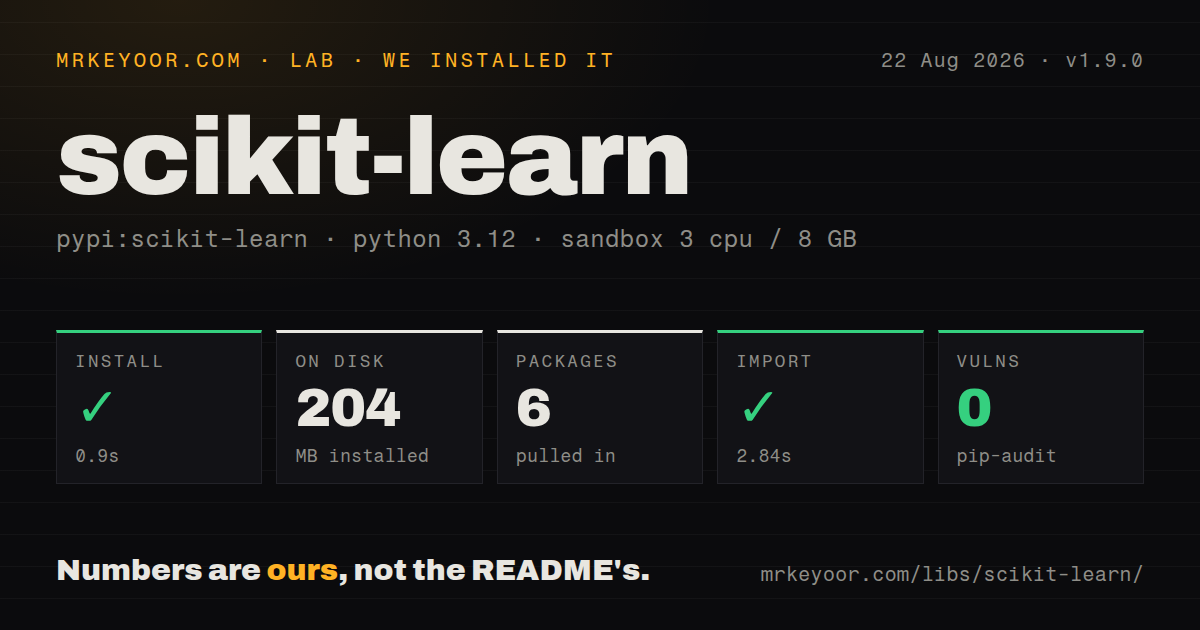
| Install | ✓ · 0.9s | 6 packages on disk · 204 MB |
| Import | ✓ | import sklearn in 2.84s · compiled extensions · py.typed · requires Python >=3.11 |
| Known vulns | 0 | (pip-audit) |
Answers from our run
Does scikit-learn install cleanly?
Yes. In a fresh container with an empty cache, pip install scikit-learn finished in 0.9s, leaving 6 packages and 204 MB on disk. pip-audit reported no known vulnerabilities.
What does scikit-learn need to run?
Python >=3.11, and a platform wheel with compiled extensions. In our run import sklearn succeeded in 2.84s, and the package ships py.typed for type checkers.
scikit-learn or xgboost: which should you use?
xgboost: Gradient-boosted trees on medium-to-large tabular data where leaderboard accuracy matters. For classical ML on in-memory tabular data, this is the library, and its Pipeline/cross-validation design quietly teaches correct methodology.
When should you not use scikit-learn?
Your problem is deep learning (images, audio, text embeddings, transformers); that is torch territory, scikit-learn deliberately does not do neural networks beyond a basic MLP
Discussed on
- hnScikit-Learn Version 1.0260 points
- hnDive into Machine Learning with Jupyter and Scikit-Learn204 points
- hnIntel Extension for Scikit-Learn183 points
- hnShow HN: Subreddit classifier using scikit-learn and a high-performance Go proxy170 points
- hnMachine Learning Cheat Sheet (for scikit-learn)158 points
Use it if
- You are doing classical ML on tabular data that fits in memory; for that job its breadth and API consistency are unmatched
- You want leak-free workflows: Pipeline plus ColumnTransformer plus cross_val_score encode the correct methodology so preprocessing is fit only on training folds
- You are learning ML; the user guide teaches the statistics behind each method, not just the function signatures, and is one of the best free ML texts anywhere
- You need a solid baseline before reaching for anything fancy; a Pipeline with LogisticRegression or RandomForest is the honest benchmark every deep model should beat
- Your problem is deep learning (images, audio, text embeddings, transformers); that is torch territory, scikit-learn deliberately does not do neural networks beyond a basic MLP
- Your data does not fit in RAM; the API is built around in-memory arrays, and out-of-core support is limited to the minority of estimators with partial_fit
- You need GPU training; scikit-learn is CPU-oriented, and for large gradient-boosted models xgboost or lightgbm will train faster and often score better on tabular data
- You need statistical inference (p-values, confidence intervals, model diagnostics); statsmodels exists precisely because scikit-learn optimizes for prediction, not inference
- You must serve models across environments long-term; pickled models are not guaranteed to load across scikit-learn versions, so version pinning becomes a production constraint
Setup reality
Our fresh Python 3.12 installation of scikit-learn 1.9.0 finished in 0.9 seconds. Six packages used 204 MB, pip-audit found no known vulnerabilities, and import sklearn took 2.84 seconds. Package metadata reports 58 direct dependencies, including optional groups, and requires Python 3.11 or newer. The wheel contains compiled .so extensions and py.typed. Its measured metadata did not identify a license.
Use wheels unless you intentionally maintain the native build toolchain. NumPy, SciPy, BLAS, OpenMP, and process-level parallelism can compete for the same CPU cores; n_jobs=-1 inside several worker processes often oversubscribes a host. Control estimator jobs and BLAS thread counts together. Plotting examples require optional visualization packages, while pandas or Polars inputs bring their own conversion and dtype concerns.
Put learned preprocessing inside Pipeline or ColumnTransformer. Scaling, imputation, encoding, feature selection, and resampling performed before a train/test split leak information and make validation scores optimistic. Set random_state where supported, choose stratified or grouped splits that match deployment, and use a metric appropriate for imbalance. Sparse output can become dense when combined transformers cross a threshold, producing a sudden memory jump on wide categorical data.
Saved estimators are executable pickle-style artifacts and must come from a trusted source. The project does not guarantee loading across scikit-learn versions, so store the package versions, training code, feature order, and data contract beside each artifact. Most estimators expect in-memory arrays and CPU execution. partial_fit exists only on selected algorithms; it does not turn arbitrary pipelines into distributed or out-of-core training.
Patterns
Split data, train, and score a first model train-evaluate
from sklearn.model_selection import train_test_split
from sklearn.ensemble import RandomForestClassifier
from sklearn.metrics import accuracy_score

X_train, X_test, y_train, y_test = train_test_split(
    X, y, test_size=0.2, random_state=42, stratify=y
)
clf = RandomForestClassifier(n_estimators=300, random_state=42)
clf.fit(X_train, y_train)
print(accuracy_score(y_test, clf.predict(X_test)))
stratify=y keeps class proportions equal across the split; forgetting it skews evaluation on imbalanced data.
Chain preprocessing and a model in a Pipeline pipeline
from sklearn.pipeline import make_pipeline
from sklearn.preprocessing import StandardScaler
from sklearn.linear_model import LogisticRegression

model = make_pipeline(StandardScaler(), LogisticRegression(max_iter=1000))
model.fit(X_train, y_train)
model.predict(X_test)
The scaler is fit on training data only and reused at predict time, which is exactly the data leak you cause by scaling before splitting.
Preprocess numeric and categorical columns differently mixed-columns
from sklearn.compose import ColumnTransformer
from sklearn.preprocessing import OneHotEncoder, StandardScaler
from sklearn.pipeline import make_pipeline
from sklearn.linear_model import LogisticRegression

pre = ColumnTransformer([
    ('num', StandardScaler(), ['age', 'income']),
    ('cat', OneHotEncoder(handle_unknown='ignore'), ['city', 'plan']),
])
model = make_pipeline(pre, LogisticRegression(max_iter=1000))
model.fit(X_train, y_train)
handle_unknown='ignore' stops predict from crashing when a category unseen in training shows up in production data.
Get an honest score with cross-validation cross-validation
from sklearn.model_selection import cross_val_score

scores = cross_val_score(model, X, y, cv=5, scoring='f1_macro')
print(scores.mean(), scores.std())
Cross-validate the whole pipeline, not just the estimator, or preprocessing leaks information across folds.
Tune hyperparameters with GridSearchCV hyperparameter-search
from sklearn.model_selection import GridSearchCV

param_grid = {
    'randomforestclassifier__n_estimators': [100, 300],
    'randomforestclassifier__max_depth': [None, 10, 30],
}
search = GridSearchCV(model, param_grid, cv=5, n_jobs=-1)
search.fit(X_train, y_train)
print(search.best_params_, search.best_score_)
best = search.best_estimator_
Pipeline parameter names use the step name plus double underscore; RandomizedSearchCV covers big grids at a fraction of the cost.
See per-class performance, not just accuracy classification-metrics
from sklearn.metrics import classification_report, confusion_matrix

y_pred = model.predict(X_test)
print(confusion_matrix(y_test, y_pred))
print(classification_report(y_test, y_pred))
On imbalanced data accuracy flatters bad models; read the per-class recall rows before believing any headline number.
Persist a trained model with joblib save-model
import joblib

joblib.dump(model, 'model-v1.joblib')

# later, in the serving process
model = joblib.load('model-v1.joblib')
model.predict(X_new)
Loads are only guaranteed with the same scikit-learn version that saved the file; pin the version and record it alongside the artifact.
Get probabilities and set your own threshold predict-probabilities
proba = model.predict_proba(X_test)[:, 1]  # P(class 1)

custom_threshold = 0.3  # favor recall over precision
y_pred = (proba >= custom_threshold).astype(int)
predict() hard-codes a 0.5 threshold; cost-sensitive problems almost always want a different operating point.
Rank features with permutation importance feature-importance
from sklearn.inspection import permutation_importance

result = permutation_importance(model, X_test, y_test, n_repeats=10, random_state=42)
for idx in result.importances_mean.argsort()[::-1][:10]:
    print(X_test.columns[idx], round(result.importances_mean[idx], 4))
Prefer this over tree feature_importances_, which inflates high-cardinality features; run it on held-out data, not training data.
Cluster unlabeled data with k-means clustering
from sklearn.preprocessing import StandardScaler
from sklearn.cluster import KMeans

X_scaled = StandardScaler().fit_transform(X)
km = KMeans(n_clusters=4, n_init='auto', random_state=42)
labels = km.fit_predict(X_scaled)
k-means uses Euclidean distance, so unscaled features let the widest-ranged column dominate the clustering.
Reduce dimensions with PCA dimensionality-reduction
from sklearn.decomposition import PCA
from sklearn.preprocessing import StandardScaler
from sklearn.pipeline import make_pipeline

pca = make_pipeline(StandardScaler(), PCA(n_components=0.95))
X_reduced = pca.fit_transform(X_train)
print(pca.named_steps['pca'].n_components_)
n_components=0.95 keeps enough components for 95 percent of variance; transform test data with the fitted pipeline, never refit.
Impute missing values inside the pipeline handle-missing-values
from sklearn.impute import SimpleImputer
from sklearn.pipeline import make_pipeline
from sklearn.ensemble import HistGradientBoostingClassifier

model = make_pipeline(
    SimpleImputer(strategy='median'),
    HistGradientBoostingClassifier(random_state=42)
)
model.fit(X_train, y_train)
Most estimators raise on NaN, so impute in-pipeline; HistGradientBoosting models are the exception and handle NaN natively.
Alternatives
| Package | Registry | Pick it when |
|---|---|---|
| xgboost | PyPI | Gradient-boosted trees on medium-to-large tabular data where leaderboard accuracy matters |
| lightgbm | PyPI | Boosted trees with faster training and lower memory on large datasets |
| statsmodels | PyPI | You need p-values, confidence intervals, and classical statistical inference, not just predictions |
| torch | PyPI | Deep learning on images, text, or audio, or anything that needs GPUs and custom architectures |
More ai / ml guides
openai · mcp · huggingface-hub · @modelcontextprotocol/sdk · tiktoken · langchain · the whole shelf →
How this guide is made: grounded in the library's documentation, release notes, changelog, and issue history, on a fixed rubric — not a hands-on install of every release. The 50 most-downloaded entries are additionally install-verified in clean containers. Corrections: contact the desk.