Short answer
The Windows reporter in issue #19 found 403 reference-only matches in a cached copy of the scanner itself. That is the reason to read this tool's evidence grades before its headline count. Use the newer Zero Breach Toolkit if you want a guided check of published spyware traces and can act on coverage warnings. Skip a self-check if you suspect active targeting and need an expert's assessment. Our sandbox attempt stopped before scanner execution. Cached-source report
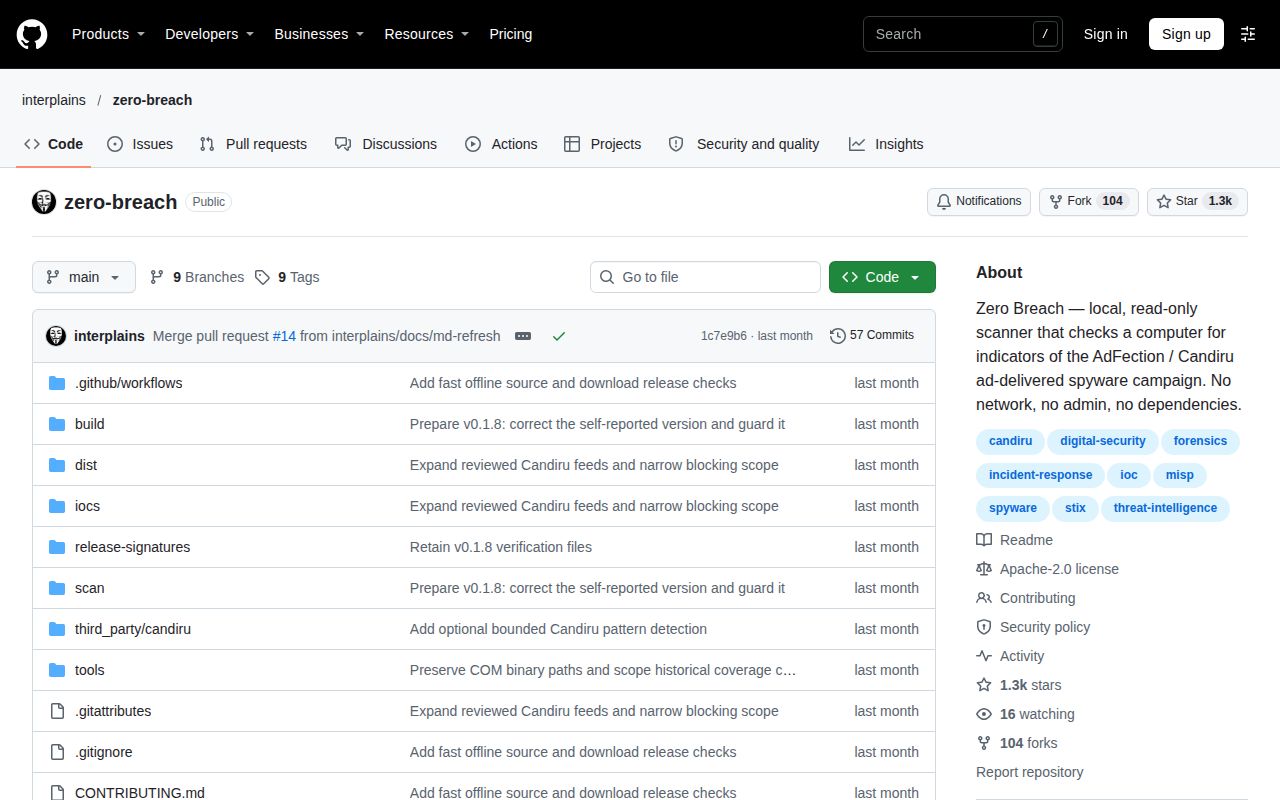
Zero Breach is the original computer scanner at interplains/zero-breach, focused on AdFection/Candiru. Zero Breach Toolkit is the broader successor at interplains/Zero-Breach-Toolkit, covering computers and phone evidence. The maintainer explicitly directs users of the old repository to fixes in the Toolkit. Choose the repository before choosing a download: a fix announced in a closed issue here may belong to the successor. Maintainer's repository clarification
The governing question is whether the report helps you make a sound decision. Finding an indicator string, finding evidence of contact and finding an infected device are different conclusions. This review follows those distinctions through actual user reports, the release history and our blocked lab attempt.
What people use zero-breach for
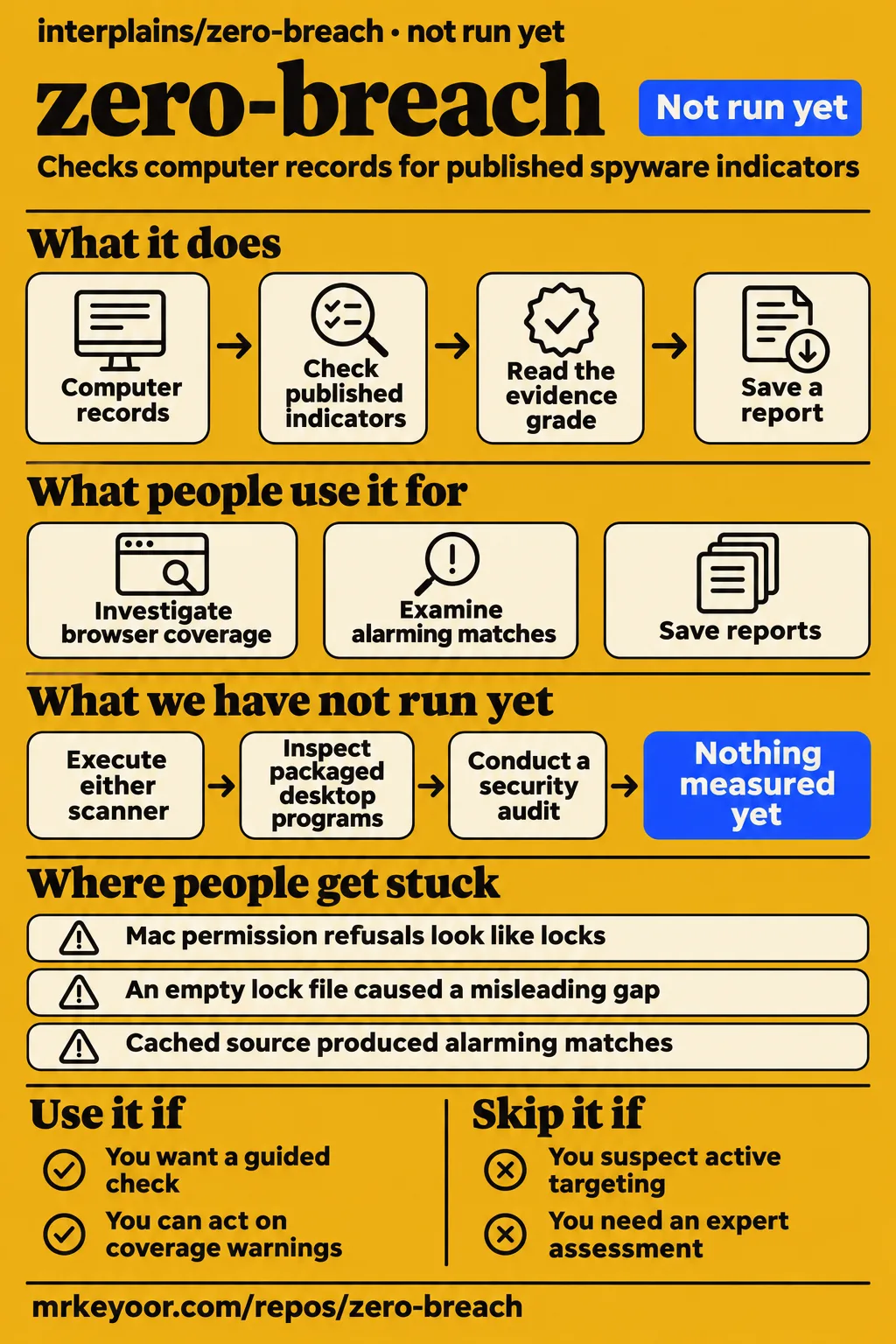
Users have used the scanner to investigate browser coverage, examine alarming matches and save reports for further interpretation. These are attributed experiences, rather than results from our sandbox.
| Who used it | What they did | What happened |
|---|---|---|
| GitHub user imadabulibda | Investigated missing browser coverage on a Mac | Granting Terminal access let a rerun discover two Chrome profiles and read six browser databases. Issue #16 |
| GitHub user csppg25 | Scanned with Chrome open, then built a fork | An empty LevelDB LOCK file caused a misleading gap; the maintainer says Toolkit v0.1.9 incorporated the fix. Issue #18 |
| The Windows reporter of issue #19 | Scanned after viewing or downloading the scanner through Chrome | The scanner's cached indicator list produced reference-only matches, with no evidence of connections to those hosts. Issue #19 |
| The contributor proposing issue #20 | Built a desktop wrapper | They reported opening the Mac app, running a check, reading the result and saving a report. Windows packaging was prepared but personally untested. Issue #20 |
The Mac permission report is especially useful because the first explanation was wrong. Chrome was closed, yet the scanner said a browser was running. The same message named browsers that were not installed. Giving Terminal access changed the outcome. For a reader, the lesson is practical: an access failure needs an access remedy, and repeatedly closing Chrome would not have addressed this report. The maintainer says Toolkit v0.1.9 separated permission refusals from actual locks. Mac report and response
The GUI contribution answers a different question: could someone avoid the terminal workflow? Its author reported a working Mac prototype, not a completed Windows trial. The maintainer closed the duplicate proposal in the original repository and redirected discussion to the Toolkit. The current Toolkit README separately offers packaged desktop programs; that later documentation should not be confused with what this contributor personally exercised. GUI proposal · Toolkit downloads
What happened when we ran it
Our November 16, 2026 sandbox attempt at commit 1c7e9b6 did not run the scanner: the harness lacked a supported Python ecosystem path, and the checkout had no Dockerfile. The recorded sandbox allocation was 3 CPUs and 8 GB RAM. These describe the attempted environment, not a measured resource requirement.
| Recorded part of our attempt | Result | Meaning for this review |
|---|---|---|
| Source checkout | commit 1c7e9b6, November 16, 2026 | Identifies the code selected for the attempt |
| Harness execution | NOT RUN: unsupported ecosystem, Python; no Dockerfile | No scanner output or installation result |
| Compose safety step | FAILED: no compose.yaml, compose.yml, docker-compose.yaml or docker-compose.yml | The lab's Compose prerequisite blocked that route |
| Teardown | ok | Cleanup completed, not a successful scan |
The safety record labels the checkout unsafe because its rule requires a Compose file. That is a harness admission decision, not a security verdict on the scanner. The precise failure is absence of the named files. It supplies no basis for diagnosing a Python package conflict or a product crash. Compose safety record · Teardown record
One generic run record says the project was deployed with its own Docker Compose. That sentence conflicts with the failed prerequisite and the explicit NOT RUN measurement. It is not evidence of a completed deployment. The usable finding from our attempt is the execution boundary above. There is no elapsed installation time, passing-test total or scan result to turn into a recommendation.
Where people get stuck: coverage and alarming wording
The issue history shows two distinct traps: unreadable evidence can look like a browser lock, and readable saved content can look alarming even when the scanner correctly labels it a reference. Diagnose the reported artifact before treating the summary as an incident.
| Symptom | What the record says | Documented response |
|---|---|---|
| A closed or absent browser is called running | imadabulibda reported a Mac permission refusal | Toolkit v0.1.9 distinguished permissions from locks and supplied Mac privacy guidance. #16 |
| Chrome looks incompletely scanned while open | csppg25 found an empty LevelDB LOCK sentinel | Toolkit v0.1.9 skipped empty LOCK files while keeping checks for files containing data. #18 |
| Hundreds of references dominate the verdict | A Windows user found the scanner's source in Chrome's cache | The maintainer reported clearer reference-only summaries in Toolkit v0.1.12; the supplied response leaves further grouping work pending. #19 |
| The menu gives choices without a recommendation | The issue #21 reporter could not decide what to do next | The maintainer says version 2 added result-specific next steps. #21 |
In the cached-source case, the reporter compared the cache file with the downloaded scanner and found identical bytes. The embedded indicator list explained the matches. The original classification was REFERENCED, so the bug was how the result read, rather than a claim that the engine had proved infection. The maintainer's response describes improved wording in the successor. It does not justify saying that every proposed reporting improvement shipped. Evidence and response in issue #19
Read the grade and location together. A name in saved page content means something different from a connection record, while a known spyware-file fingerprint warrants a different response again. The Toolkit's interpretation guidance explicitly separates references, historical records, configuration, contact and file-content matches. Counting weak matches cannot replace that reading. Interpretation contract
Security: a released fix matters more than a reassuring label
GitHub user okba14 confirmed that the signed v0.1.7 artifact used system PowerShell and did not execute a planted powershell.exe. That is concrete, bounded trust evidence: a reporter demonstrated a failure, the maintainer changed the executable path and working directory, and the reporter exercised the released artifact. PowerShell report
The original Windows calls used PowerShell's bare executable name. A local attacker controlling a searched location could substitute a program, execute code with the scanner user's privileges and forge scan results. The report explicitly excluded remote exploitation and privilege escalation. Preserve that scope: calling this a remote takeover flaw would misstate the evidence just as much as ignoring it. The fix pinned the interpreter to its absolute System32 path and used a controlled working directory. Issue #7 and released mitigation
The reporter also noticed that the v0.1.7 single-file download called itself 0.1.6. The issue thread alone leaves that discrepancy hanging. The original repository's v0.1.8 release notes separately say the self-reported version was corrected. This is a useful reason to keep artifact identity, signature checks and displayed version separate when investigating an older result. Original v0.1.8 release
Offline scanning also needs a precise scope. The Toolkit's guidance separates scans from updates and Android collection. Version 3 adds an online file lookup that asks permission, and its separate doors feature can change some settings after asking, with a reversal path. A scanner's read-only promise cannot describe every action in that larger application. Decide which operation you are authorizing before pressing its button. Scope guidance · Version 3 features
The release history changes which results deserve confidence
Toolkit 2.0.3 asks users to repeat green phone checks from 2.0.0, 2.0.1 or 2.0.2. Those versions could show green when no usable phone evidence had been read, including an empty folder or damaged input. This is a specific action for an affected reader, not a general warning about all scanner results. 2.0.3 correction
Later corrections also show why a dated download matters. Release 2.0.3 fixed an undefined feeds error displayed after indicator updates, even though the lists had updated. Release 2.0.4 corrected a false Mac out-of-date warning caused by parsing a vulnerability-record date as a version, and removed a leftover Windows terminal whose closure could end the GUI-started check. These are upstream release reports, rather than failures encountered on our box. 2.0.3 notes · 2.0.4 notes
The supplied release listing identifies Toolkit 3.0.2 as the latest release and dates it November 14, 2026. Its notes report small-screen layout fixes and a Mac permission wait that no longer holds up a check. English readers have English documentation, while the Toolkit README advertises desktop apps in 27 languages. The release history gives reasons to choose a recent artifact, rather than assuming the original repository's older download contains these changes. Release listing · Toolkit README
Social attention is a different sort of record. On X, shushant_l included Zero-Breach-Toolkit in a list of starred repositories. That post reports attention, not a scan outcome. Elite Performance Exclusive did something narrower and more useful: its reviewer downloaded 0.1.10, reported a matching checksum and inspected network-related code. Keep that review tied to its release snapshot. X list · Independent review
Zero-breach vs MVT and the newer Toolkit
MVT is intended for technologists and investigators doing mobile forensics, while the newer Toolkit offers a guided desktop route and computer checks. Choose according to the evidence you have and the person interpreting it. MVT README · Toolkit README
| Choice | Why choose it | Decision boundary |
|---|---|---|
| Original Zero Breach | A readable scanner focused on AdFection/Candiru computer evidence | Use it for that specific scope, keeping its release separate from Toolkit fixes. Original repository |
| Zero Breach Toolkit | Guided desktop apps, computer checks and phone-evidence workflows | The maintainer directs users here for broader coverage and later fixes. Toolkit |
| Mobile Verification Toolkit | Mobile forensic utilities for an investigator | Its README explicitly says it is not intended for end-user self-assessment. MVT |
| Updates and stronger account authentication | The independent review prioritizes these for people without elevated targeting risk | Routine maintenance is a better first action than chasing a reassuring scan. Review's advice |
| A digital-security helpline | The Toolkit recommends expert help first for suspected active targeting | Asking for help does not require completing this scanner first. Project guidance |
MVT's own warning is relevant whichever route you choose: public indicators are insufficient to determine that a device is clean. A friendlier window changes access to the workflow, not the completeness of published threat intelligence. If someone on your team already interprets mobile acquisitions, use their established process. If you need a guided first look at a computer, evaluate the Toolkit's supported desktop path. MVT's indicator warning
What the other reviews get wrong
Elite Performance Exclusive's description of the Toolkit as three days old belongs to its 0.1.10 review snapshot. The supplied release record already reaches 3.0.2. Its checksum and code-reading observations remain attributed observations about the earlier release; the age description should not follow the product indefinitely. Earlier review · Later releases
Exposing Israel's introductory video says Python is required and presents the tool as never going online. Its transcript introduces the toolkit and investigation workflow, rather than furnishing a detection benchmark. The current README offers packaged desktop use without Python or commands. The scan's offline behavior also needs to be distinguished from updates, collection and the optional version 3 online lookup. Introductory video · Desktop route · Separate operations
Two current descriptions need historical or functional boundaries too. Read-only applies to scanning evidence, while the separate doors action can alter settings with consent. And today's cautious clean-result wording does not erase the older phone-verdict defect corrected in 2.0.3. For an affected user, repeating that phone check matters more than a general reassurance about the project's intentions. Version 3 scope · Phone-result correction
Questions people ask
Zero-breach is the original AdFection/Candiru computer scanner on GitHub; Zero Breach Toolkit is its broader successor, where the maintainer directs users for newer fixes. Repository clarification
What is zero-breach, and where is its GitHub repository?
The original project is interplains/zero-breach; the broader project is interplains/Zero-Breach-Toolkit. Follow the latter for the packaged Toolkit and the later fixes discussed here. This distinction also separates the software from unrelated companies and cloud-security slogans sharing its name. Original GitHub repository · Toolkit GitHub repository
Is Zero Breach Toolkit real and safe to run?
It is a real open-source project with downloadable releases and a documented security-fix history. That history includes okba14's confirmation of the released PowerShell mitigation. Assess the exact artifact and intended operation, rather than treating the name or a signature as a blanket safety judgment. Released-artifact check
Does Zero Breach Toolkit send my data anywhere?
Scanning is designed to work offline; updates and Android collection are separate operations. Version 3 also offers a file lookup online only with permission. Choose the scan operation when you want local analysis, and treat enabling an online feature as a separate decision. Operation boundaries · Optional lookup
How does Zero Breach Toolkit compare with MVT?
MVT targets mobile forensic work by technologists and investigators. The Toolkit adds a guided desktop interface and computer checks. MVT explicitly discourages end-user self-assessment, so its longer history should not be mistaken for an easier path for a worried beginner. MVT README · Toolkit scope
Can Zero Breach Toolkit detect Pegasus?
The Toolkit says it checks for published traces of Pegasus and other known mercenary spyware. A match needs interpretation according to its evidence grade. A no-match result means none of the loaded indicators appeared in the checked records, not that every possible spyware infection was excluded. Published scope · Interpretation guidance
Who needs a spyware check, and is Zero Breach Toolkit right for me?
The project directs people who suspect active targeting to expert help first, including Access Now's helpline or Amnesty's Security Lab. For a lower-risk reader, the independent review prioritizes updates and stronger sign-in. Choose a scan because it answers an evidence question, rather than expecting it to settle every security concern. Project advice · Independent advice
Why use a specialized spyware triage tool instead of a standard antivirus scan?
This scanner examines local records for published campaign indicators and explains the evidence grade and unreadable areas. That is the specific task to choose it for. Its documented workflow includes historical and reference evidence that must be interpreted in context, rather than a promise to replace the rest of your security tools. Evidence interpretation
Why does the scanner say my browser is running when it is closed or not installed?
Issue #16 traced that wording on a Mac to permission refusals, including checks involving browsers that were absent. The maintainer says Toolkit v0.1.9 corrected the distinction. Use that version history and the report's access details before assuming another browser process is responsible. Mac permissions issue
Do hundreds of indicator matches mean I am infected, or could they come from cached scanner source?
They can come from cached scanner source: the issue #19 reporter demonstrated exactly that on Windows. All reported matches were references to the embedded list. Read the artifact and evidence grade before treating the count as contact with spyware infrastructure. Cached-source evidence
What should I do after a scan, and how do I save a dated report?
The maintainer's issue #21 response recommends saving the readable report first and says supplying a folder produces a dated filename. Version 2 added next steps tailored to the result. Use the minimal sharing summary when seeking interpretation, and keep the full evidence private unless you authorize sharing. Saving guidance · Privacy guidance
How should packaged apps be released so users can verify and trust them?
The Toolkit documents release checksums, detached signatures and public build records. In issue #18, the maintainer rejected treating a hash file beside the executable as tamper protection because both files could be replaced together. Use the documented external trust checks for the selected release. Trust discussion · Current release checks
Should a contributed desktop GUI live in the main repository or a companion repository?
The supplied issue #20 response redirects the duplicate proposal to the Toolkit repository's issue #23. It does not settle the contributor's main-versus-companion question in that thread. Follow the linked current discussion rather than inferring a decision from the old issue being closed. GUI proposal response
What we have not tested yet
We did not execute either scanner, reproduce the user reports, inspect the packaged desktop programs or conduct a security audit. Our allocation and blocked harness attempt supply no install, build, test-suite, scanning-speed or memory-use benchmark. The image label is n/a, and actual runtime and operating-system versions require raw toolchain logs. No pack screenshots document a successful run on our system.
The supplied user and release records do not establish a controlled detection rate, confirmed discovery of a real infection, fleet-scale reliability or support capacity. The sampled X material is promotion, the Bilibili search is unrelated, and no Reddit discussion in this pack supplies missing adoption evidence. The independent review inspected network behavior in an older release; that is narrower than a full audit of the current Toolkit.
We also have not assessed translation quality, every supported phone schema, current Mac permissions, or the version 3 settings-changing and online features. Issue #21 shows why report privacy deserves its own decision: a confused user pasted a transcript into another AI. The Toolkit's own guidance says to keep full reports private and obtain authorization before uploading or messaging evidence. Before sharing a result, decide who needs it and whether the minimal summary answers their question. Report-handling guidance