Vuetify gives Vue 3 teams a complete Material-based UI system
Vuetify is for teams that would rather choose a component system than design one screen at a time. Its Vue 3 package covers common controls and layout work, then adds theming, responsive defaults, localization, icons, and Sass customization. The official installation paths include Vite, Nuxt 3, Laravel, and a CDN. That range makes it plausible for both a new application and an existing Vue codebase.
The trade is visible in our 3,035-file checkout. Adopting Vuetify means adopting its component vocabulary, spacing assumptions, theme machinery, and Material Design ancestry. You can change colors, defaults, Sass variables, and blueprints, but a deeply bespoke visual language will still require deliberate work. Teams that want a recognizable system quickly get more value than teams whose designers plan to replace most defaults.
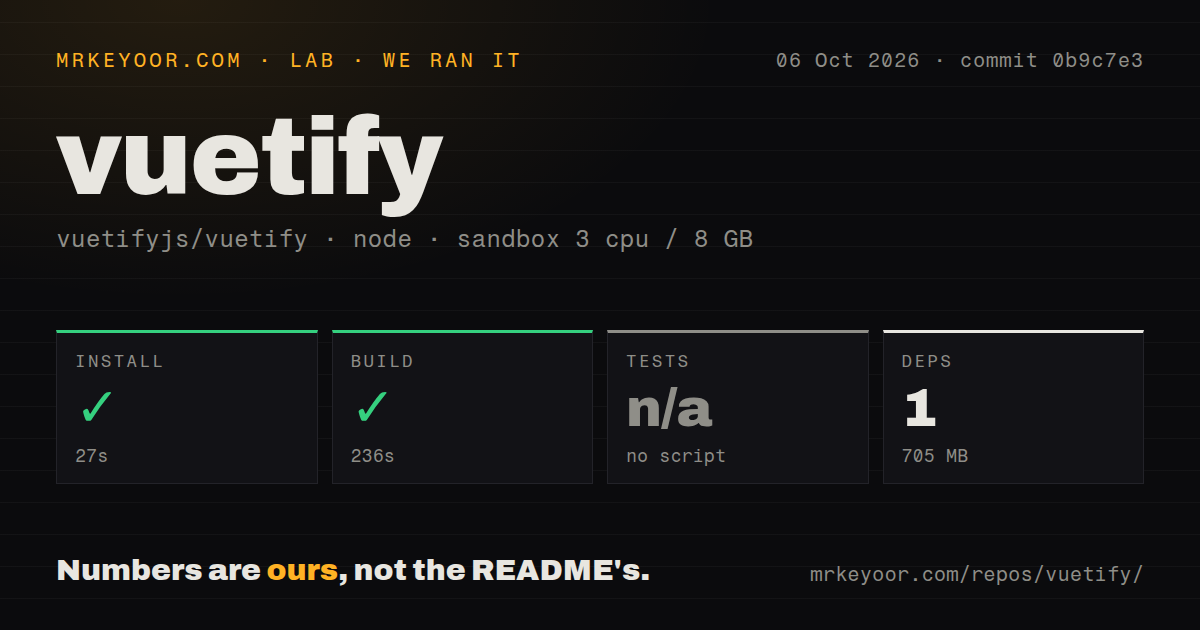
A 27-second install led to a 705 MB contributor environment
Our fresh Debian sandbox installed commit 0b9c7e3 in 27 seconds. The lab summary recorded 1 package installed and 705 MB on disk. That figure describes the repository's contributor environment, not the size added to a production application. The codebase is a pnpm workspace with documentation, build tools, browser testing dependencies, packages, and release machinery, so cloning Vuetify is much heavier than adding its published package to an app.
The source tree contained about 203,686 lines and occupied 9.8 MB before dependencies. At that commit, the root package pinned pnpm 10.26.1 and required Node 24.11.1 or newer. The published Vuetify package declared Vue 3.5 or newer as a peer. Application setup needs no account or service credential, though Nuxt and bundler integrations require their documented plugin configuration.
What happened when we ran it
Our run completed the build in 236 seconds after the successful 27-second install. The sandbox had 3 CPUs, 8 GB of RAM, Node 22, no secrets, and no elevated privileges. Build success is useful evidence that commit 0b9c7e3 assembled in a clean container. It is not a browser-performance result, a bundle-size measurement, or proof that every component behaves correctly.
The lab skipped tests because it found no root test script or target. It reported 6 CI workflow files, a Dockerfile, a compose file, monorepo workspaces, and no top-level tests directory. Source inspection shows test scripts and component test folders inside the Vuetify package, so "skipped" must not be read as "there are no tests." The narrower finding is that our standard root test discovery had nothing it could run.
Vuetify 4 supports evergreen browsers, not every browser named in the README
The detailed Vuetify 4 browser page lists Chromium 119, Firefox 128, and Safari 16.4 as fully supported. Chromium 99 and Firefox 97 receive partial support, with documented color and number-format limits. Internet Explorer is unsupported. Teams running kiosk hardware, managed enterprise desktops, or long-lived embedded browsers should compare their fleet against that table before building a design system on top.
There is a documentation mismatch worth catching. The repository README says modern browsers including Safari 13+ are supported, while the Vuetify 4 browser page at commit 0b9c7e3 names Safari 16.4. Follow the version-specific browser page for v4 decisions. The README also says components target a minimum width of 320 px, which gives mobile teams a concrete floor but does not replace testing on their own layouts.
Vue 2 is finished, while Vuetify 3 remains under LTS
The README states that Vuetify 2 is end of life and receives no community support, including security fixes. Commercial support is offered through a partner. The LTS page marks Vuetify 4 as active and Vuetify 3 as maintained through July 27, 2027. It promises at least 6 months of critical bug and security fixes for the latest minor of the previous major release.
That policy makes the major version a purchasing decision, not a cosmetic upgrade. Starting a new app on v4 avoids beginning on the maintained branch, while an existing v3 team has a dated support window for migration planning. A Vue 2 team should price a real upgrade or paid extended support. Staying put without either means accepting the README's explicit security-support boundary.
The October 6 release is active, but funding is under strain
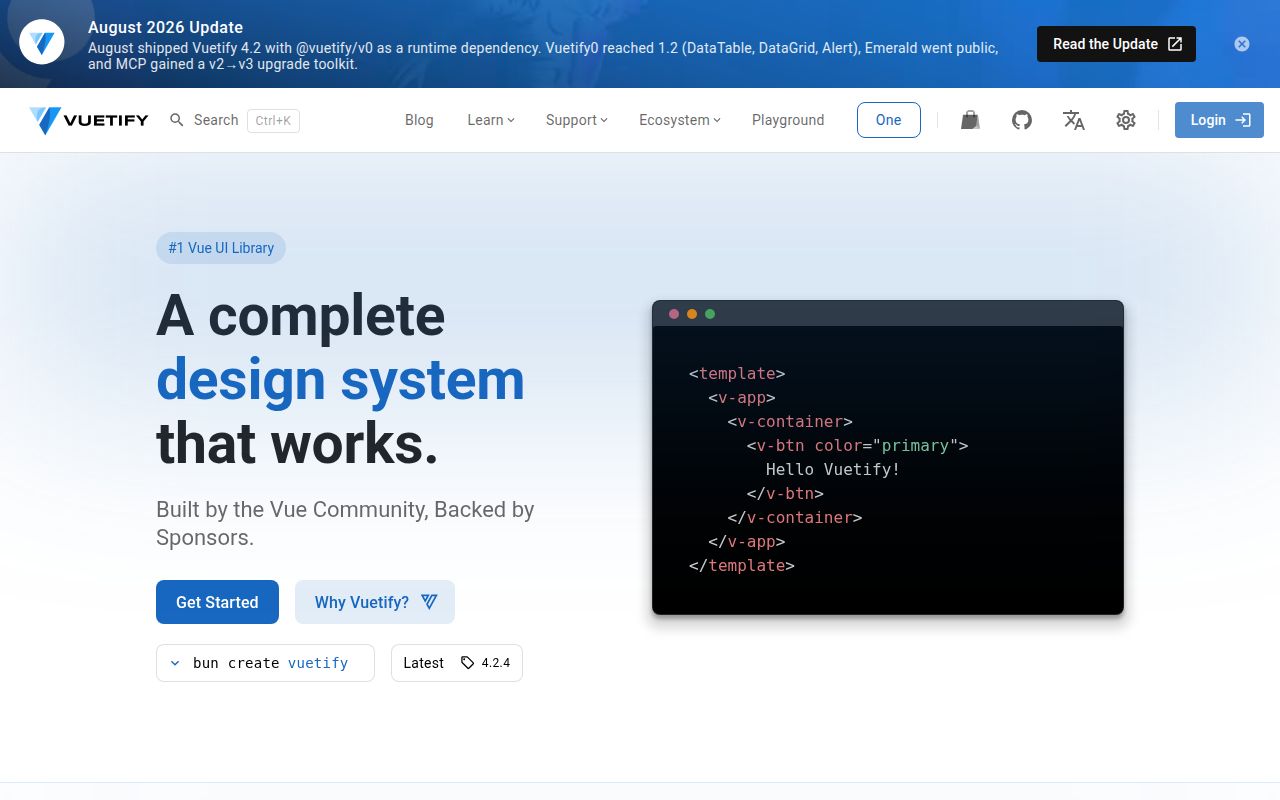
GitHub showed 41,037 stars, 281 open issues, and 105 open pull requests on October 6, 2026. Release v4.2.4 shipped that day with fixes for icons, routing, right-to-left carousel controls, date locale mapping, overlays, pagination, and CSS layers. The repository was also pushed that day. Release cadence and issue activity both point to active maintenance rather than an old project coasting on adoption.
The same v4.2.4 notes say OpenCollective funds are running low, the team has scaled down, and contributor compensation is barely sustainable. That statement comes from the maintainers, so it belongs beside the activity signals. Vuetify remains a mature choice for Vue 3, especially when its Material-based defaults fit. A serious adopter should still track funding, pin releases, and budget migration work rather than treating 6 months of prior-major support as permanent insurance.