Passing source checks after Vue 2 end of life
The recorded Vue 2 checkout passed installation, build and tests. Upstream support has still ended. For an existing application, these are separate inputs to a maintenance decision.
The repository README identifies vuejs/vue as the inactive Vue 2 repository and vuejs/core as the actively maintained repository. It directs new projects to Vue 3 and recommends that existing Vue 2 users upgrade.
This review is for maintainers investigating existing Vue 2 code. It combines the supplied source-check results with the project's support notice, then proposes a practical next step for assessing an application's migration.
What happened when we ran it
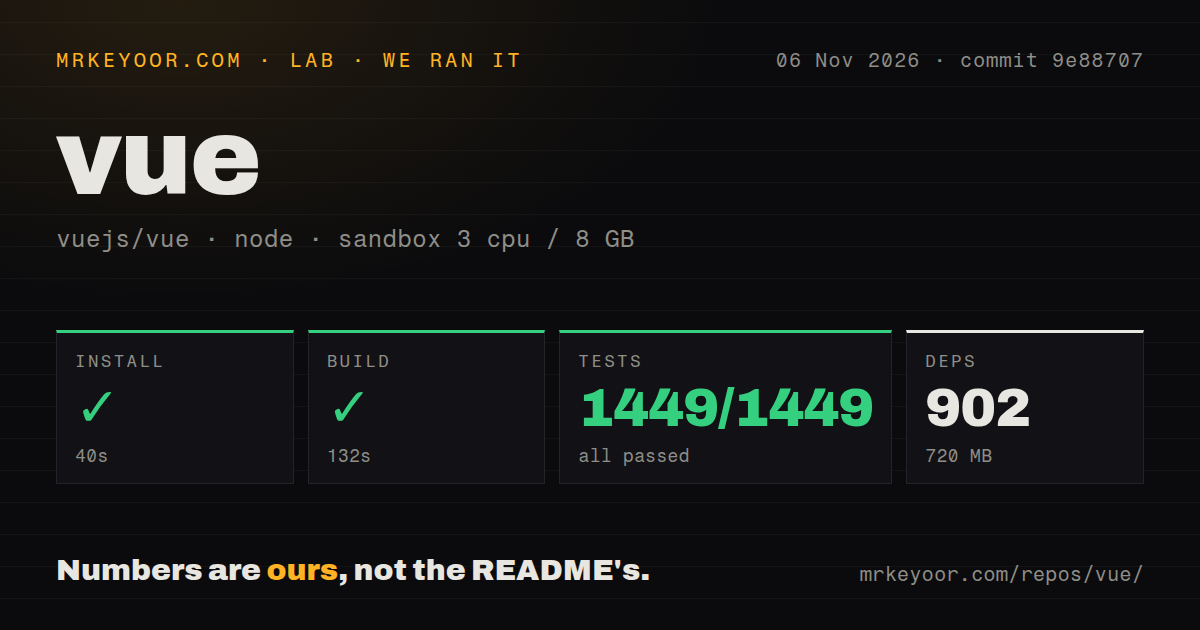
The supplied sandbox run used pnpm at commit 9e88707 on November 6, 2026. Installation succeeded in 40 seconds, recording 902 dependencies and 720 MB on disk. Build succeeded in 132 seconds. Tests succeeded in 228 seconds; the Vitest record reports 1,449 passed, zero failed and a total of 1,449.
The checkout contained 505 files, approximately 75,288 source lines and 2.5 MB. The recorded installed footprint was substantially larger than the source checkout.
The sandbox configuration listed 3 CPUs, 8 GB RAM and image lab-node:22. The image label does not establish the actual runtime or operating-system version. The scan recorded two CI workflow files, a tests directory and monorepo workspaces, with no Dockerfile.
These results describe this source checkout's recorded checks. They do not measure browser rendering speed, application bundle size, application integration or migration effort. The supplied evidence also lacks the exact commands and raw toolchain logs needed to present a complete reproduction procedure.
Upstream support ended in December 2023
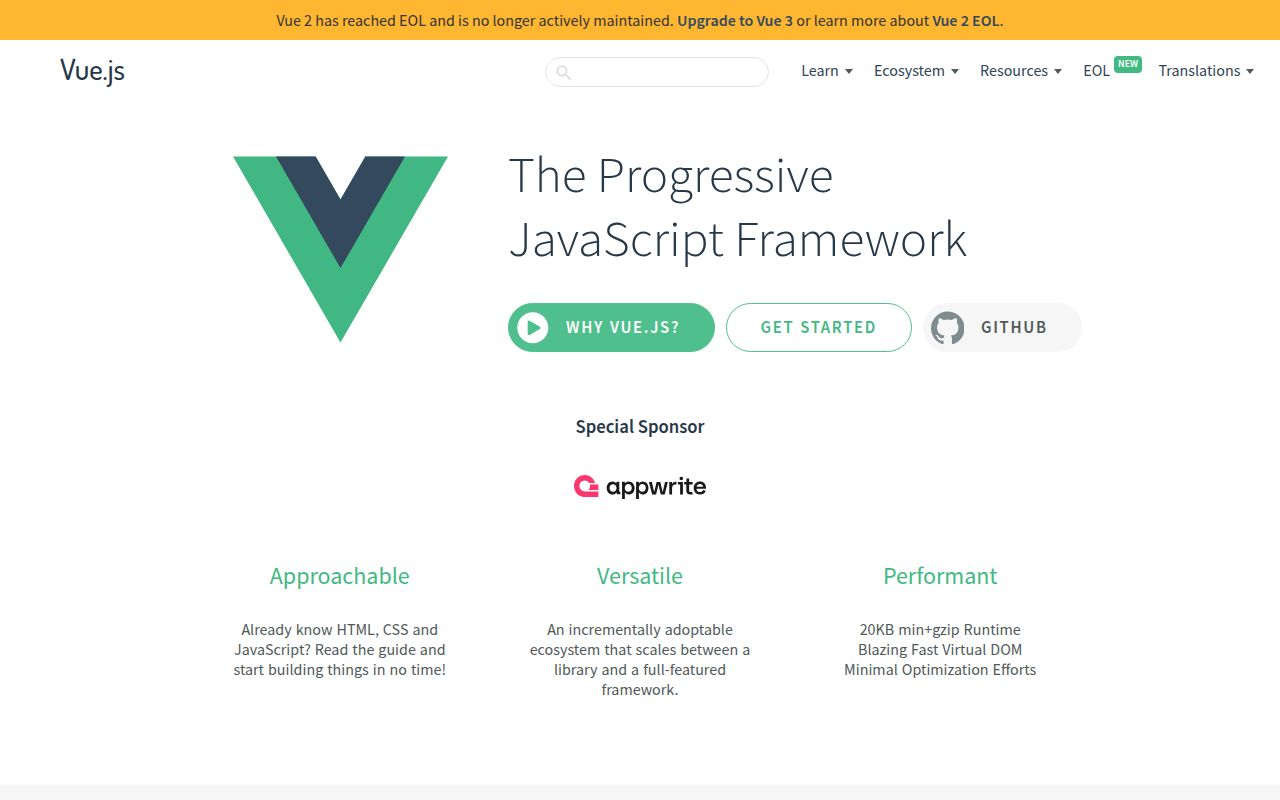
The official end-of-life page says Vue 2 reached end of life on December 31, 2023 and no longer receives new features, updates or fixes. It identifies 2.7.16 as the final Vue 2 release. The measured checkout is identified by commit 9e88707; this review does not equate that commit with the final release tag.
The project points teams unable to migrate toward commercial extended support through HeroDevs. That service's coverage and contract were not evaluated here. If your application needs extended support, verify the covered packages, obligations and exclusions before choosing it.
The project's explicit inactive notice grounds this review's maintenance recommendation. Repository activity alone would not establish a commitment to future fixes.
Start with the application's dependencies
The official migration guide describes changes between Vue 2 and Vue 3 and points to a Vue 3 migration build with Vue 2-compatible APIs. That provides a starting point, but it does not establish compatibility for your application.
Inventory your component libraries, routing and rendering integrations. Record their exact versions and check their documented Vue 3 migration paths. Use that inventory to identify dependencies that need replacement, upgrades or further investigation.
Then choose a representative feature for a migration trial. A form with validation and navigation can expose integration work that an empty page would miss. Record the required changes and the behavior that must remain the same. This is a proposed evaluation method; no application migration was performed in the supplied sandbox run.
If you stay on Vue 2 temporarily, assign responsibility for defects and set a date to revisit the decision. The source-check result can inform framework investigations, while the application's support arrangement needs its own decision.
Choosing the next framework
Vue 3 is the maintained Vue option identified by the Vue 2 README. Evaluate it first for a new Vue application or an existing application's upgrade. No Vue 3 migration timing was measured here.
Preact documents familiar React APIs, hooks and React compatibility through a preact/compat alias. Consider it when those APIs fit your intended application. The supplied evidence does not establish a Vue-to-Preact migration path or comparative performance.
How the ratings work
The assessed dimensions use a limited five-point editorial scale: 1 means a major documented barrier, 3 means a documented or recorded core path with material limits, and 5 requires independent application-use checks. Unassessed dimensions receive no numerical score.
Source setup earns 3 because installation, build and tests passed, while exact runtime reproduction and application integration remain unverified. Documentation earns 3 because the supplied README, end-of-life guidance and migration overview document the maintenance decision and an upgrade starting point; the linked migration procedure was not evaluated. Community support responsiveness and application production reliability remain unassessed.
For an existing Vue 2 application, the next useful result is a dependency inventory and a representative migration trial. Use those findings to decide who will maintain the application and what support it needs until migration is complete.