Phaser gives a browser game more than a renderer
Phaser combines scenes, input, physics and asset loading for games written in JavaScript or TypeScript. That makes it a sensible candidate when your browser game needs those systems together and you want to work in the web ecosystem. The README also documents cameras, tilemaps and tweens. You can spend the evaluation on whether its game structure fits your project, rather than assembling every subsystem before you have something playable.
For a new project, I'd consider Phaser when the browser is the primary destination and code is your preferred authoring environment. An existing Phaser game needs a different decision: whether its renderer customizations can survive the selected version. The current migration documentation names changes that matter more to that decision than the README's performance claims. We haven't reproduced those performance claims.
What happened when we ran it
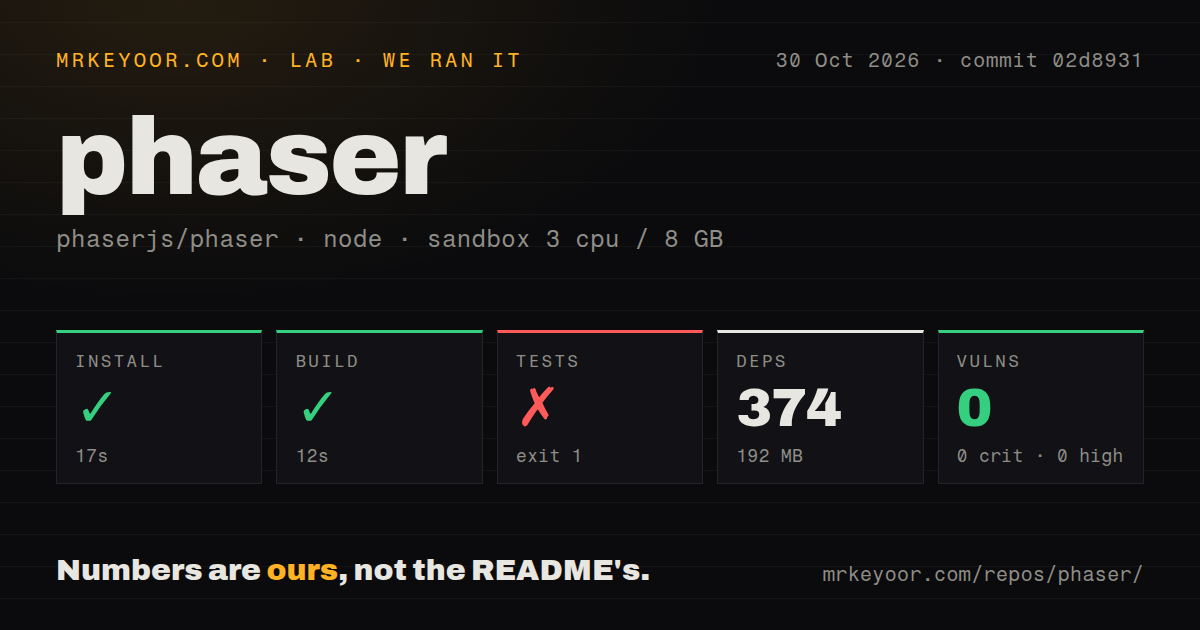
Our run of Phaser at commit 02d8931 on October 30, 2026 recorded a successful install step in 17 seconds and a successful build step in 12 seconds. It recorded 374 dependencies and 192 MB on disk. The checkout contained 3,603 files, about 525,090 source lines and 33.4 MB. These are repository-environment measurements, rather than the size of a game downloaded by a player.
The test step exited 1 after 587 seconds. The tail reports 23,305 passed, 4 failed and 4 todo across 23,313 test entries. Its file summary reports 1,095 passed and 2 failed test files. BaseTween.test.js accounts for the four named test failures in the displayed summary. The supplied tail doesn't identify the other failed file or include the assertions and exceptions needed to explain either file's result. We can't attribute the failure to timing, the browser environment or a Phaser defect from this excerpt.
The npm audit result recorded 0 known vulnerabilities across its reported severity categories. That is a point-in-time dependency-audit result, rather than a security guarantee. The stderr line from MultiFile.test.js refers to an onFileFailed case; the excerpt doesn't list that file as the other failing file. Treating every error-looking log line as a test failure would invent a diagnosis the summary doesn't give us.
Our sandbox configuration specified 3 CPUs, 8 GB RAM and image lab-node:22. The label doesn't establish the actual Node or operating-system version. The scan detected one CI workflow and a tests directory, with no Dockerfile. This run supplies no device frame-rate result, rendered-game inspection or browser compatibility matrix. A completed repository build leaves those game-specific checks to do.
Phaser 4 changes custom rendering code
The migration guide says custom Phaser 3 WebGL pipelines need to be rewritten as render nodes. It also describes changes to renderer internals and replaces the old FX and Mask systems with filters. If your game depends on custom pipelines, put that work in the adoption estimate before treating a familiar public API as evidence of an easy upgrade.
The same guide says Canvas rendering remains available but is deprecated. A team that requires a continuing Canvas-first path should resolve that mismatch before choosing the current generation. The README's headline still mentions both Canvas and WebGL, so the migration guide supplies a qualification that the short description misses. Our repository build doesn't demonstrate parity between those rendering paths.
These are current documentation statements, separate from the measured commit. The supplied lab block identifies 02d8931 but doesn't establish its package version. Don't silently attach the latest release label to that run, or use its successful build to certify a migration. First inventory the game's custom rendering and effects, then check those exact features against the selected release.
Templates connect Phaser to an existing web project
The README offers npm and CDN routes and an interactive project creator with JavaScript and TypeScript templates for several front-end frameworks. React and Vue are among the named options. These are useful entry routes if the game lives alongside an existing website. The measured repository installation doesn't tell us how a generated application will behave, and we didn't run those templates as separate installations.
Choose the integration you expect to ship, then make a small playable slice using representative assets and input. Include the effects or custom renderer work that would be expensive to replace later. If you expect native distribution, the README says native app targets use third-party tools. That extra toolchain belongs in the evaluation rather than being assumed covered by a browser framework's build result.
Recent reports accompany an older last-push date
The repository API reports the last push as August 21, 2026. The recent issue and PR feed includes October activity about pointer coordinates, clock callbacks and isometric maps. Those reports show continuing activity around the project, without establishing that proposed fixes have shipped. The older push date alone doesn't justify calling Phaser abandoned, and the active feed doesn't resolve our test failures.
PixiJS and Godot change what you build around
PixiJS documents WebGL and WebGPU rendering with graphics, assets and input features. Consider it when you want a rendering library around which to assemble your own application systems. Godot provides a unified interface for creating 2D and 3D games. Consider it when you want an editor-centered engine workflow. We have no comparative setup, rendering or export measurements for either alternative.
For Phaser, start with the smallest playable scene that exercises your intended renderer and target device. For an existing game, use the migration inventory to choose that scene. Resolve the full BaseTween failure details before depending on the measured checkout for a release decision.