Four coding engines share one event-backed workspace
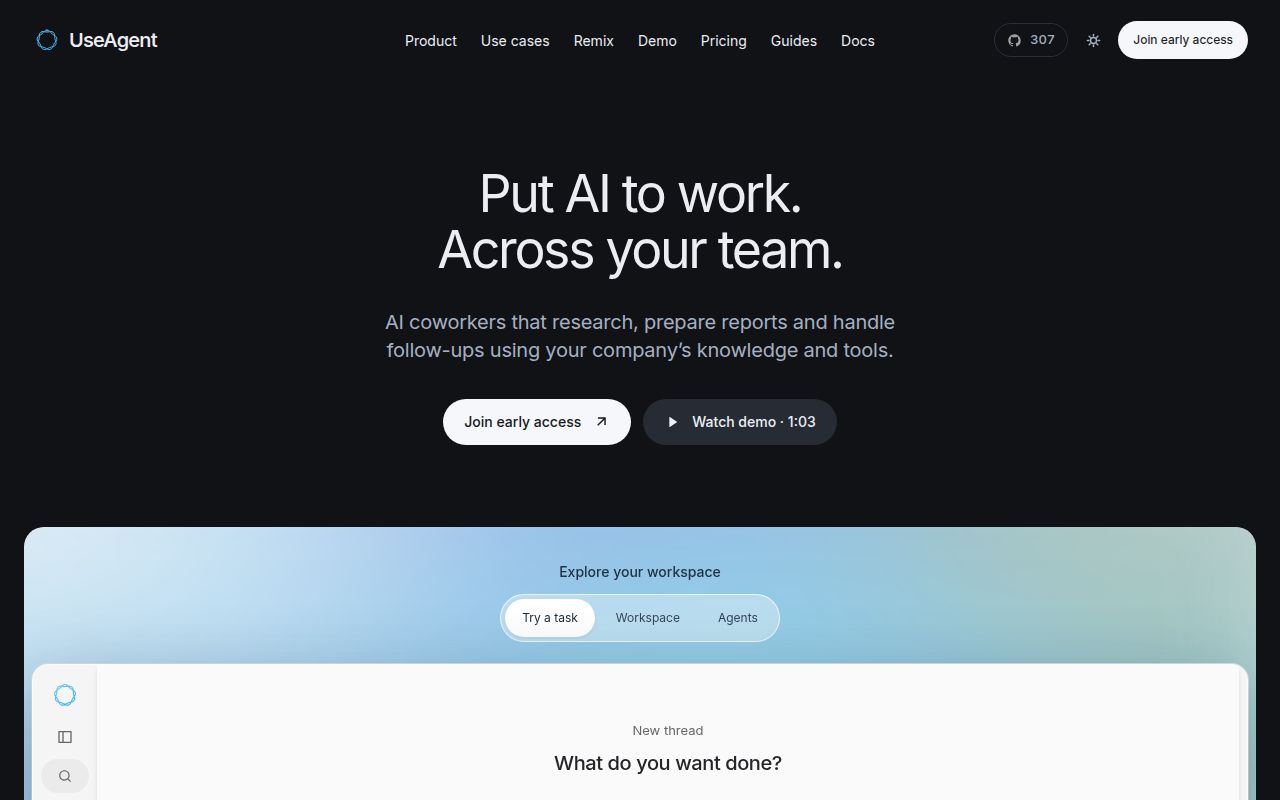
useAgent puts Claude Code, Codex, OpenCode, and Pi behind one session interface. A user starts work from the web app, Slack, a schedule, or the REST API, then follows commands, browser activity, files, and the terminal in a thread. Postgres stores the run timeline, while finished documents, spreadsheets, presentations, code changes, and other artifacts return to the shared workspace. Skills and playbooks let teams reuse instructions across tasks.
The measured repository is much larger than its 15.7 MB checkout suggests. At commit 1904983, our scan found 1,854 files and roughly 298,589 lines of source. Frontend, backend, shared contracts, a command-line client, documentation, infrastructure, and an optional memory service all live together. That breadth explains why useAgent feels closer to an internal agent platform than a chat wrapper. It also means an operator owns more than one web process.
Local setup needs nine Bun installs and Postgres 16
The quick start loops through nine workspaces and runs bun install --frozen-lockfile inside each. Postgres 16 needs the pgvector extension, which the stock image does not include. The backend listens on port 3201 and the frontend on 3400. A useful task then needs a provider connection and an execution environment, so seeing the UI is only the first setup milestone.
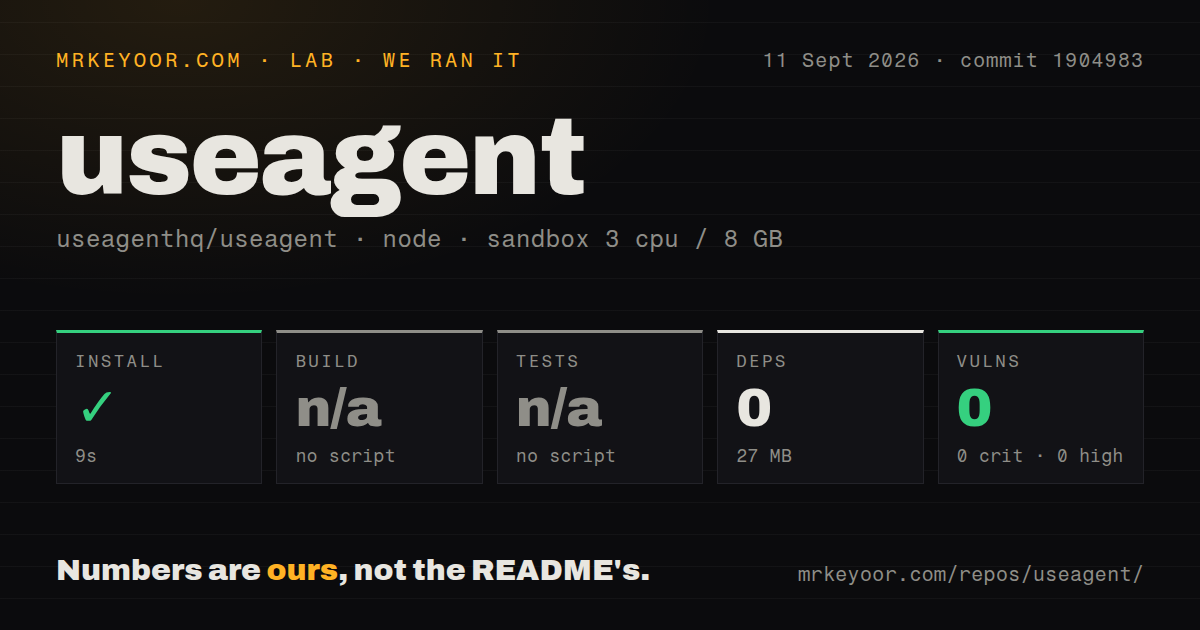
Our npm install completed in 9 seconds, reported 0 packages installed, and left 27 MB on disk. That outcome is accurate for the npm command we ran, but it is not the product's documented install. The root package has Bun scripts and no root dependencies for npm to fetch. A buyer should not read the short time as evidence that nine workspace installs, database setup, frontend startup, and backend startup have passed.
Self-hosting adds Ubuntu 24.04 or an equivalent Linux host, Bun, Node, Docker, Caddy, DNS, and HTTPS. The reference guide calls 4 vCPUs and 8 GB of RAM a comfortable start for the control plane. It also asks for three long-lived application secrets, database passwords, an initial admin credential, and a public origin. Those are project requirements rather than results measured by our sandbox.
What happened when we ran it
Our sandbox cloned commit 1904983 into a fresh unprivileged Node 22 container with 3 CPUs and 8 GB of RAM. npm completed in 9 seconds and installed 0 packages. The checkout then occupied 27 MB. Since useAgent documents Bun and per-workspace installation, this run only establishes that the root npm surface performs no meaningful dependency setup.
There was no npm build target, so the build step was skipped. There was no npm test target, so tests were skipped too. We cannot report a passing compile or test count. npm audit found 0 known vulnerabilities, including 0 critical, high, moderate, or low findings, but it also inspected an install with 0 added packages. The repository's Bun dependencies need their own installation and checks before that security result becomes useful.
Every real thread needs a sandbox provider
Agent sessions run in isolated Linux sandboxes. Daytona is the managed option and starts with an API key. CubeSandbox keeps the fleet on your own hardware, adding Docker services, a prepared template, and more capacity planning. The backend documentation also describes Box support. Engine adapters keep their native protocols across providers, though desktop, recording, and computer-use capabilities differ by sandbox.
At measured commit 1904983, the repository had 2 CI workflow files, no Dockerfile, and no tests directory. Those signals do not mean the current code lacks tests or deployment assets elsewhere; the backend guide names package-level Bun tests and self-host scripts. They do show why our generic Node runner found no root verification path. Evaluators should follow the repository's Bun commands and add a live smoke for each chosen engine and sandbox pair.
The security boundary stops at one backend node
useAgent keeps raw integration and provider credentials out of the sandbox. Short-lived, scoped capabilities cross trusted provider and knowledge gateways, and approval tools can pause a run for a one-shot decision tied to arguments. This is a sensible shape for agents that browse, run shell commands, and open repositories. It also places secret rotation, gateway availability, connector configuration, and audit review on the operator.
The backend currently enforces a single process because its organization-change invalidation bus is process-local. Artifacts remain on that backend node, and shared object storage is future work. Our scan's 298,589 source lines and 2 CI workflows suggest plenty of implementation surface, while the skipped build and tests leave current behavior unverified by our lab. High-availability buyers should wait for durable fan-out and shared storage or build those pieces themselves.
Current commits cannot hide the alpha constraints
The last push was September 15, 2026. GitHub listed 307 stars and 0 open issues or pull requests, and the issues API returned no public issue history. The latest release on September 12 is a verified native-runtime asset; the latest application release in the list is v0.0.3 from August 31. Commit and release activity are current, while issue response cannot yet be judged from an empty tracker.
The README calls the project alpha and warns that APIs and schemas may change. That label fits our evidence: a 1,854-file platform with no npm build or test target, a 0-package npm install, and major operational limits documented in the backend guide. The lack of open issues should not be read as proof of stability. It means the public tracker offers no bug history to study.
Shared oversight is the reason to adopt it
Start with one engine, one sandbox provider, and a disposable repository. Run the documented Bun typecheck and backend tests, then test restart recovery, approval pauses, credential isolation, artifact export, and sandbox deletion. Our 9-second npm result covered none of that, despite reporting 0 audit findings. The meaningful evaluation begins only after Postgres, Bun, the gateway, and a real sandbox are all involved.