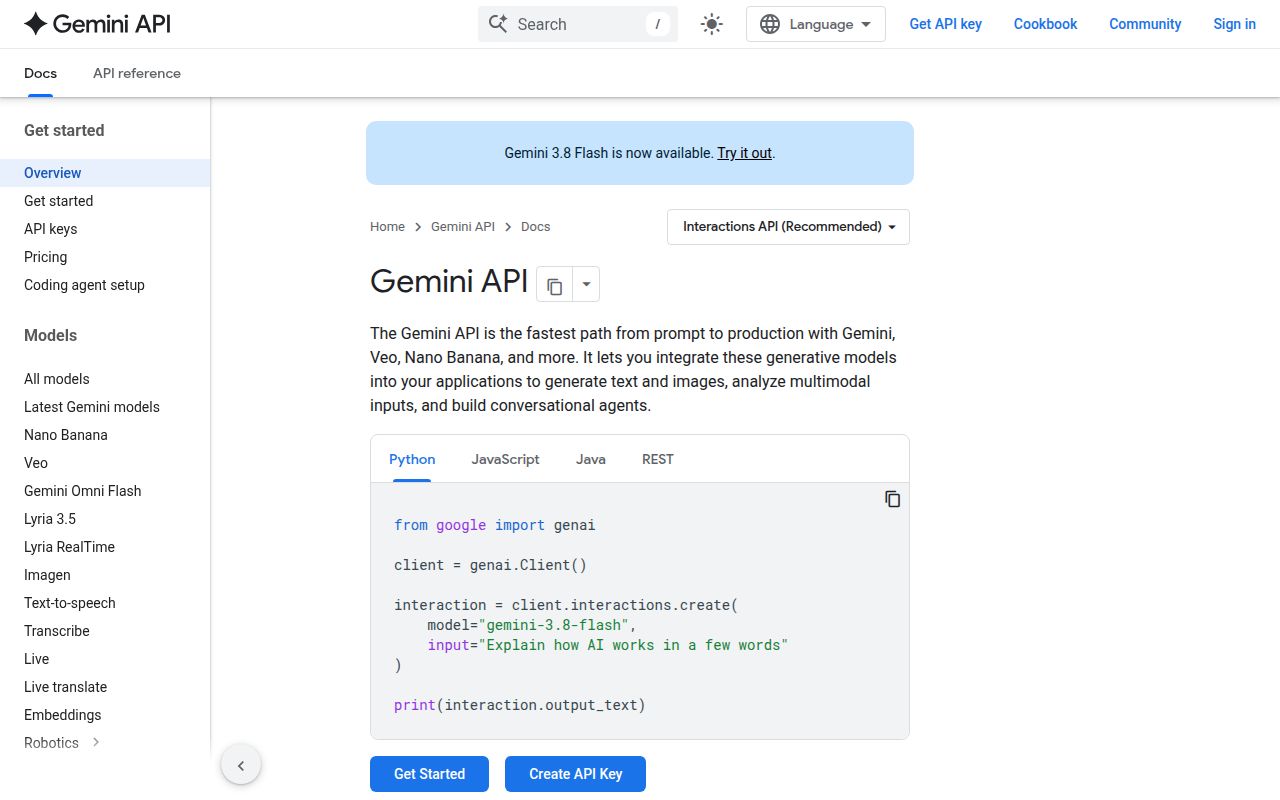
Three skills give agents current Gemini guidance
The repository contains 3 skills: gemini-api-dev, gemini-live-api-dev, and gemini-omni-flash-api. The first covers standard generation, streaming, tool calls, structured output, embeddings, agents, and migration from older SDK patterns. The Live skill focuses on bidirectional audio, video, text, session management, and ephemeral browser credentials. Omni adds Python scripts for uploading, inspecting, preparing, generating, editing, and extending video. This is a reference pack, not an SDK or proxy service.
The basic skill names current models and SDKs, rejects deprecated families, and tells the coding agent to fetch the matching official page before writing code. A static skill can point an agent toward today's source of truth, while linked documentation carries detailed parameters and edge cases. This division only works if the agent has a documentation tool or web access and follows the lookup instruction.
Version 2.1.0 has six documented installation paths
The Codex manifest reports version 2.1.0, and the README documents 6 ways to add the skills: Vercel Skills, Context7, Antigravity, Claude Code, Cursor, and Codex. Manifests exist for several plugin formats, and users can install the collection or choose one skill. A text application can therefore omit the longer Live and Omni instructions.
A working Gemini application still needs a Google SDK, an API key, provider access, and its own tests. The Omni helper requires Python 3.10 or newer and google-genai 2.19.0 or newer. Its media paths also call ffmpeg and ffprobe. None of these runtime pieces arrive because a plugin manager copied the skill files.
What happened when we ran it
commit 80dd31d received no executed lab run. The harness identified Python as the repository language but found no supported ecosystem entry point and no Dockerfile, so it stopped before installation. There is no measured build status, test count, dependency total, installed size, timing, or vulnerability result. Reporting any of those as zero would be wrong because the corresponding steps never ran.
The repository is mostly Markdown with a small set of Python media utilities, which explains the mismatch with an application-oriented harness. The absence of a runnable project check still leaves buyers without an independent signal about the examples or scripts. Test the exact API calls inside the application that will ship, especially after a model, SDK, or skill update.
Google's evaluation used 117 code-generation prompts
Google's linked blog says its evaluation harness used 117 prompts that generated Python or TypeScript Gemini SDK code. The README reports correct best-practice API code on 87% of tasks with Gemini 3 Flash and 96% with Gemini 3.1 Pro. Those are Google's results under its grading setup. They do not describe our lab or predict correctness for a particular agent wrapper and feature mix.
The same blog says installed skills may retain old information because updates are manual. That risk matters here because the files prescribe model names, SDK minimums, deprecations, and event shapes. Pin the repository commit, record the skill version used by a project, and review refreshes. A changed global copy is harder to audit than an ordinary dependency update in version control.
Paid-tier interactions are stored for 55 days by default
The main skill says interactions are stored by default for 55 days on a paid tier and 1 day on the free tier. Turning storage off also disables previous-interaction chaining and background execution. Tools, system instructions, and generation configuration are scoped to each interaction and must be supplied again on later turns. Those rules affect privacy and correctness, so they belong in the application's design rather than only in agent context.
The Live skill documents 16 kHz mono PCM input, 24 kHz output, and a 15-minute audio-only limit without compression. Audio with video drops to 2 minutes, connections last about 10 minutes, and function calls are synchronous. Code execution and URL context are unavailable. Handlers must process every content part in an event and clear queued playback when an interruption arrives.
Omni editing accepts source clips up to 10 seconds
The Omni skill accepts generation durations from 3 to 10 seconds and describes extensions up to a 40-second total. Uploaded video for editing is limited to 10 seconds. Regional rules are decisive: uploaded editing and extension are unavailable in the EEA, Switzerland, the United Kingdom, and some US states. Check eligibility before building a workflow around the included scripts.
Those scripts use ffmpeg and ffprobe, upload inputs to Gemini, wait for activation, and save outputs locally. Video with an audio stream asks the model to preserve or adapt that audio, while stripping it requests a new track. This choice changes the deliverable, so an agent should ask before removing audio or extending a prior interaction.
A one-day-old push outweighs zero GitHub releases
GitHub showed 4,096 stars and 9 combined issues and pull requests on September 12, 2026. The last push was September 11, one day earlier, and that merge corrected the Codex installation command. Other September changes updated model guidance and raised the plugin version. The repository is active even though GitHub returned 0 published releases and 0 tags. Pin a commit because there is no release artifact to anchor an installation.
The README says the project is not an officially supported Google product and is outside Google's open-source vulnerability rewards program. That sets clear support expectations. Gemini Skills is useful current context for an agent, especially for Live API work, but its text sits between a changing service and generated application code. Official documentation and tests in the consuming project remain the authority.