Sixty-seven skills widen Claude Code's reference shelf
Claude Skills packages 67 specialist roles into one Claude Code plugin. The catalog covers language and framework work, architecture, databases, security, testing, operations, and data tooling. Each skill has a SKILL.md entry point and can route the agent to narrower reference files when a task calls for them. That is a sensible answer to context limits: a React question should not load the Kubernetes material, and a PostgreSQL tuning request should not begin with a mobile guide.
Breadth is both the appeal and the caution. The README counts 371 reference files across the collection. Installing them does not add a compiler, scanner, browser, cloud account, or subject expert to Claude Code. It changes the instructions available to the agent. You still need the real project context, working tools, credentials, tests, and a person who can reject unsafe or outdated advice. Treat the pack as a reference shelf, not proof that the generated work is correct.
The 22-second install is simpler than choosing the right skill
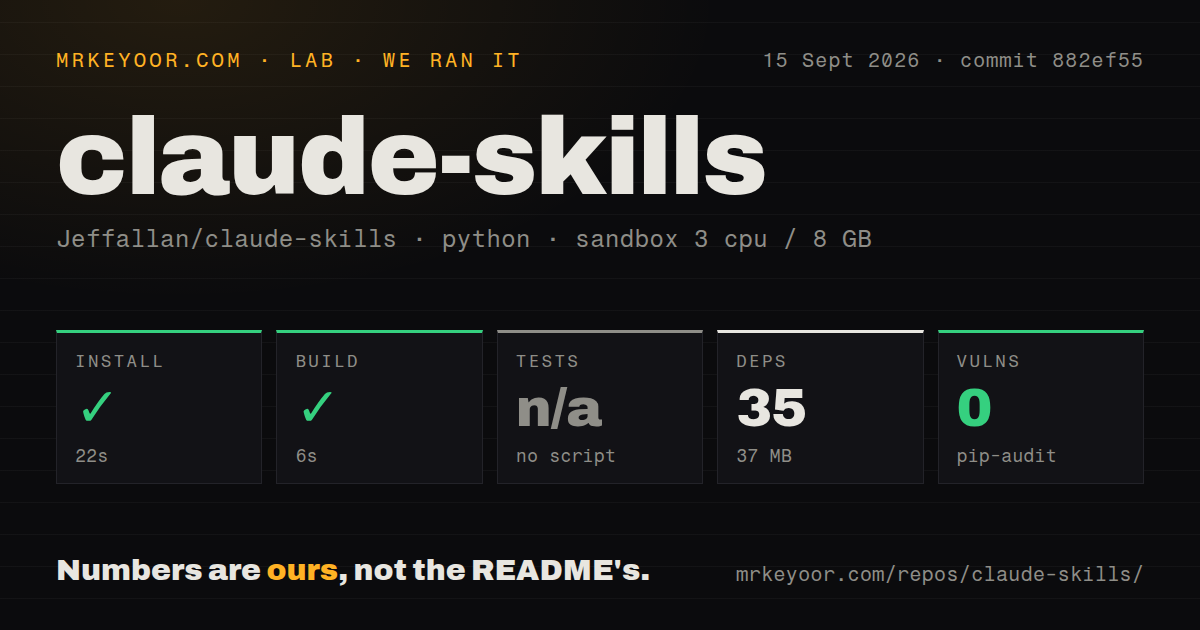
Our fresh Debian sandbox installed commit 882ef55 in 22 seconds. It pulled 35 Python packages and occupied 37 MB, while the checkout itself contained 563 files, about 4,703 lines of source, and 5.7 MB of data. The build completed successfully in 6 seconds. Pip-audit reported 0 known vulnerabilities in the installed Python dependencies. Those are modest repository costs for the amount of written material included.
User installation has several routes. Claude Code can add the repository as a marketplace and install fullstack-dev-skills, then needs a restart. A GitHub URL works as another plugin route. Skills.sh and Agent Skills CLI advertise wider agent support, but the quick-start guide says those methods install skills only. They leave out /common-ground and the /project:* commands, so choose the method based on the functions you need rather than copying the shortest command.
What happened when we ran it
Our run passed installation in 22 seconds and the build in 6 seconds. It installed 35 packages, used 37 MB, and returned 0 known findings from pip-audit. We found three CI workflow files in the repository. There was no Dockerfile, which is reasonable for a collection consumed by an existing agent rather than a service that listens on a port.
Tests were skipped because the checkout exposed no test script or target to the lab, and it had no tests directory. That does not cancel the successful build. It limits what the result proves. The build can catch structural or documentation errors, while the lab result says nothing about whether a React answer is current, a Terraform change is safe, or a nine-step project workflow produces better software. Those outcomes need task-level evaluation inside your own repositories.
Nine project commands bring Jira and Confluence into scope
The project layer covers discovery, synthesis, approval, planning, ticket execution, completion, and an epic retrospective. Nine commands move documents and tickets through Jira and Confluence. The workflow guide requires an Atlassian MCP server, and it describes confirmation or approval checkpoints before creating tickets, publishing documents, changing ticket status, or closing an epic. This is much more operationally consequential than loading a Python reference.
That layer fits a team whose source of truth already lives in those two Atlassian products. Everyone else inherits a workflow shaped around services they do not use. Even for an Atlassian team, MCP credentials need the least access the workflow can tolerate, and write actions deserve a trial project first. A skill file can tell an agent to pause for approval, but your client configuration and permission model decide what the agent can actually reach.
v0.4.16 added checks after broken references and safety gaps
Release v0.4.16, published August 7, 2026, added a checker for file paths cited inside skill markdown. The release notes say several bad relative and absolute paths had survived earlier versions, including one tied to a contributor's local machine. The same release tightened Terraform apply and production deployment instructions so the agent must present the change and receive explicit approval. These fixes show maintainers responding to concrete failure modes in instructional software.
The repository validator checks YAML frontmatter, required metadata, section order, description triggers, reference paths, count consistency, workflow definitions, and related-skill links. That is useful editorial engineering. It mainly tests whether the material is shaped and connected as intended. Open issue 226 separately tracks five remaining npm audit findings in the static documentation site's toolchain. Our 0-finding pip-audit result applies only to the 35 Python packages installed by the lab.
August code and September pull requests show ongoing maintenance
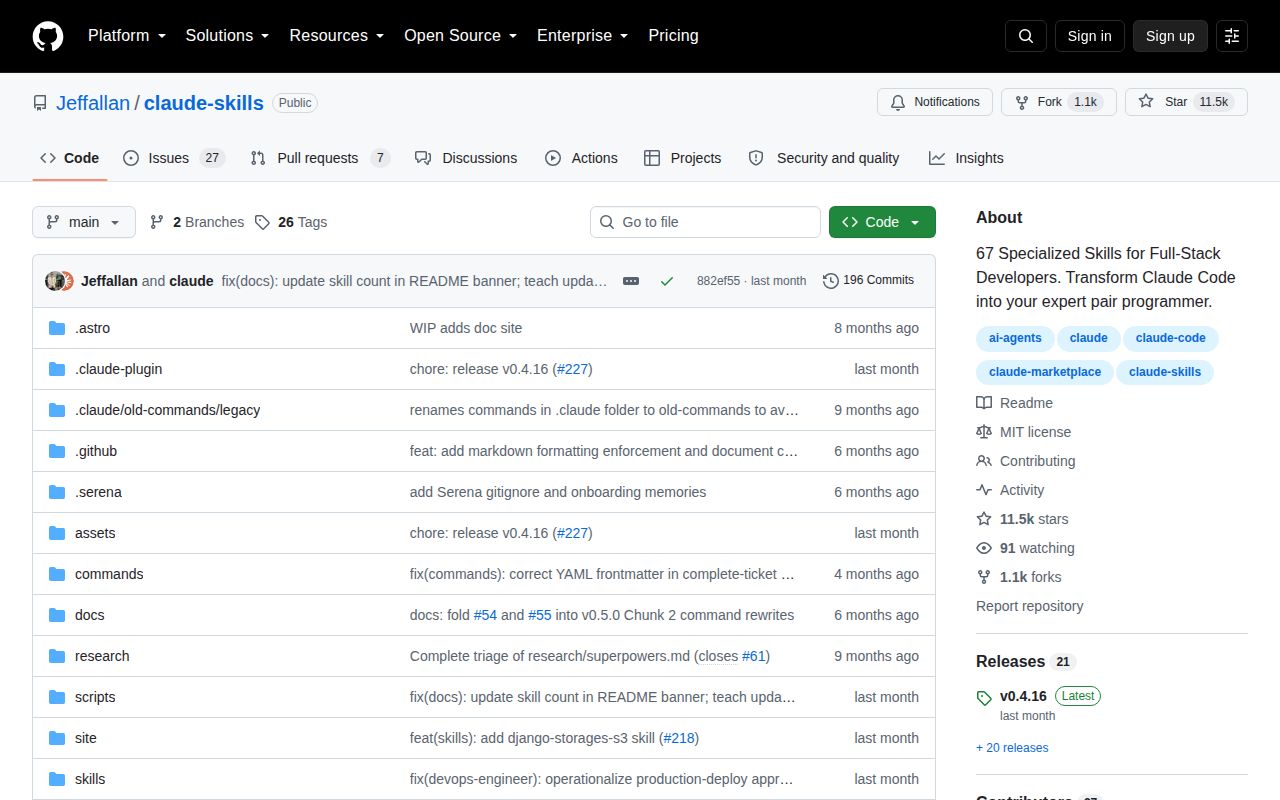
The repository's last recorded push was August 7, 2026, the date of v0.4.16, while open pull requests were updated as late as September 1. GitHub listed 11,482 stars and 34 combined issues and pull requests when fetched, including seven open pull requests. One of those proposes a marketplace-name correction after issue 234 reported that the documented command failed while manual marketplace installation worked. The issue record and pull requests add context that a release date alone would miss.
Anthropic's skills repository is the cleaner choice for the official specification, templates, and a smaller collection of examples. Superpowers is narrower in another way: it imposes one development method across several coding agents. Claude Skills suits the developer who would rather select among framework and role references. Start with two or three skills that match a live project, inspect the loaded instructions, and compare the resulting patch with your normal review bar before installing the whole workflow around Jira.