Sixteen departments keep 172 skills from loading at once
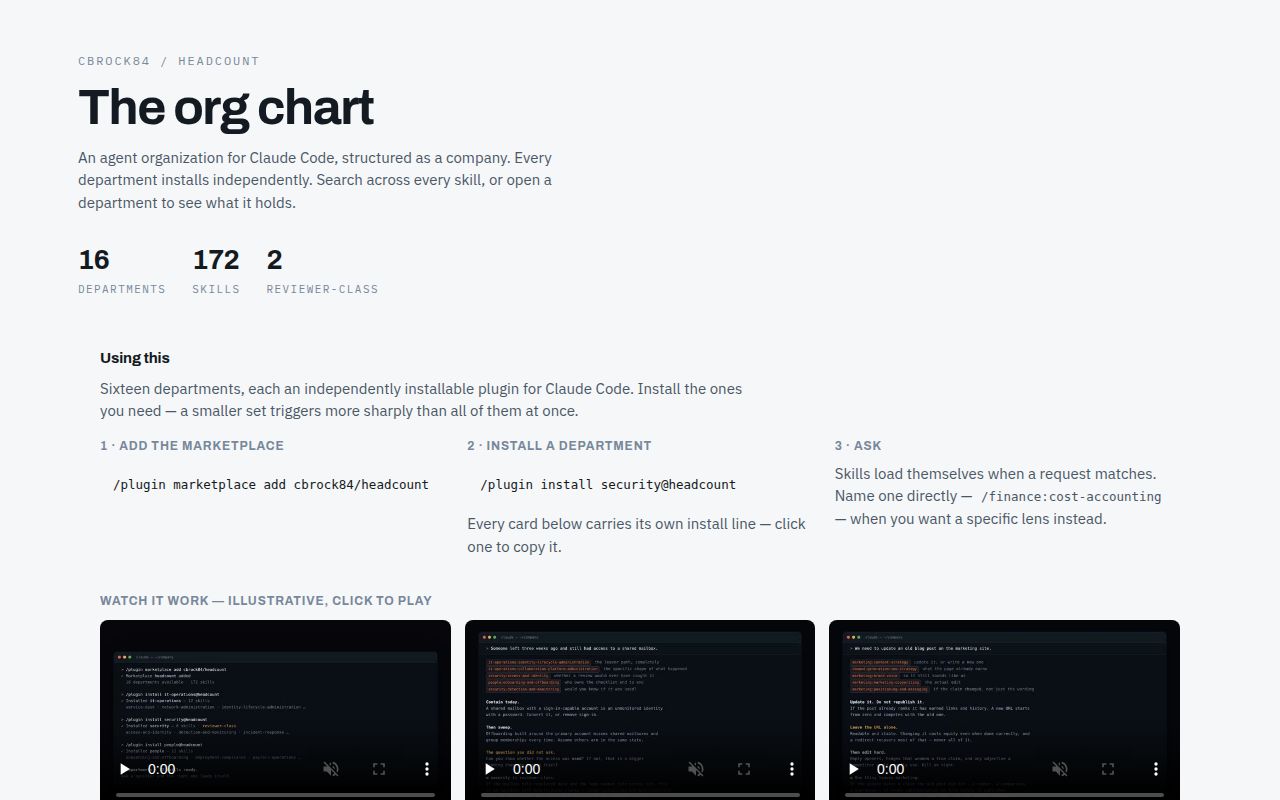
Headcount packages 172 Claude Code skills as 16 independently installable departments. Instead of adding one huge instruction file, you choose areas such as technology, finance, product, security, or operations. Claude sees each skill's trigger description and loads the full instructions when a request matches. The department prefix also prevents names from colliding, so finance:unit-economics and a similarly named skill elsewhere can remain distinct.
That shape is Headcount's best idea. The getting-started guide warns that installing all 16 departments creates too much triggering surface, then suggests small bundles based on the work you do. A product builder might start with product, technology, and data analytics. An operator might choose executive, finance, and operations. This is curation rather than simulation: nothing hires agents or runs a business after installation.
What happened when we ran it
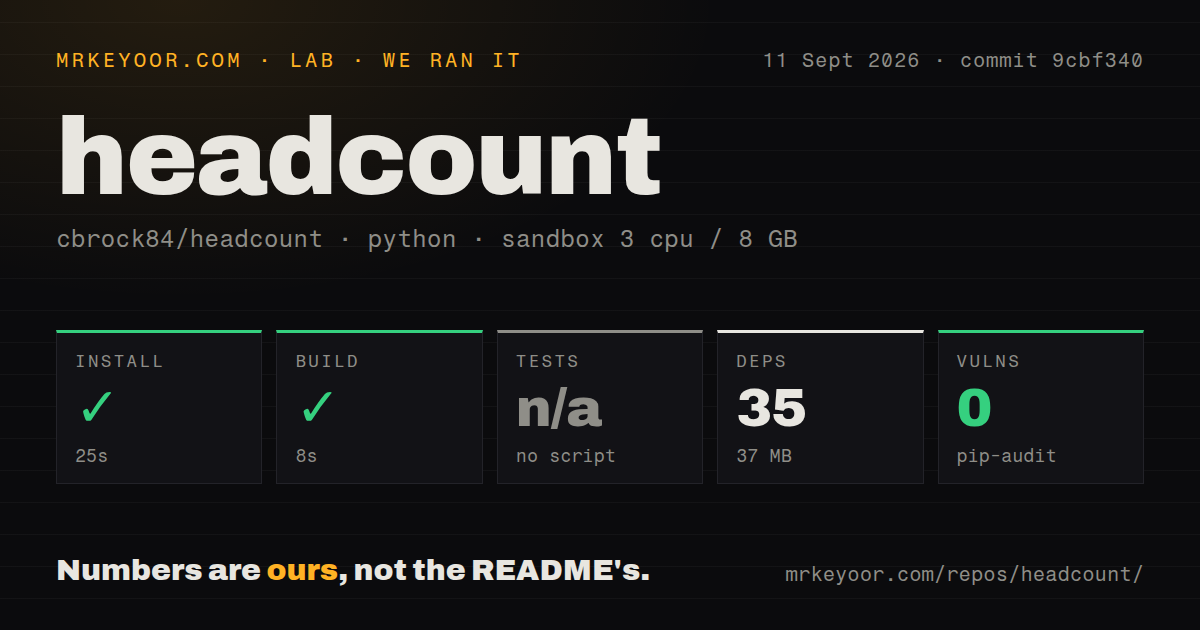
Our sandbox installed commit 9cbf340 in 25 seconds, adding 35 Python packages and occupying 37 MB. The build completed in 8 seconds. The checkout contained 244 files, about 2,007 lines of source, and 4.9 MB before installation. These figures come from a fresh Debian container with 3 CPUs and 8 GB of RAM.
The harness found no test script or target, so it skipped tests. Pip-audit reported 0 known vulnerabilities in the installed Python packages. Repository signals showed 1 CI workflow, no Dockerfile, and no tests directory. The successful build establishes that the project machinery completed in our environment. It does not establish that Claude will select the right skill or produce a sound answer for a real contract, incident, or hiring decision.
The 8-second build checks structure rather than answer quality
Headcount's own check-all.sh is substantial. It validates skill frontmatter, unique names, references between skills, marketplace manifests, generated documentation, source catalogs, US English spelling, and exclusive file ownership. It also rebuilds vertical editions and verifies their emitted repositories. The GitHub Actions workflow runs that same script with read-only repository permissions.
Those checks catch broken packaging and catalog drift. They cannot grade whether a financial model is correct or a threat model found the important boundary. That requires scenario evaluations with known expectations, and the measured commit exposed no test target for them. Anyone adopting Headcount for repeated work should save a small set of representative prompts, expected questions, unacceptable answers, and human review criteria. Run that set again when the model or skill text changes.
Reviewer-class departments are instructions, not access controls
Security and legal-risk have a distinct role in the organization. Their charters say they review work from other departments, own no write surface in that review role, and can issue blocking findings that the reviewed department cannot overrule. The security charter also limits its work to defensive use and directs statutory questions to legal review and qualified counsel.
This separation can improve an agent workflow because the builder is not asked to approve its own work. Enforcement still lives in Claude following the instructions and in the human or orchestrator respecting the result. It is not a permission system outside the model. A team should connect a blocker to a real release gate, named owner, or approval step if ignoring it would expose production data or create a contractual obligation.
Regulated skills state where the machine must stop
The contract-review skill opens with a plain disclaimer and sends jurisdiction-specific matters, litigation, employment, financing, and acquisitions to a licensed attorney. The contributor guide requires similar boundaries for law, privacy, compensation, medical, financial, and safety topics. That makes these skills useful for organizing facts, spotting missing questions, and preparing a professional review.
It does not make the 172-skill catalog a substitute for qualified people. The finance, legal, security, and people departments can sound authoritative because their methods are specific. Treat their output as structured preparation. Keep source verification, jurisdiction, company policy, current facts, and final accountability with the person who owns the decision. The project says much the same in its getting-started guide, which is a strength rather than fine print.
Claude Code is the current installation boundary
The published instructions use Claude Code's marketplace and plugin commands. Adding the marketplace once and installing a department are the only user-facing setup steps. The guide says this adds skills without changing the project, adding dependencies, or running anything automatically. That makes removal and experimentation low risk inside a Claude Code setup.
Draft pull request 40 adds manifests for ChatGPT and Codex over the same skill tree. It was still open on September 16, 2026, so that support should not be described as shipped. Superpowers is the better alternative when you need a coding method across several agent products today. Anthropic's skills repository is the better reference when you want first-party format examples or document tooling.
Current commits matter more than the missing release page
GitHub recorded the latest push on September 16, 2026. The repository had 1,527 stars and 2 open pull requests, with no open issues in the fetched list. GitHub returned no latest release, although the marketplace manifest labels the plugins version 1.0.0. The absent release page is a packaging caveat, not evidence that work stopped.
Headcount is worth installing by department if you already use Claude Code and recognize several recurring decisions in its catalog. Begin with the smallest useful set, test it on work whose right questions you already know, and add a human gate where the answer can move money, expose data, or bind the company. The catalog is broad. Its safe value comes from narrowing it.