Sixty-nine entries give coding agents a usable vocabulary
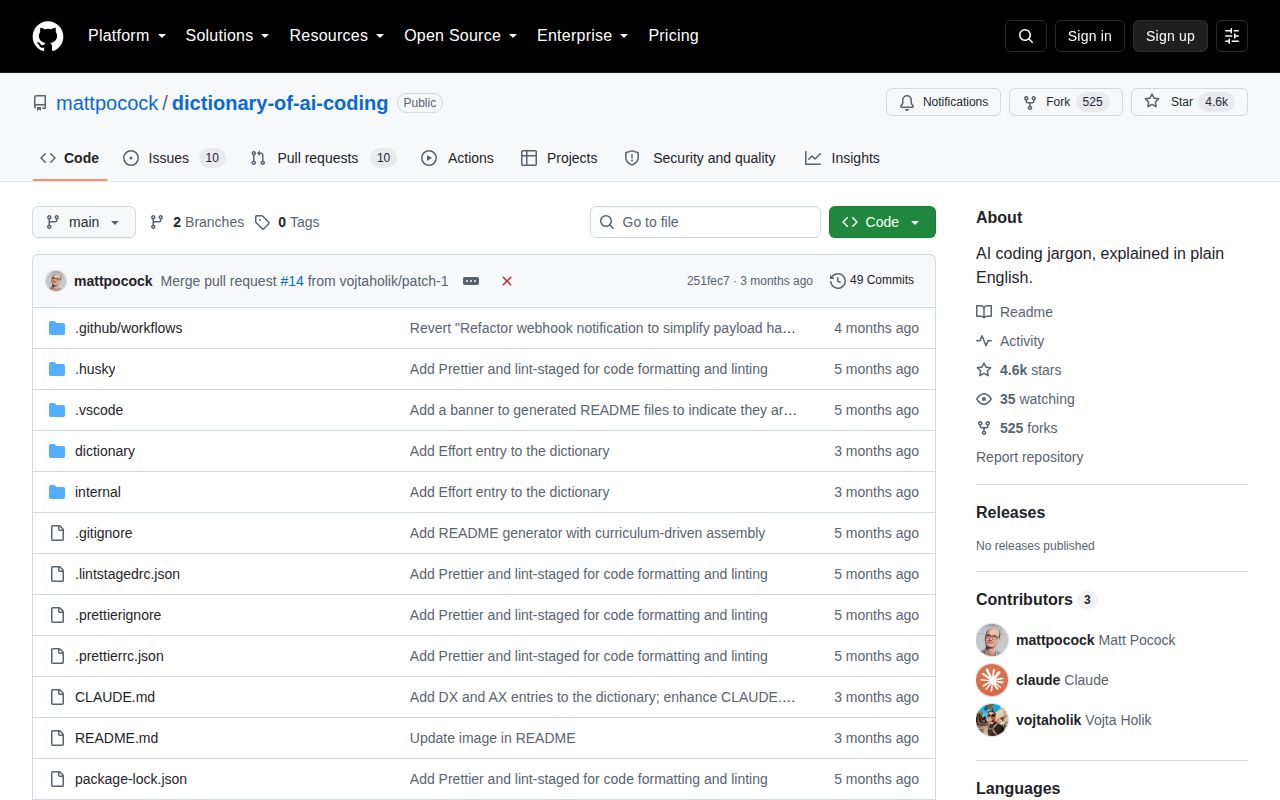
The dictionary directory contains 69 files, arranged into 7 sections that move from models and sessions through tools, failure modes, handoffs, memory, and working patterns. Each entry explains one term, links related entries, gives a usage exchange, and sometimes warns against a vaguer phrase. The result is meant for reading and discussion. It does not provide an agent, model wrapper, prompt library, or API that an application can call.
Across 69 entries, the strongest distinction is the separation of model, harness, and agent. A model predicts tokens; a harness supplies context, tools, and the loop; an agent is the working system a user experiences. The entries then connect that distinction to statelessness, sessions, permission modes, sandboxes, and tool results. Many confused debugging conversations improve once a team can identify whether the failure belongs to model behavior, missing context, a harness decision, or an external tool.
Seven sections favor working language over formal definitions
The README groups 69 files into 7 sections and reads like one developer correcting another, with concrete exchanges under every term. The token entry explains why unusual identifiers consume more context, the handoff entry distinguishes a durable artifact from a conversational summary, and the human-review entry insists on reading the diff instead of the agent's description. Entries for DX and AX explain why a codebase that works for experienced employees may still be hard for a stateless agent to operate.
Across 69 definitions, that voice is the appeal and the limit. The dictionary often tells readers which wording to avoid, and it advances specific working ideas such as a smart zone, attention budget, grilling, clearing, and agent experience. Some are useful labels rather than settled technical terms. Teams can adopt them as house vocabulary, but a standards document, research paper, or vendor comparison should trace technical claims to primary material and define disputed terms for its own audience.
What happened when we ran it
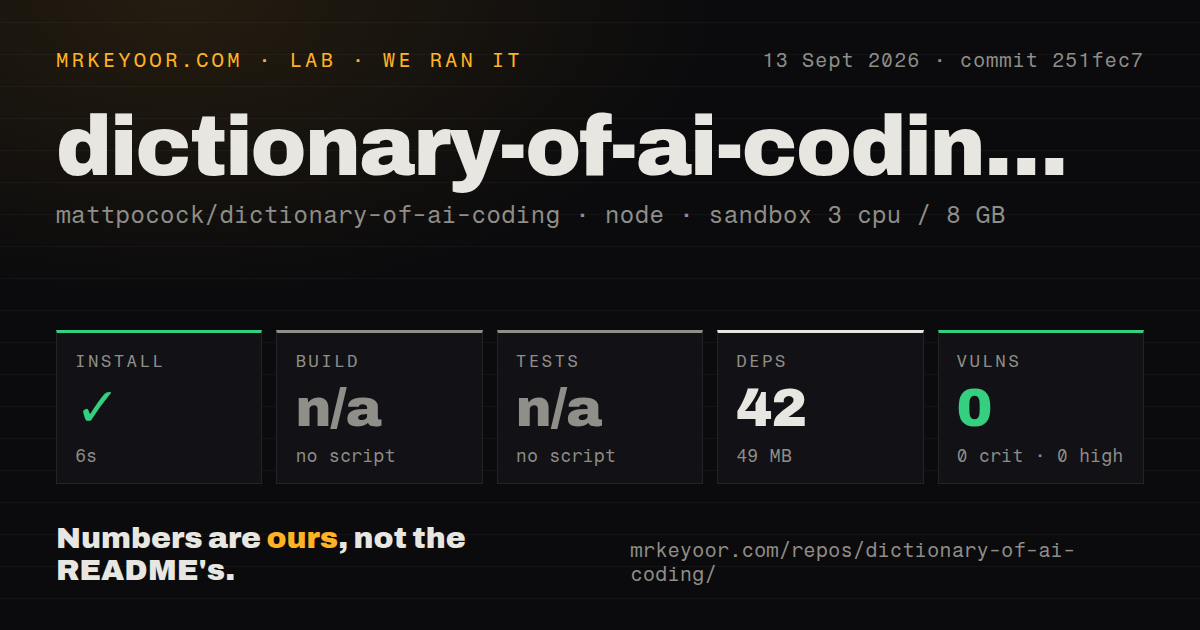
Our sandbox installed commit 251fec7 in 6 seconds, adding 42 npm packages and consuming 49 MB on disk. Npm audit reported 0 known vulnerabilities. The repository itself measured 0.3 MB, with 88 files and about 168 lines of source code. Most of the value sits in Markdown, while the small TypeScript generator assembles those entries into the README from an internal curriculum and template.
There was no build script or target, so the lab skipped the build step. There was also no test script or target, so no tests ran. That is less alarming here than it would be for a library because the deliverable is prose, yet generated content still benefits from a freshness check. The lab found 2 workflow files used for CI and no tests directory. Nothing in this run checked links, factual accuracy, entry completeness, or consistency between definitions.
Three requested terms are still absent from the 69-entry set
The 69-file dictionary still omits eval, quantization, and distillation, each requested in an open issue. Eval is especially central to current coding-agent practice because teams use it to compare prompts, models, tools, and end results. Its absence makes the dictionary less complete for readers moving from casual agent use into repeatable assessment. Quantization and distillation sit closer to model production, so leaving them out is more defensible under an AI-coding scope, though their requests show readers expect some model vocabulary too.
Issue 10 raises a narrower accuracy question about non-determinism. The entry says identical context may produce different output and presents this as inherent to model use; the issue asks whether a controlled random seed changes that claim. The discussion has 7 comments and remains open. A 69-file glossary benefits from this kind of scrutiny, but readers should not quote a compact explanation as if its boundaries have been agreed by the field.
The 88-file repository has no license for reuse
The 88-file repository contains no LICENSE file, and GitHub detects no license. Issue 21 explains the practical cost: people want to adapt the entries for consulting, tools, teaching, and translations, while another open request seeks permission for a German edition. Public source is readable source, not automatic permission to reproduce it. Until the author adds terms or grants permission, organizations should link to the dictionary and write their own definitions when redistribution is part of the plan.
The generated README joins 69 files with an internal curriculum and template. Issue 19 reports that running the generator at commit 251fec7 changed the header URL and image assets because the committed README lagged behind its template. The reporter says dictionary content was unaffected. Even so, a generated reference should make freshness verification a required check so source edits and the public artifact cannot drift unnoticed.
July code and September contributions show uneven maintenance
The last push was July 2, 2026, while GitHub showed 4,554 stars and 20 combined open issues and pull requests. Contributor activity continued into September: current pull requests address output-token wording and malformed frontmatter, while issues request missing terms. That combination is not evidence of abandonment. It does show that interest and proposed fixes are arriving faster than changes have recently reached the main branch, and there is no release tag to mark an editorial edition.
For a 69-file reference, the alternatives move quickly into longer study. Microsoft offers a fuller course with lessons and code; the Hugging Face Agents Course moves from vocabulary into agent construction; the Agent Skills specification is the authoritative choice for that one packaging standard. Dictionary of AI Coding is faster than all three when the immediate problem is a muddled conversation about context, tokens, handoffs, or review. Keep the link, question the prescriptive parts, and do not build licensed derivative material from it yet.