Forty-two notebooks work better as a syllabus than a dependency
The README maps 42 notebooks across foundational RAG, query enhancement, context enrichment, advanced retrieval, evaluation, memory, explainability, and larger architectures. That breadth is the reason to open this repository. You can put semantic chunking beside contextual compression, compare reranking approaches, then inspect Graph RAG or corrective RAG without finding each idea in a different blog. Most entries link to Colab, and the better notebooks explain the method before showing code.
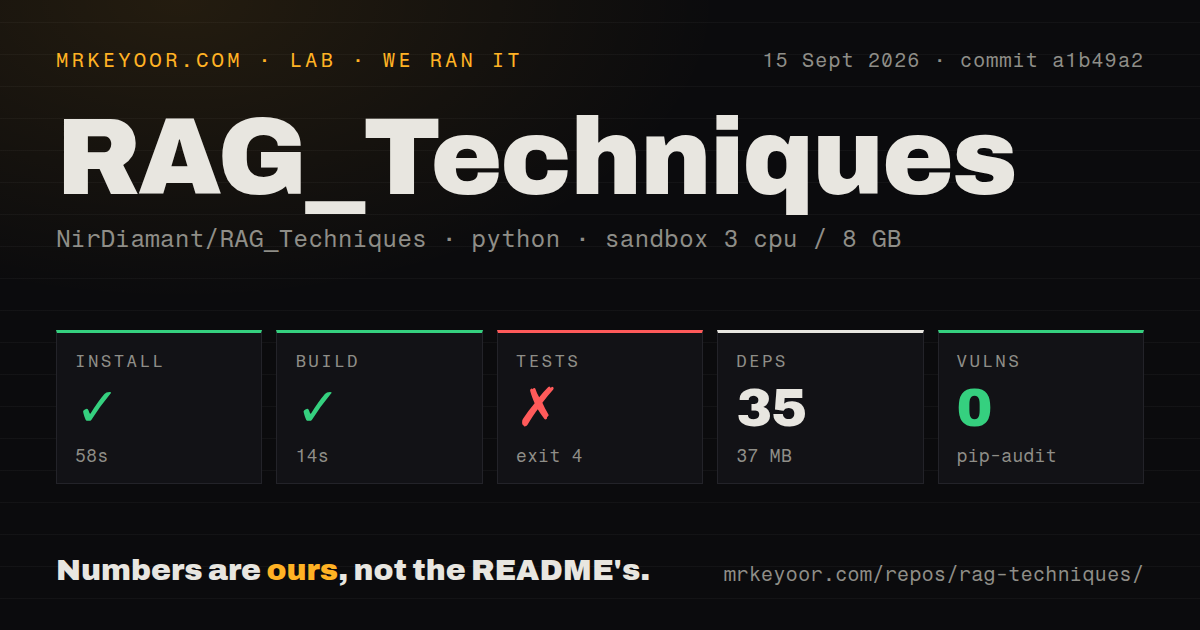
The checkout is smaller than the table of contents suggests. Our sandbox counted 134 files, about 4,897 lines of source, and 20.3 MB at commit a1b49a2. Much of the useful material lives in notebook prose, diagrams, and compact example code. This makes RAG_Techniques good for answering an early design question: which retrieval experiment deserves a week of your time? It does not supply the packaging, interfaces, or operational controls needed after that answer.
Seven of 41 notebooks had a no-paid-key path in August
In an August 2026 issue response, the maintainer counted 7 of 41 notebooks with a genuine no-paid-key route using Ollama, Hugging Face, or local embeddings. The remaining examples leaned more heavily on hosted services. The basic RAG notebook prompts for an OpenAI key, builds embeddings with OpenAI, and says its evaluation path currently works only with OpenAI. That is a real expense and access constraint for a tutorial collection aimed partly at learners.
The local option needs careful reading too. Its title promises a fully local pipeline, then the code requires HUGGINGFACEHUB_API_TOKEN and uses the Hugging Face Inference API for generation. A later cell explains that offline generation requires replacing that endpoint with a local pipeline. Our 35-package sandbox environment never reached this distinction because collection failed sooner. Treat every notebook as an independent example and inspect its cells before deciding what credentials or model downloads it needs.
What happened when we ran it
Our sandbox installed commit a1b49a2 in 58 seconds, adding 35 packages and using 37 MB on disk. The build succeeded in 14 seconds. Those are modest numbers for a Python tutorial repository, and pip-audit found 0 known vulnerabilities in the installed set. The clean setup result does not prove that every notebook's cell-level requirements are present, since the repository has no root dependency file that declares the whole collection.
Tests stopped after 17 seconds with exit 4. Pytest was loading tests/conftest.py when Python raised ModuleNotFoundError: No module named 'langchain_openai'. No tests were collected, so there is no pass count to report. The log shows a missing import and nothing more. It does not tell us whether adding that package would uncover further failures, and we will not turn one clear error into a theory about the rest of the suite.
The non-commercial license rules out ordinary product reuse
Section 1.3 of the custom license prohibits commercial use without prior written permission. It also requires attribution for permitted non-commercial use. The contributor terms grant the licensor an exclusive, perpetual right to use submitted contributions for any purpose, while contributors retain non-commercial rights to their own work. A company evaluating code for a paid product should have counsel read those terms before copying a helper, notebook, or diagram. GitHub reports the license as NOASSERTION, which fits the custom text.
Reproducibility has a separate paper cut. The repository has 2 CI workflow files and a tests directory, yet the current tree has no requirements.txt. Both workflows still run pip install -r requirements.txt before pytest. Our run's missing langchain_openai import is therefore consistent with a visible gap between the automation and the checked-in files. There is also no Dockerfile. Colab cells can get an individual lesson moving, but they are not a shared environment contract for all 42 notebooks.
A September push matters more than the April book release
GitHub recorded 29,489 stars and a push on September 15, 2026, the day we fetched the repository. The combined open count was 5, split into 1 issue and 4 pull requests. Several documentation pull requests had also closed in late August and early September. That is current activity, not an abandoned notebook dump. The small open count should not be read as a defect total because GitHub combines issues and pull requests in its repository figure.
The latest release, book-v1.0, was published on April 15, 2026 and announces a paid visual companion book. It is not a versioned code release for the notebooks. That distinction matters when you are looking for upgrade notes or a stable dependency set. Recent pushes show maintenance, while the release history does not give application teams a code version to pin. The repository behaves more like an updated publication than a conventional Python package.
Use it to choose an experiment, then rebuild the experiment yourself
RAG_Techniques earns its place in a research bookmark folder because 42 worked-through topics are easier to compare than scattered posts. Start with the smallest notebook that matches your retrieval problem. Read the explanation, run the cells in an isolated environment, and record the inputs and evaluation method. Then carry the idea into a project that owns its dependencies, tests, service boundaries, and data policy. Copying the repository wholesale buys breadth you probably will not exercise.
The decision is sharper for commercial work. A 58-second install and 14-second build make exploration cheap, while the custom license blocks casual production reuse and the test suite did not begin. Use the examples to learn how a method is assembled. If the method survives your own corpus and evaluation, implement it under terms and packaging your team can support. The missing dependency at the test door is a useful warning: the notebook is the lesson, not the warranty.