mrkeyoor.com_
Tue 29 Sept 06:36 UTC
AI Toolsevaluationupdated 29 Sept 2026

unreel review

UNREEL is a Next.js streaming site that writes an episode in batches and generates each video clip while the previous clip plays. It demonstrates an endless AI channel using fal-hosted video, image, and language models, with one mode for continuous stories and another for hard-cut comedy channels.

Verdict

Our sandbox built UNREEL in 26 seconds, but npm audit found 2 vulnerabilities and the repository provides no test target. Treat it as a sharp demonstration of live clip buffering and frame chaining, with a paid fal account and private fork ready. Its absent license, thin maintenance record, and missing production controls rule it out as a service you should expose unchanged.

We ran it

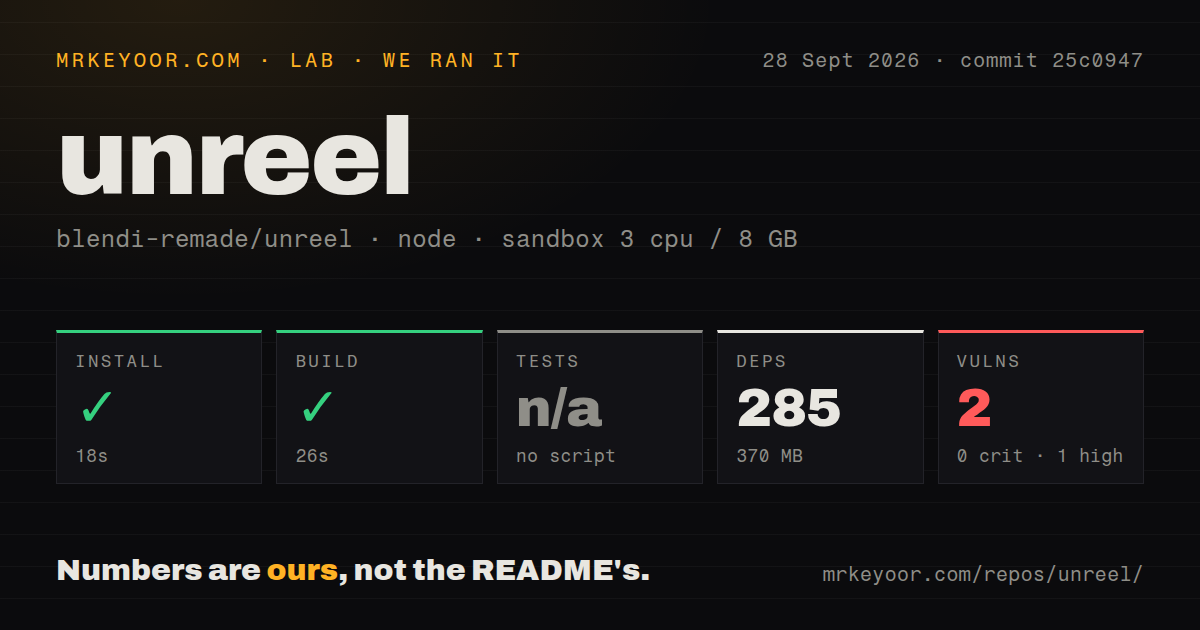
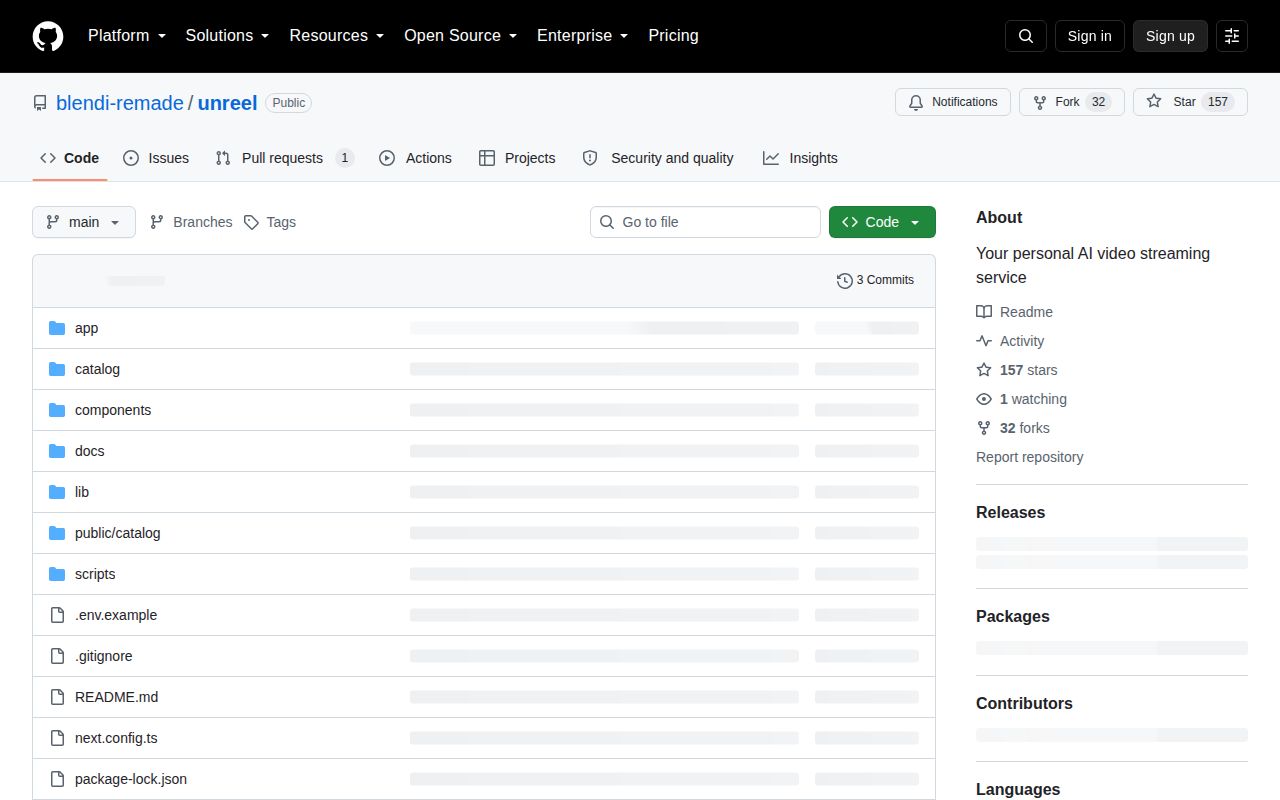
Lab card: what happened when we ran unreelScreenshot of unreel (github.com/blendi-remade/unreel)
Install✓ · 18s285 packages · 370 MB
Build✓ · 26s
Testsn/ano test script
Known vulns20 critical · 1 high · 1 moderate · 0 low (npm audit)
Repo54 files~2,610 lines of source · 9.5 MB · 0 CI workflows

Answers from our run

Does unreel build from source?

Dependencies installed in 18 seconds (285 packages), and the build succeeded in 26 seconds. We cloned commit 25c0947 into a clean Debian container with 3 CPUs and no project-specific setup.

Does unreel have tests you can run?

Not through a standard command: the project exposes no test script or target that our harness could run.

Does unreel have known vulnerabilities in its dependencies?

npm audit flagged 2 known advisories in the dependency tree at the time of our run.

Who should not use unreel?

Teams that require an explicit open-source license: GitHub reports no license, and the repository tree has no LICENSE file.

What are the alternatives to unreel?

Remotion, ComfyUI, Wan2.2. Our sandbox built UNREEL in 26 seconds, but npm audit found 2 vulnerabilities and the repository provides no test target.

Setup3/518-second install; playback needs a paid fal key and generated assets
Docs4/5The buffer, model choices, costs, and title format are explained
Community1/5157 stars, 1 open PR, and no source push since launch day
Maturity1/5No license, tests, CI, release, auth, or spending controls

Who it’s for

Frontend engineers studying how to buffer live-generated video without showing a spinner between every clip.
Creative coders who already have a fal account and want a compact example they can pull apart.
Teams prototyping short AI channels where 480P output and per-viewer generation costs are acceptable.
Next.js developers interested in same-origin media proxying and browser frame handoffs for image-to-video continuity.

Who it’s NOT for

Teams that require an explicit open-source license: GitHub reports no license, and the repository tree has no LICENSE file.
Production services that need automated regression checks: package.json has no test script, the repo has no tests directory, and our lab had no test target to run.
Public deployments without their own authentication, quotas, and spend controls: viewers trigger paid fal generation through the server proxy, while the app ships no account or budget layer.
Buyers who need a model-neutral or self-hosted pipeline: the stream is wired to fal, MiniMax H3 Max Turbo, Nano Banana 2, and Gemini 2.5 Flash.
Security-sensitive teams that require a clean dependency audit before evaluation: our npm audit found 1 high and 1 moderate vulnerability.

Setup reality

Our fresh Debian sandbox installed commit 25c0947 in 18 seconds, adding 285 packages and using 370 MB on disk. The build succeeded in 26 seconds. There was no test script or target, so tests were skipped; npm audit reported 2 known vulnerabilities, 1 high and 1 moderate.

Local playback needs a fal API key. Building the included shelf also runs a paid catalog job for the covers and previews; the README says existing assets are skipped unless you force a rebuild. No database or separate worker is documented.

The app fixes story output at 480P and depends on generation finishing ahead of playback. A public version needs authentication, request quotas, cost caps, abuse handling, and deployment monitoring that this repository does not include.

Each 8-second clip buys time to generate the next one

UNREEL begins with a pre-rendered preview, then asks a showrunner model for the first live shot. Story clips start from the final frame of the previous clip, while comedy channels use independent hard cuts. The player queues completed videos and switches when the current one ends. The governing idea is easy to see in the code: playback time becomes the generation window for whatever comes next.

The README says an 8-second story shot at 480P takes about 2.5 seconds to render on MiniMax H3 Max Turbo. That is the author's figure, not one we benchmarked. In the implementation, the showrunner requests 1 shot, then 4, then batches of 10. Story rendering stays serial because each clip needs the previous frame; chaos mode can generate 2 clips at once. The queue holds up to 3 ready clips.

Continuity comes from a browser frame grab, not a character model

For a story, the browser loads a generated clip through a same-origin media route and captures its last frame. That image becomes the starting input for the next image-to-video request. The proxy accepts only HTTPS URLs on fal.media or its subdomains, which narrows the route instead of fetching any URL a caller supplies. If a frame capture fails, the stream falls back to a hard cut.

This is clever, but visual continuity still depends on the video model following the frame and prompt. The code does not track characters as structured entities or correct drift after generation. Dialogue follows a prompt rule: 1 quoted line is sent to the model and repeated as the caption. The README says speech was checked with Whisper, but the repository includes no repeatable speech evaluation or sample result set.

What happened when we ran it

Our sandbox installed commit 25c0947 in 18 seconds. The checkout contained 54 files, roughly 2,610 lines of source, and occupied 9.5 MB. Npm added 285 packages, bringing disk use to 370 MB. The Next.js build completed successfully in 26 seconds inside an unprivileged Node 22 container with 3 CPUs, 8 GB of RAM, and no secrets.

There was no test script or target, so the lab skipped tests rather than inventing a command. Npm audit reported 2 known vulnerabilities: 1 high and 1 moderate, with 0 critical and 0 low. Our scan found no CI workflow, Dockerfile, or tests directory. We did not run a live stream because the sandbox had no fal key, so this run says nothing about clip quality, continuity, latency, or viewing cost.

A paid fal key sits behind every generated minute

The app uses fal for the showrunner, video clips, covers, and previews. FAL_KEY stays on the server, and the browser talks through @fal-ai/server-proxy. That protects the literal credential from client JavaScript. It does not create user accounts, quotas, or a spending ceiling. Anyone allowed to use the deployed interface can start generation that reaches the paid account behind it.

The README estimates that a 10-minute viewing session costs well under $1 at the stated Turbo rate, plus language-model calls. It also prices the one-off catalog job per cover and preview. Those are upstream price claims and can change. A serious fork needs per-user limits, cancellation behavior, request logs, rate limiting, and a hard budget outside the UI. Closing a tab is the only stop instruction the README gives.

The 54-file app is easy to read and hard to adopt unchanged

The stack is intentionally narrow: Next.js 15, React 19, TypeScript, and 4 runtime dependencies in package.json. Titles live in one catalog file, branding lives in another, and the central queue fits in lib/stream.ts. That makes UNREEL unusually approachable as an example. Adding a title means supplying its premise, visual style, key-art prompt, preview prompt, and mode.

The repository has no stated license, which blocks a straightforward open-source adoption decision. It also has no tagged release. GitHub showed 157 stars and 1 open issue or pull request on September 29, 2026; that open item was a pull request for Mixpeek search. The repository was created and last pushed on September 3. A documentation pull request was closed on September 8, but issue activity is not the same as maintained source.

The missing controls matter more than the polished browse screen

UNREEL proves that a generated stream can feel immediate when a cold open hides the first request and later clips arrive ahead of playback. Its code also makes failures visible: a missed batch is retried, a failed frame grab becomes a cut, and a late first clip can hold the last preview frame. Those are useful product decisions packed into a small project.

They do not cover production ownership. There is no login, billing allocation, moderation queue, persistence, multi-user isolation, test suite, CI gate, or documented deployment path. Our 26-second build proves the snapshot compiles. The 2 audit findings and absent tests show why it should remain a private experiment until a team supplies the operational layer and receives clear permission to use the code.

Alternatives

ProjectWhat it isPick it when
Remotion gh↗A React framework for deterministic, code-driven video composition and rendering.pick this instead when repeatable output and an editable timeline matter more than generating an endless stream live.
ComfyUI gh↗A node-based interface and runtime for building local generative media workflows.pick this instead when you want local model control, reusable graphs, and your own GPU infrastructure.
Wan2.2An open video-generation model family for text-to-video and image-to-video work.pick this instead when self-hosting the video model matters more than UNREEL's ready-made streaming interface.

What people are saying

  1. [velocity-scout] blendi-remade/unreel

Sources

  1. UNREEL README
  2. Streaming state machine
  3. fal client and model configuration
  4. Media proxy route
  5. Package manifest

More ai tools reviews

wechat-intelligence-hub · dlss5-visual-enhancer · ABot-Recon · camera-to-blender · DLSS-NR-on-AMD · commerce-agents · the whole board →