
The repository documents a product it does not contain
UNIGIT describes an AI workbench where models can use tools, handle files, preserve project context, switch providers, and return usable deliverables. Those are product claims and directions. The repository gives you no code path for checking them. Its README explicitly identifies the project as a public brand and ecosystem hub, while the runtime remains proprietary.
The boundary document is detailed across 22 tracked files. It excludes desktop, mobile, server, admin, website, routing, billing, tool execution, context management, task recovery, marketplace internals, production infrastructure, and test evidence. Public material may eventually include stable contracts, mock hosts, manifests, and synthetic examples. None of those product-facing artifacts is present in the current tree.
The public-private boundary is specific enough to be useful
Many commercial repositories leave visitors guessing whether source is missing by accident. UNIGIT names what stays private and why. It also says the public repository has a separate directory and Git history, with no synchronization relationship to internal worktrees. Contribution rules prohibit customer data, credentials, private history, production configuration, and examples derived from anonymized customer material.
That honesty improves due diligence without making the product open source. The MIT license covers included code, text, and synthetic examples, while TRADEMARKS.md withholds rights to use the UNIGIT name or marks in a product or identity. Prospective partners should also note that a public listing does not establish integration, endorsement, quality, compliance, or long-term availability.
What happened when we ran it
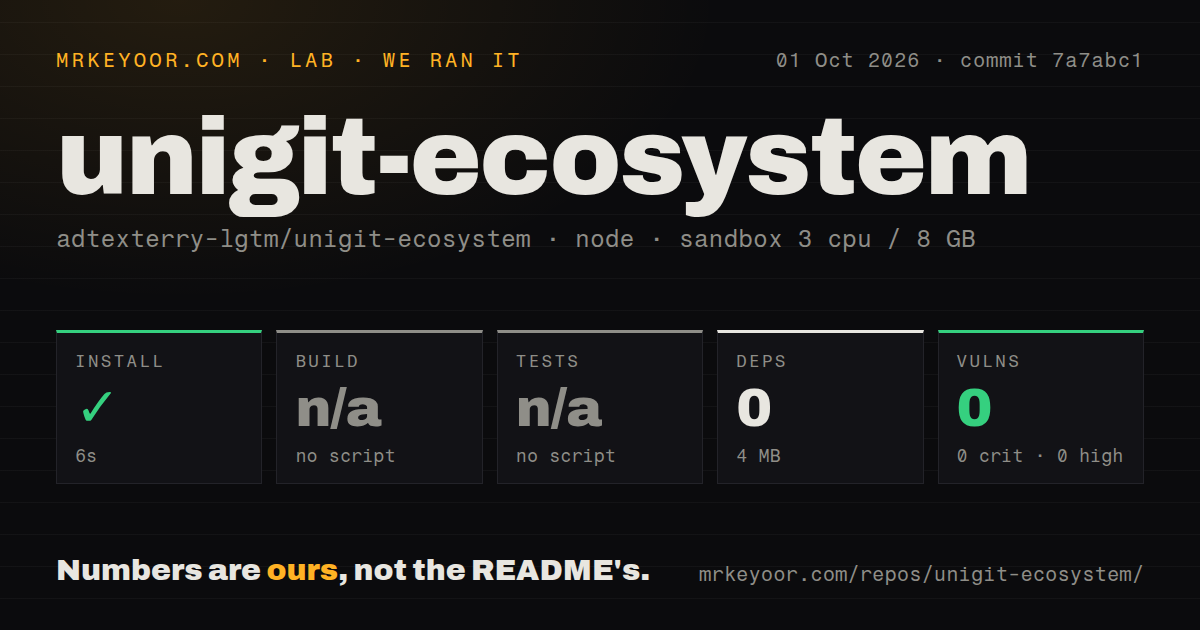
Our Node 22 sandbox installed commit 7a7abc1 in 6 seconds. Npm installed 0 packages, and disk use was 4 MB. There was no build script, so the build step was skipped. There was also no test script, so no test suite ran. Npm audit found 0 known vulnerabilities across an empty dependency tree, including 0 critical, high, moderate, and low findings.
The repository does have one executable check outside the lab's build and test targets. npm run verify invokes a Node script that reads tracked Git files. A GitHub Actions workflow runs it on pushes to main and on pull requests. That is publication hygiene for this hub; it does not exercise the workbench, website, download, provider routing, file handling, or partner integration.
The boundary check covers a narrow leak pattern
The verification script rejects 4 categories of forbidden paths, including .agents, private application directories, infrastructure folders, and .env files. It also looks for 4 secret shapes: private-key headers, GitHub tokens, AWS access keys, and strings beginning with sk-. Text files from an allowlist are scanned, while other file extensions are skipped.
This is a useful backstop, though the scope document promises a wider publication review. It says releases should pass secret scans, path scans, link checks, and manual diff review. The script performs the first two in limited form. It does not check links, entropy, generic passwords, other cloud credentials, image metadata, or whether public prose exposes private architecture. Manual review still has to catch disclosures the patterns miss.
Ecosystem participation is currently an intake form
The repository has structured issue forms for resource recommendations and partnerships. A resource submission should include a public source, license, maintenance status, and representative use cases. UNIGIT says it will assess task value and verify basic source and security facts. Sensitive commercial or customer material belongs outside the public issue flow.
There is no public catalog entry, manifest schema, SDK, signing method, permission model, or integration test in the 22-file checkout. The README labels model discovery, capability installation, a marketplace, and a knowledge base as next or future directions without delivery dates. A tool author can introduce a project today, but cannot build against a published UNIGIT extension contract from this repository.
Stars do not substitute for product activity here
GitHub showed 1,318 stars and 45 forks on October 1, 2026. The repository was created and last pushed on September 2. It has no GitHub release and no open issues or pull requests. Its only issue was an automated GitHub connector acceptance event opened and closed on September 7. That event confirms a connector touched GitHub; it says nothing about user-facing workbench quality.
The dates describe a young, quiet public hub. They do not prove abandonment because the product is developed elsewhere, and they cannot prove health for the same reason. Product buyers need evidence from the downloadable application, release notes, support record, privacy terms, and their own files. This repository can only be judged on documentation and contribution handling.
Open WebUI is the clearer choice when code access matters
UNIGIT may suit someone who wants a packaged commercial workbench and accepts a private core. This repository alone cannot support that buying decision. It contains a coherent vision, a careful disclosure boundary, and a partner door. It lacks the runtime, product tests, release history, and extension surface needed for technical evaluation.
Open WebUI, Dify, and LibreChat expose working implementations that teams can inspect and host. They are larger operational commitments, but their public code lets an engineer verify authentication, data paths, model connectors, and deployment behavior. Use UNIGIT Ecosystem for contact and policy. Use a public runtime when local proof and control are requirements.