Six files do not contain the desktop client
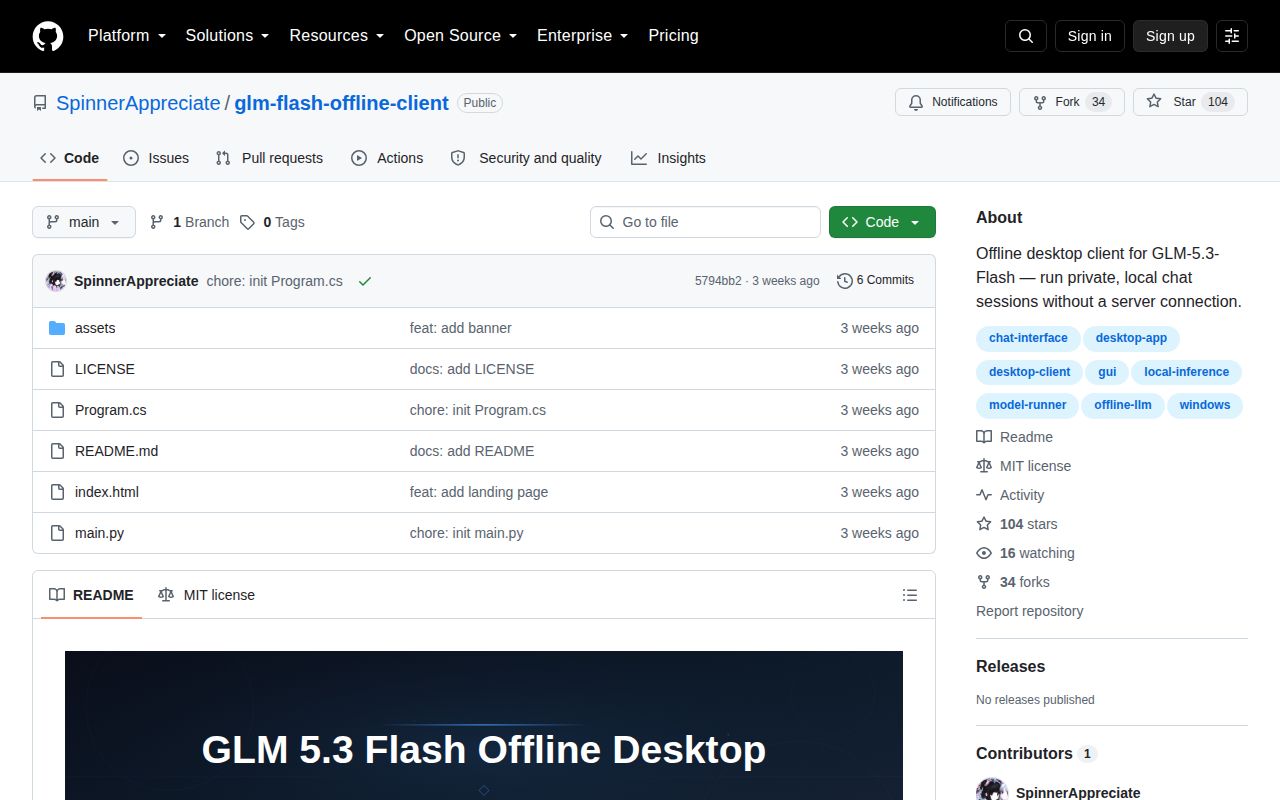
GLM Flash Offline Client makes a useful promise: run a fixed language model on Windows, keep prompts on the machine, and avoid metered cloud APIs. The repository does not supply the software needed to check that promise. Our checkout at commit 5794bb2 contained 6 files, occupied 1 MB, and had about 2 lines of source by the lab count. Both files that look like implementation entry points, Program.cs and main.py, are zero bytes.
The README says the repository is the official documentation hub and sends readers to a GitHub Pages site for an 8 GB archive. GitHub itself has no published release for the project. That separation matters. A reviewer cannot trace the claimed executable back to the MIT-licensed repository, reproduce a build, or compare a downloaded binary with a tagged source commit. For software meant to read private legal, medical, or HR text, that missing chain is a reason to stop.
The 1,013,246-byte landing page hides its behavior
The checked-in index.html is 1,013,246 bytes and consists of heavily obfuscated JavaScript inside a bare loading page. Static inspection did not reveal a normal download link in readable markup. Obfuscation alone does not prove harmful behavior, and we did not execute the page or fetch any binary it might request. It does make the project's only delivery route harder to examine than a normal GitHub release with named assets and checksums.
The README goes much further than the repository evidence. It claims CPU and NVIDIA GPU modes, a 128K context window, conversation export, batch processing, an SQLite history store, and a live performance panel. It also says the binary comes from a clean Rust and C++ codebase with telemetry excluded. No Rust or C++ source appears in the 6-file checkout. These may describe an external binary, but the repository gives a developer no way to confirm them.
What happened when we ran it
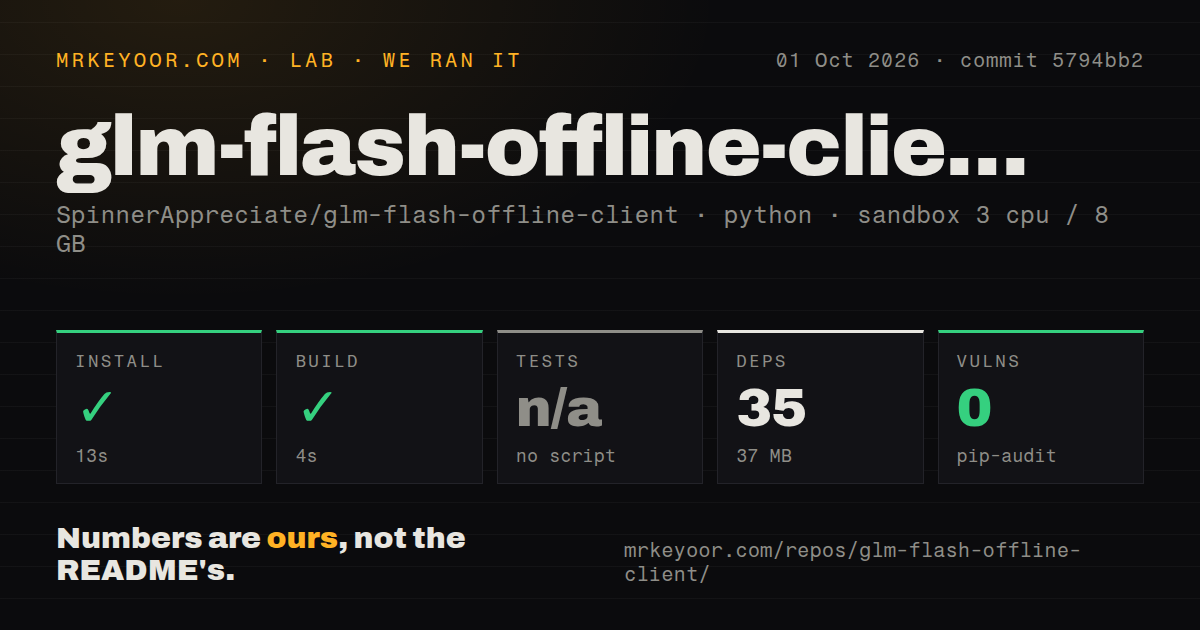
Our sandbox installed commit 5794bb2 in 13 seconds. The Python-oriented harness added 35 packages and used 37 MB on disk, then its build step succeeded in 4 seconds. Pip-audit found 0 known vulnerabilities in that installed environment. The container had 3 CPUs, 8 GB of RAM, Python 3.12 on Debian, no secrets, and no elevated privileges.
There was no test script or target, so the test stage was skipped. The repository also has no tests directory, CI workflow, or Dockerfile. A successful dependency install and build can look reassuring on a result card, but those checks did not compile, launch, or test the Windows program described in the README. The 35 installed packages belong to the path our harness found, while the advertised application is distributed elsewhere.
That distinction is the whole review. Our run establishes that the small repository passes two automated steps and that its Python environment had no known advisory in pip-audit. It does not establish that an 8 GB archive exists, that its executable works offline, or that it sends no telemetry. We measured no model quality, token rate, memory use, or Windows compatibility, and the repository provides no test result that could fill those gaps.
The hardware claims have no reproducible test behind them
The README gives unusually exact requirements: Windows 10 or 11, 16 GB of RAM minimum, 32 GB recommended, 10 GB of free storage, and an optional GTX 1060 with 6 GB of VRAM. It also estimates 10 to 15 tokens per second on a modern laptop with 32 GB of RAM. None of those figures came from our lab, and this repository contains no benchmark script, model manifest, or binary release with which to repeat them.
There is a smaller contradiction in the setup guidance. One section says the app has no dependency on the Visual C++ Redistributable beyond what Windows includes. Troubleshooting later tells users with a missing DLL to install the latest Microsoft Visual C++ Redistributable. Either instruction could make sense for a particular build, but there is no published build metadata here to settle which runtime is required.
One day of commits is the entire visible history
The repository was created on September 8, 2026, and all 6 visible commits landed within roughly 3 minutes. The last push was September 8. GitHub showed 104 stars, 34 forks, and 0 open issues and pull requests on October 1, 2026. Zero open reports can mean a clean queue; with no application source, releases, tests, or subsequent commits, it does not demonstrate that users have exercised the claimed client.
The MIT license covers the material in the repository. The README separately says bundled model weights have their own terms in a THIRD_PARTY_NOTICES file inside the download archive, a file that is absent from the checkout. A company cannot complete a license review from the repository alone. It would need the external archive before it could even read those additional terms.
Choose a local runner you can inspect
Ollama, KoboldCpp, and text-generation-webui solve overlapping local-inference jobs while exposing their implementation and release history. They still require normal diligence around model licenses, network behavior, and downloaded weights. The difference is that a technical buyer can inspect the code path, follow build instructions, and compare published artifacts with a visible project history.
GLM Flash Offline Client asks for trust at the exact point where an offline tool should provide evidence. Our 13-second install does not repair that gap. Until the actual client source, a reproducible build, and a verifiable release appear, the sensible decision is to leave the download alone.