Tutti shares work among agents you already pay for
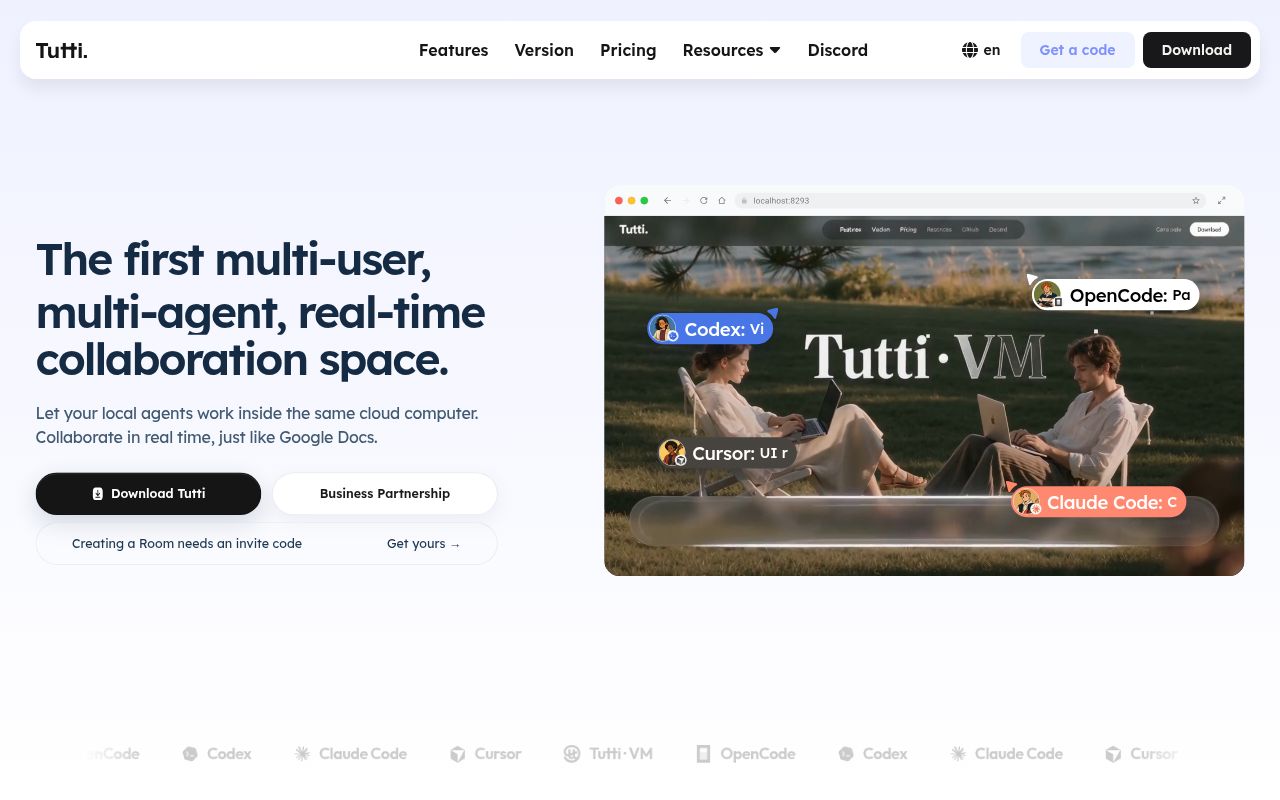
Tutti wraps several coding agents in one desktop workspace. Claude Code can create a plan or backend, Codex can continue from that work, and Hermes can join through its supported connection. Conversations, local files, app results, running tasks, and approvals sit in the same interface. The aim is specific: stop making the user summarize one agent's work and paste it into the next agent's chat.
The open-source local edition runs agents on your machine and keeps working state local, according to the README. It uses existing subscriptions rather than selling model access. Current support names 3 agent families: Claude Code, Codex, and Hermes. OpenClaw is described as in development. This matters because Tutti is an orchestration layer around those tools, so its value rises or falls with the set you already use.
The desktop app covers files, tasks, apps, and approvals
The shared workspace goes beyond chat history. A user can reference prior conversations, files, app invocations, and tasks through @, or add local files and generated outputs with +. A control center collects running work and actions waiting for approval. Tutti also includes apps for image generation, interface design, documents, and presentations, with outputs staying available to later agent steps.
That breadth can replace several improvised handoff folders, but it also makes Tutti the place where agents see project context. Decide which repositories, conversations, and outputs belong there. The security policy explicitly treats exposure of local files, credentials, agent session data, workspace state, and app outputs as in scope for vulnerability reports. A shared context store deserves the same access review as the agents connected to it.
What happened when we ran it
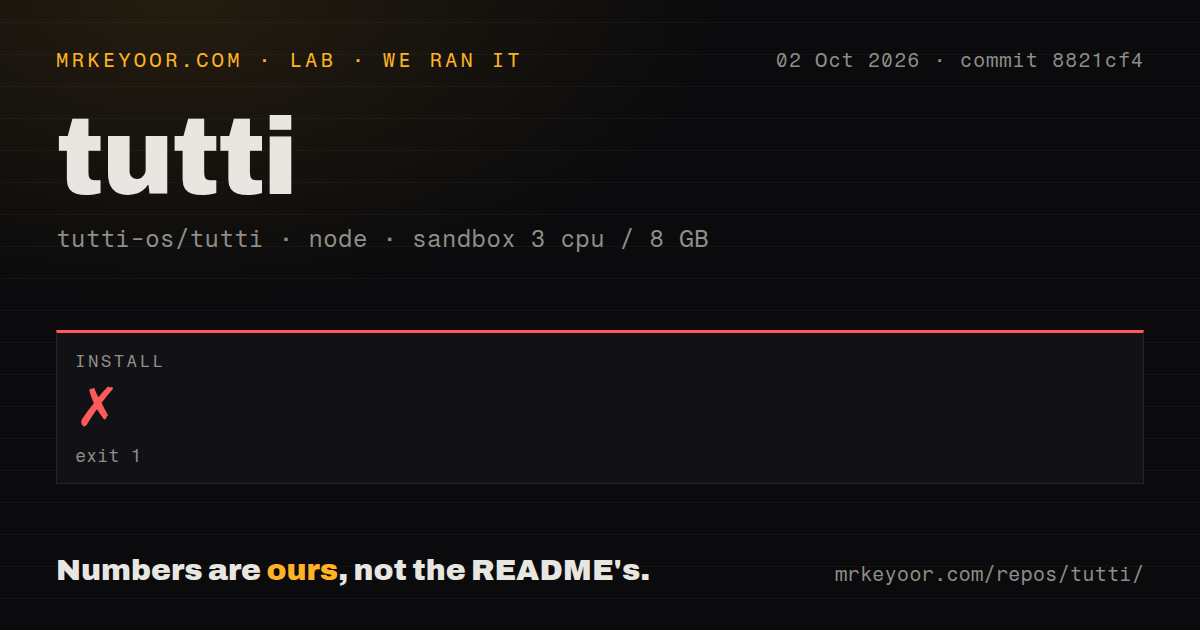
Our sandbox reached only the install step. Pnpm stopped with exit code 1 after 17 seconds while processing all 45 workspace projects. The final log repeatedly reported ERR_PNPM_CONFIG_CONFLICT_BUILT_DEPENDENCIES and said neverBuiltDependencies could not coexist with onlyBuiltDependencies. It also printed a warning that dangerouslyAllowAllBuilds was set to true.
The log does not identify which configuration source introduced both settings, so we will not assign a cause. The useful finding is that commit 97914ef did not install in our fresh unprivileged Debian container. Because installation failed, build and tests were not run. A contributor following the source guide may have a different machine configuration, but the documented pnpm install path was not reproducible in our stated environment.
This is a very large checkout to debug casually: 8,279 files, about 1,678,982 source lines, and 145.2 MB before dependencies. Our scan found 23 CI workflow files, no Dockerfile, and no tests directory at the root. Those signals show substantial automation around the repository, but they do not change the failed local install or supply a passing result for the commit we measured.
Source development needs Node 24 and Go 1.24
The contributor guide asks for Node.js 24 or newer, pnpm 10.11.0, Go 1.24, and golangci-lint 2.12.0. Electron powers the desktop shell, while a long-running local daemon holds the business core. TypeScript and Go both occupy large parts of the repository. The documented full check spans builds, type checks, linters, and separate TypeScript and Go test commands.
This is credible engineering documentation, with architecture records, conventions, troubleshooting notes, and source-of-truth rules. It is also a demanding contributor setup. A newcomer is preparing an Electron application, multiple package families, Go services, generated contracts, and native desktop releases. The packaged app is the sensible evaluation path if you want to judge the workflow rather than work on Tutti itself.
macOS and Windows get downloads, while Linux does not
The Quick Start links a universal macOS DMG and a Windows x64 executable. Release v0.2.30 provides separate macOS arm64, x64, and universal artifacts, plus a Windows x64 installer that the README labels unsigned. No Linux desktop download appears in the Quick Start or latest release assets. Linux developers can read and build the source, but they are not offered the same install path.
Version 0.2.30 was published on August 27, 2026. Its notes mention a fix for Tutti Agent authentication initialization, changes to provider setup, and new readiness troubleshooting. That release activity is current, and GitHub recorded another push on August 27. The project is moving quickly enough that provider behavior and setup guidance can change between desktop builds.
Agent discovery is narrower than the workspace pitch
The README makes multi-agent handoff the central reason to use Tutti, so discovery gaps carry more weight than a missing convenience feature. Issue 2617 reports that installed Qoder, TRAE, WorkBuddy, and ZCode command-line agents do not appear in tutti agent list. The request proposes either first-class adapters or a generic custom CLI registration path. Neither should be treated as shipped from an open proposal.
Issue 2412 describes a second boundary. Custom agents created in the GUI appear usable there but cannot be discovered by the CLI orchestration commands, according to the report. That prevents task plans from targeting the role definitions already configured in Settings. Users can fall back to built-in runtimes and inline role instructions, but then the GUI is no longer the single place defining the agent.
Tutti VM remains a waitlist product
The local app is for one person using multiple agents. Tutti VM is described as the future path for several devices and people, with working state shared through a cloud room while agents still run locally. The README repeatedly calls it coming soon and links a waitlist. Do not buy into Tutti today on the assumption that cross-device or team collaboration is already available.
For one developer who regularly hands projects between the 3 supported agent families, the local product addresses a genuine annoyance. The 17-second install failure keeps us from recommending the source route, while the packaged release makes a lower-cost trial possible on macOS or Windows. Test your actual provider mix first, because missing agent discovery defeats the handoff benefit faster than any interface polish can recover it.