Six passing tests support the small Go core
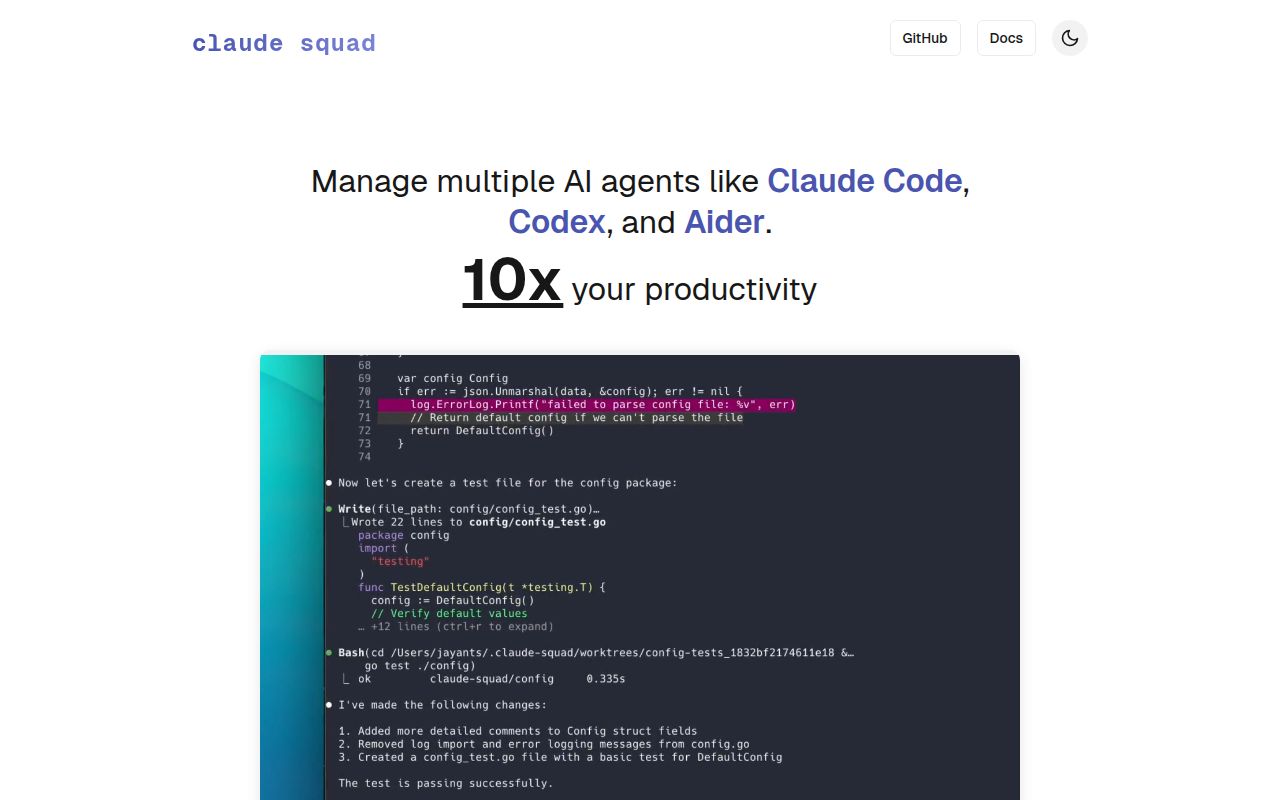
Claude Squad gives parallel coding agents a shared terminal dashboard. Each task runs under tmux in a separate Git worktree, so two agents can edit the same repository without writing into the same checkout. The interface shows sessions, terminal output, and diffs. From there you can attach to an agent, pause it, resume it, check out its work, or commit and push its branch. The design is understandable because it builds on tools developers already use.
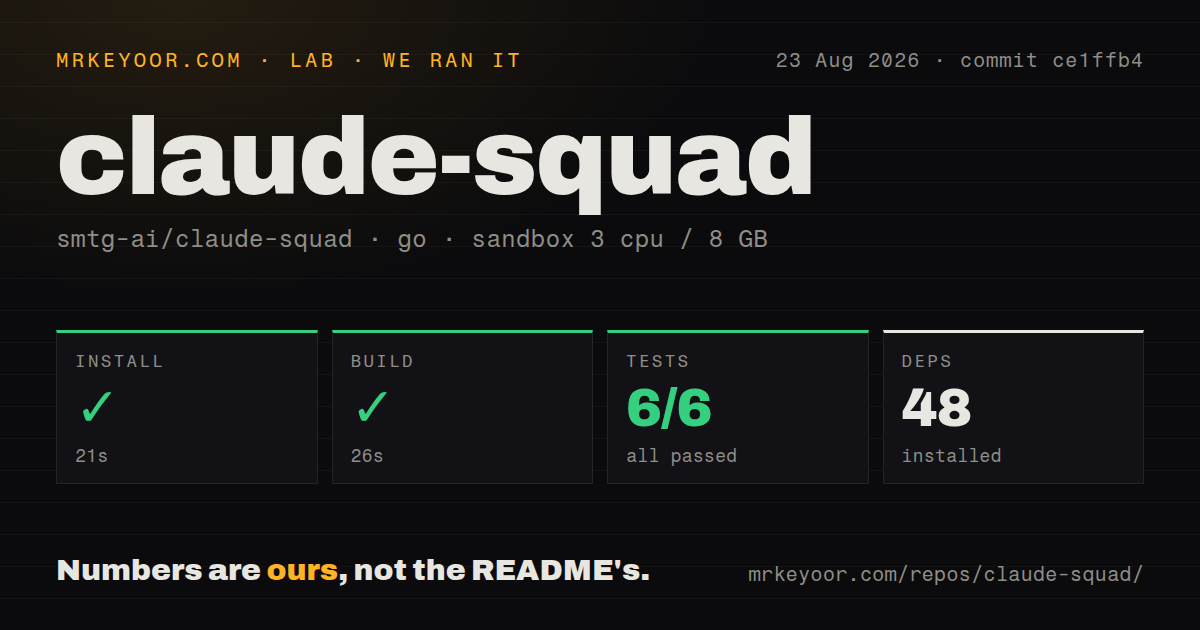
Our checkout was compact: 86 files, about 10,088 source lines, and 1.5 MB. The install fetched 48 Go packages in 21 seconds. Building took 26 seconds, then the test step passed 6 of 6 tests in 44 seconds. That result makes the source itself easy to trial. It says less about whether five agents can run your application's databases, ports, and dependency trees at the same time.
Worktrees prevent file conflicts but do not clone your environment
A Git worktree isolates tracked files and branch state. It does not include ignored .env files, a Python virtual environment, node_modules, local databases, or a unique port allocation. Open issue 260 describes new Claude Squad sessions starting without those pieces and asks for a setup hook. The reporter also calls out Docker Compose project-name collisions and multiple servers trying port 3000.
Plan for that gap before creating several sessions. A repository-specific script can copy safe configuration, install or link dependencies, assign ports, and create disposable databases. Keep real secrets out of the worktree when an agent does not need them. Claude Squad's isolation is useful, but it only covers Git. The 48-package Go install does not remove application-level shared state.
What happened when we ran it
Our sandbox installed Claude Squad in 21 seconds, adding 48 Go packages. The build completed in 26 seconds. Tests took 44 seconds and reported 6 passed, 0 failed of 6. We ran commit ce1ffb4 in an unprivileged Debian container with 3 CPUs, 8 GB of RAM, and no secrets.
The repository had 5 CI workflow files, no Dockerfile, and no tests directory. Go tests can live beside package code, so the missing directory does not conflict with the 6 passing tests. We did not launch Claude Code, Codex, Gemini, or Aider; authenticate to GitHub; create a real worktree; push a branch; or measure concurrent agent resource use. Those operations need user accounts and a repository with meaningful tasks.
tmux, gh, and an agent login are still prerequisites
The README requires tmux and GitHub's gh command. The default launched program is claude, and maintainers recommend its latest version. Codex users are told to export OPENAI_API_KEY, while other programs keep their own authentication rules. Named profiles in ~/.claude-squad/config.json can select commands such as claude, codex, or an Aider invocation with a local model.
That command flexibility is useful and risky. A profile is a shell command Claude Squad starts inside the worktree, so configuration deserves code-review discipline. The experimental --autoyes option automatically accepts prompts for Claude Code and Aider. Use it only in a disposable branch with narrow credentials and a clear task. A separate worktree can contain file damage, but it cannot undo an agent's network calls, cloud changes, or messages sent with available credentials.
Codex startup prompts can race the CLI
Open issue 266 reports that the prompt supplied through the new-session flow may be written before Codex has finished initializing. The described result is a blank waiting prompt: the intended task never arrives. The report traces the path to a direct PTY write and notes that readiness detection exists for some assistants but not Codex. That is a real concern for anyone launching tasks and immediately moving on.
Until the project confirms a fix, watch each new session long enough to see that the agent received its instruction. Release v1.0.20, published August 20, 2026, fixed recovery when a tmux session dies and corrected base-commit recording for sessions created from existing branches. Those changes show maintainers working on session state, but the release notes do not claim to solve issue 266.
Native Windows is a published binary without a working session path
Issue 275 reports that the v1.0.17 Windows binary launches its interface but fails as soon as the user creates a session. According to the report, the creack/pty dependency compiles through an unsupported stub on Windows and returns an error before tmux is invoked. The README does not state native Windows support limits. WSL may change the environment, but the issue says there is no native workaround for the tested binary.
GitHub showed 8,367 stars, 53 combined issues and pull requests, and a last push on August 20, 2026. v1.0.20 was released the same day, while issue 260 had activity on August 14. That is healthy current motion, paired with visible platform and orchestration gaps. On macOS or Linux, Claude Squad is a good supervisory layer for developers who review every branch. It does not yet make parallel agents automatic or consequence-free.