Synthetic evidence makes pipeline mistakes inspectable
Hypoarena generates artificial literature with planted causal chains, then runs hypotheses through verification, debate, and ranking. Because the answer is planted, a developer can ask whether the pipeline recovered it or lost it along the way. That is a useful task for a research toolkit. It gives you known inputs and inspectable artifacts before a real model makes the process harder to diagnose.
Our measured checkout contained 311 files and about 33,620 source lines in 1.3 MB. The scope includes citation-bearing graphs, paraphrase deduplication, hypothesis revisions, and Bayesian belief updates. Those pieces help investigate how a discovery workflow behaves. The README explicitly says the demonstration does not establish real scientific discovery capability. Keep that sentence attached to any attractive ranking chart or recovery result produced by the example.
What happened when we ran it
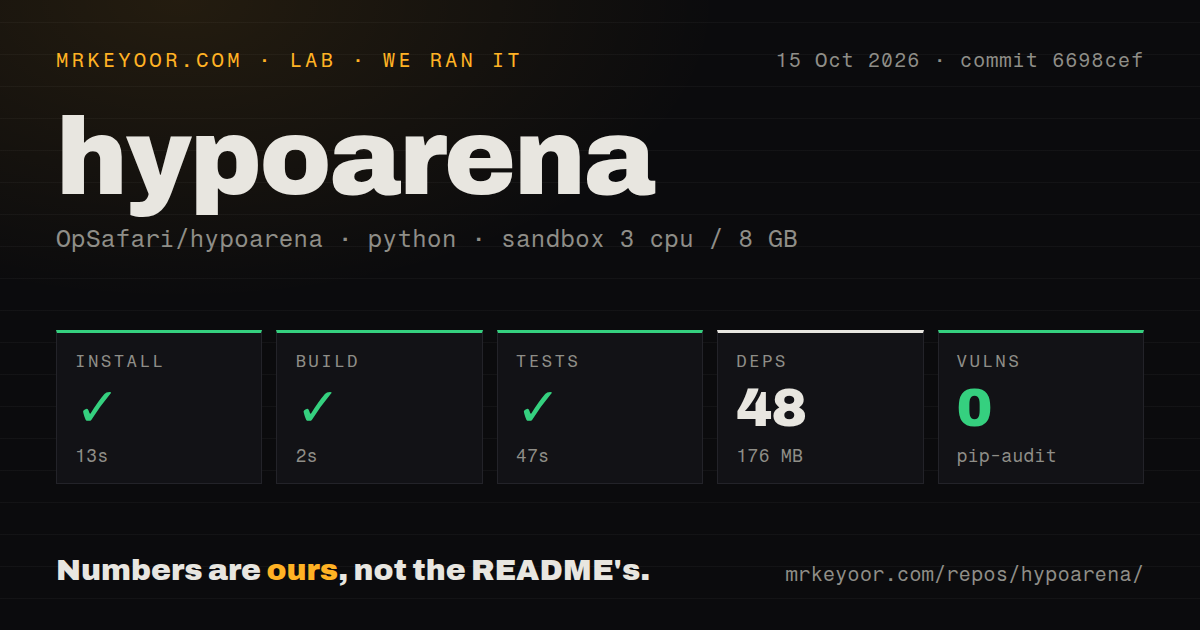
Our Hypoarena run installed 48 packages in 13 seconds, built in 2 seconds, and passed its test step in 47 seconds. We measured commit 6698cef on October 15, 2026, using the uv Python 3.12 Bookworm image. The fresh Debian container had 3 CPUs and 8 GB of RAM, ran without elevated privileges, and contained no secrets. Installation occupied 176 MB.
Pip-audit reported 0 known vulnerabilities in the audited environment. The scan found two CI workflows and a tests directory, with no Dockerfile. The supplied result gives no test count or breakdown by optional feature, so there is no basis for declaring every possible configuration covered. The supported finding is that the commands selected by our harness completed successfully in this container.
The 47-second test result says nothing about discovering a useful medical mechanism or extracting reliable claims from actual papers. Our measurement setup supplied no scientific discovery benchmark. The workbench's default operation avoids real models and downloaded weights, which helps explain why a successful local run is attainable without an inference service. It also places a clear limit on what the successful run proves.
Default operation needs no hosted model account
The package requires Python 3.11 or newer and uses NumPy in its core runtime. PyTorch is an optional extra for a small demonstration ranker. Scripted and replay adapters provide responses for the hypothesis loop. That arrangement suits teaching, debugging, and controlled experiments, particularly when a remote API changing its behavior would make yesterday's result difficult to reproduce.
Our 176 MB installed environment is a reasonable starting point for that offline work. Real-service integration is available through an OpenAI-compatible HTTP adapter, but remote endpoints require an explicit opt-in. The agent adapter documentation distinguishes loopback mock behavior from actual model evaluation. Configuring a provider changes the experiment, so keep its model choice and responses alongside the run artifacts.
Citation matching cannot establish scientific truth
The grounding verifier checks whether a cited document and character span exist, then applies overlap, polarity, and numeric checks. A fabricated quotation can therefore trigger a precise flag, which is useful when debugging a generated claim. The grounding reference also describes the limits: synonym changes can reduce overlap, direction words are not fully understood, and numeric comparisons ignore units.
A passing 47-second suite cannot make those heuristics understand a result's meaning. If a statement preserves a number while changing its unit, the documented matching rule can miss the distinction. For real literature, a reviewer must still examine methods, population, units, and whether the citation supports the causal claim. The workbench makes some errors visible, while leaving the scientific judgment with you.
Ranking and belief updates depend on supplied judgments
The tournament ranks hypotheses using rubric-based comparisons, and the belief stage accumulates graded evidence. In the offline examples, the quality ordering and evidence are constructed. Recovering that ordering demonstrates behavior under those assumptions. A higher-ranked hypothesis is not automatically more scientifically plausible, especially when the judge or evidence model changes outside the synthetic corpus.
Our 48-package run did not introduce a real model judge or verify real-world calibration. The optional ranker learns synthetic quality signals, as the project's honesty note explains. That is a useful example of a training loop, but adopting it for research requires defining what a correct judgment means in your field. The graph structure can remain valid while its underlying claims remain wrong.
The current issue queue questions resume provenance
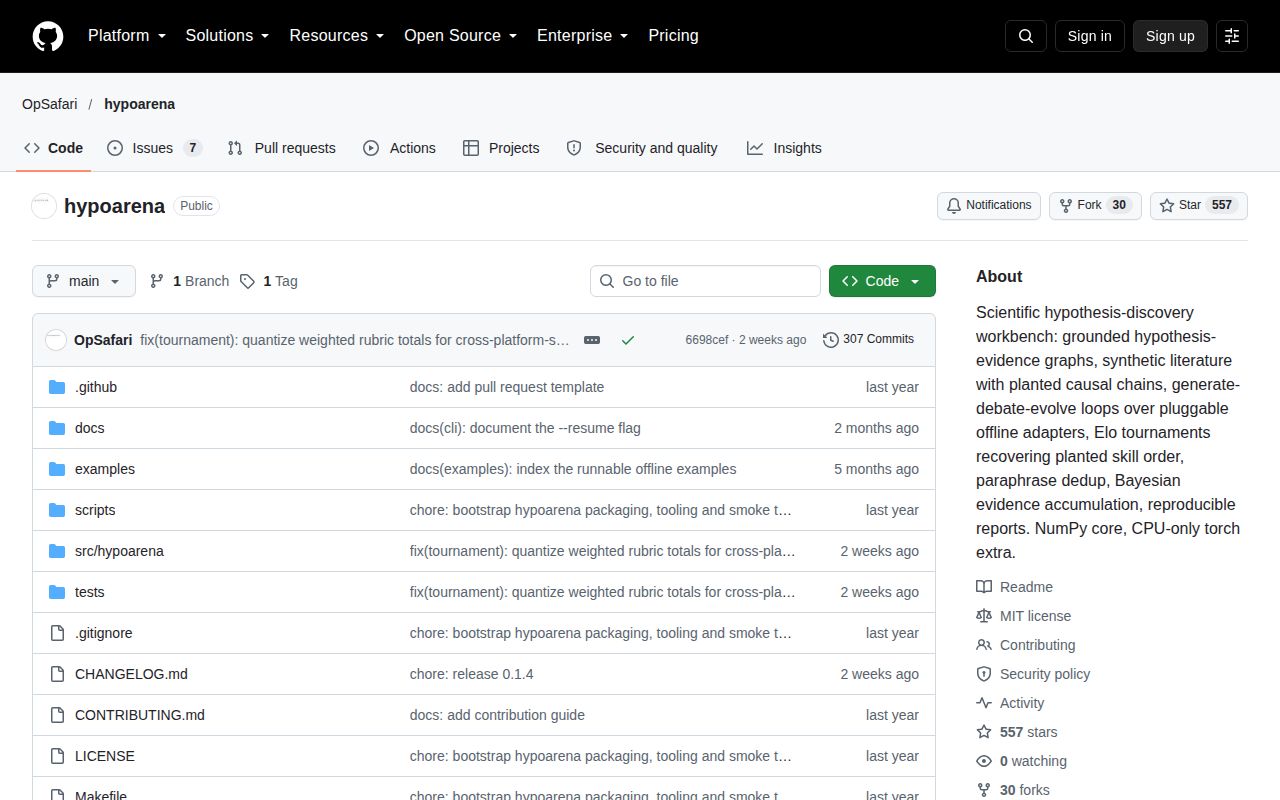
The latest release is v0.1.4, published October 9, 2026, and the last push was October 14. GitHub listed 557 stars and 7 open issues and PRs. Recent activity includes maintenance changes and open reports about resuming incompatible configurations or retaining stale downstream checkpoints. Those reports concern the runner's artifact provenance, which is central to the project's reproducibility claim, rather than an unrelated integration.
Issue 8's configuration reproduction and issue 9's stale-checkpoint reproduction warrant checking before reusing artifact directories. They are separate from our passing lab result. Start with a fresh directory for an experiment you intend to compare. Choose Hypoarena when you need to inspect a hypothesis pipeline's mechanics, and retain human scientific review when the corpus stops being synthetic.