Ascend hardware decides whether this library belongs in your stack
DeepGEMM-Ascend provides matrix-multiplication kernels for Huawei Ascend NPUs, the operations underneath much of a language model's computation. The README lists Ascend 950 hardware and CANN 9.20 as its development and validation environment. That's the first adoption filter. If your machine or deployment target doesn't match the supported stack, the familiar Python API isn't enough reason to choose this port.
The project covers BF16 and lower-precision matrix operations, attention-related scoring, and fused work for mixture-of-experts models. It aims to preserve DeepGEMM's interfaces while handling Ascend-specific layouts and compiler details. Our checkout contained 298 files and about 54,914 source lines, occupying 2.9 MB. That makes it inspectable for a kernel engineer, but understanding what to pass into those interfaces still requires knowledge of tensor layouts and the target model.
What happened when we ran it
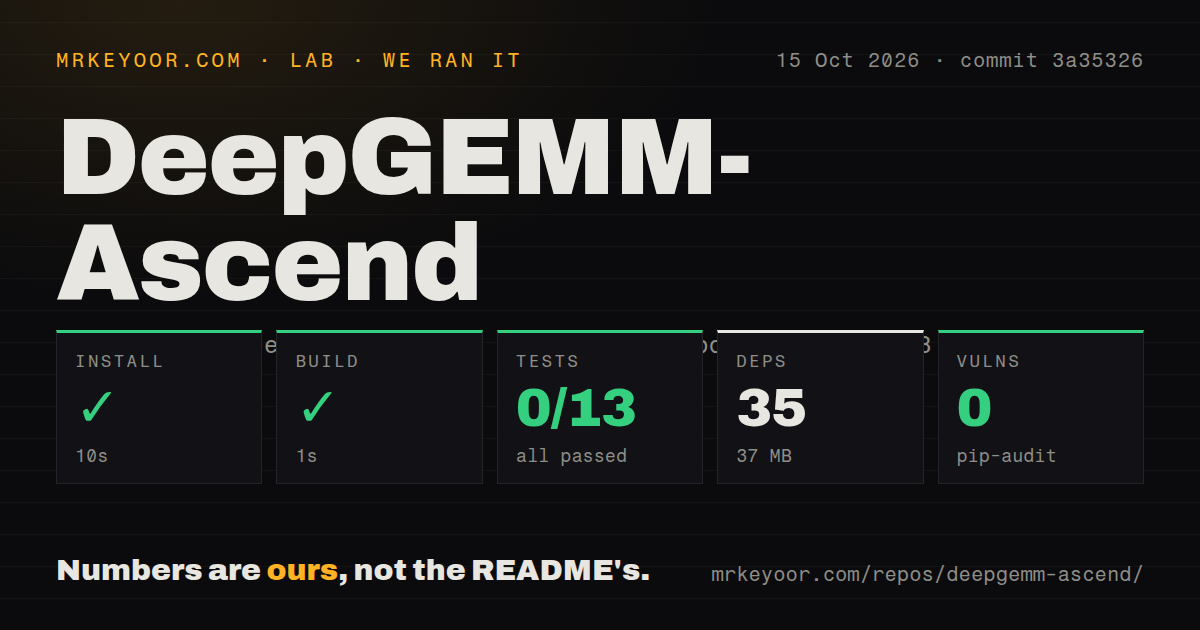
Our DeepGEMM-Ascend run installed 35 packages in 10 seconds, occupied 37 MB, and completed the build step in 1 second. We used commit 3a35326 on October 15, 2026, inside an unprivileged Debian container with Python 3.12, 3 CPUs, 8 GB of RAM, and no secrets. Pip-audit reported 0 known vulnerabilities. These are results from the harness path, without a measured device-kernel execution or throughput result.
Pytest failed with exit code 1 after 2 seconds. The summary recorded 0 passed, 0 failed, and 13 collection or setup errors. Listed files include FP8 GEMM, layout, lazy initialization, hyperconnection, and MegaMoE cases, plus Ascend and CUDA files in the bundled deep-jit tree. Collection errors prevent a meaningful correctness judgment about those kernels. A suite that cannot reach its cases doesn't demonstrate either correct or incorrect numerical output.
The supplied log tail lists affected files without their exception messages. It doesn't establish why collection failed, so calling the errors missing hardware, missing packages, or broken kernels would exceed the evidence. Our scan found a tests directory, no CI workflow files, and no Dockerfile. The defensible result is that installation and the harness build completed, while the available test command could not establish a working kernel stack in that environment.
API compatibility still requires different scaling data
The README explicitly says Ascend scaling-factor layout differs from NVIDIA's. Pairs of scaling factors are packed into an integer representation and stored in a particular order for the hardware. Utility functions transform those factors into the expected layout. That is a meaningful integration boundary for an existing DeepGEMM caller: a familiar function name doesn't prove that tensors prepared for another backend are ready to pass unchanged.
The 37 MB installed footprint also excludes the practical question of an existing Ascend software environment. Requirements include torch_npu, a compiler and standard library with C++20 format support, and the CANN toolkit. The HC prenorm kernel uses TileLang. Development instructions require a recursive clone for submodules, then a native extension path. Inspect those requirements before treating a successful Python package operation as a complete deployment recipe.
Runtime compilation adds paths and cache ownership
DeepGEMM-Ascend discovers its toolkit through ASCEND_HOME_PATH or ASCEND_TOOLKIT_HOME. Its JIT runtime compiles kernels and uses configurable cache directories, with the first configured path receiving newly compiled results. That's an operational choice on a shared server: decide where artifacts live and which service identity can write them. The README also says runtime settings are captured when the JIT runtime is first created, so late environment changes can be misleading.
The 1-second build result doesn't time that future compilation work or model inference. The runtime settings expose compiler commands, selected configurations, and debug output for diagnosing the target system. They are useful tools for someone already responsible for NPU execution. For an application developer wanting a ready inference endpoint, this library leaves the serving framework, scheduling, and model integration as separate work.
Published performance depends on the profiling method
The README's performance tables describe Ascend 950DT with CANN 9.20 and cold-L2 profiling. Those are upstream measurements, and our sandbox didn't reproduce them. An open profiling-method discussion asks how clearing the cache affects reported performance. The issue concerns this repository's benchmark helper and distinguishes different cache-clearing operations. It provides a concrete reason to preserve the measurement method when making your own comparisons.
For a project whose selling point is kernel speed, the 13 collection errors leave a large evidence gap. I would require numerical checks and representative shapes on the intended hardware before replacing an existing path. Keep preprocessing and communication inside your comparison where your workload pays for them. An isolated kernel table cannot establish the end-to-end effect on the service you operate, especially when model shapes or scaling layouts differ.
October development supports an evaluation, not automatic adoption
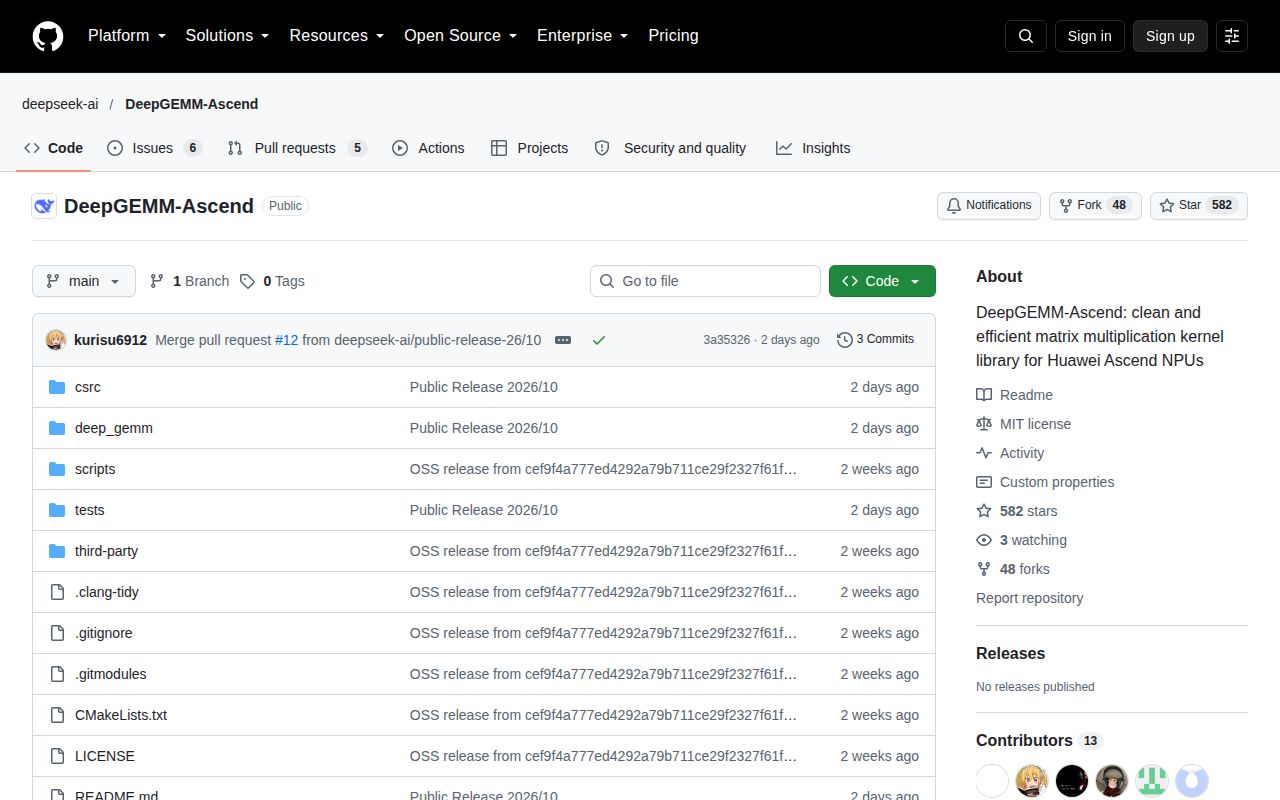
The last push was October 14, 2026, and GitHub listed 582 stars with 11 open issues and PRs combined. No latest tagged release was returned, but issue discussion and a profiling-fix proposal continued in October. That's current development activity. Choose upstream DeepGEMM for its supported platform path, or investigate TileLang when authoring kernels is the goal. Choose this port when Ascend is already your target and you can supply the hardware validation our sandbox could not.