Ascend 950 hardware defines the audience
DeepEP-Ascend targets Huawei Ascend 950 hardware and the communication links between participating ranks. Its job is moving tokens to selected experts and combining their results in a mixture-of-experts model. The README opens with Chinese and English introductions, followed by English operating guidance. This is a specialized dependency for the engineer integrating a model runtime. It has little to offer someone looking for a standalone inference server or a general Python acceleration package.
Our checkout contained 217 files and about 28,179 source lines, occupying 1.6 MB before installation. The README's requirements are more consequential than that small download: supported NPU drivers and firmware, CANN, Bisheng, communication libraries, and matching PyTorch plus torch_npu. The project also requires connectivity through UBMEM and UBC_CTP/URMA. Access to an Ascend machine alone does not establish that your topology matches the supported path.
What happened when we ran it
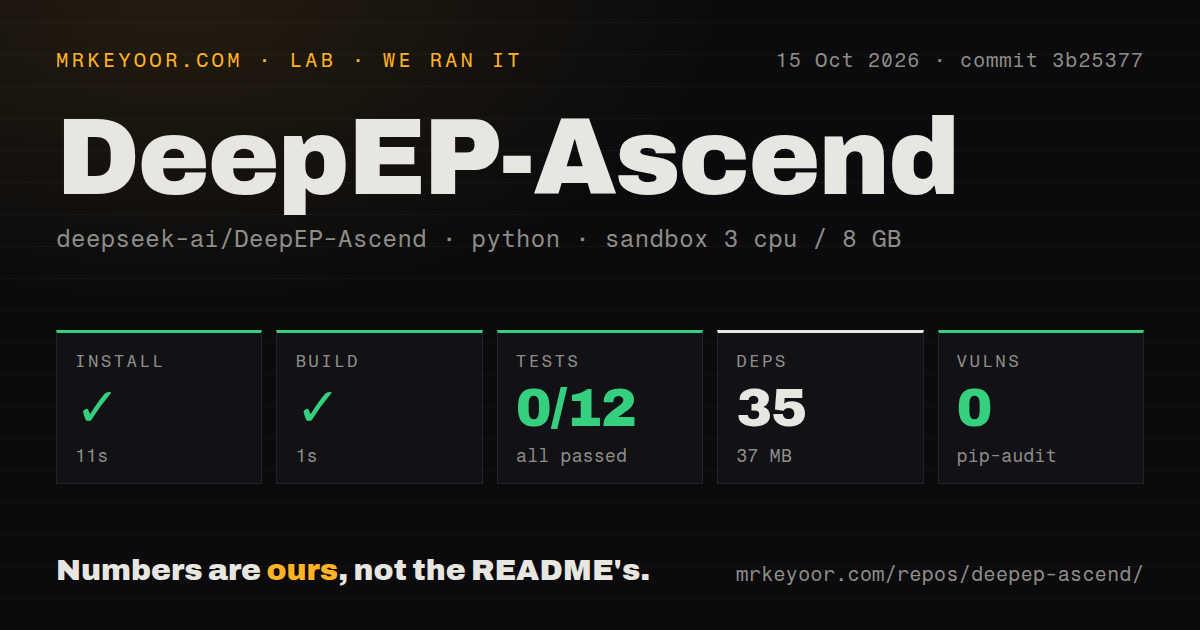
Our sandbox installed commit 3b25377 in 11 seconds, adding 35 packages and occupying 37 MB. The build step passed in 1 second on October 15, 2026. We used an unprivileged Debian container with 3 CPUs, 8 GB of RAM, Python 3.12, and no secrets. Pip-audit reported 0 known vulnerabilities. Those package-level results do not establish that an NPU kernel compiled or that communication between devices worked.
The test command failed with exit 1 after 2 seconds. Pytest reported 0 passed, 0 failed, and 12 collection/setup errors. That is different from executing assertions and finding incorrect outputs. The supplied tail names communication, Engram, expert-parallel, pipeline-parallel, utility, and DeepJIT files, but omits the underlying exception messages. It cannot tell us whether an unavailable library, configuration problem, or source defect caused each error.
The log's pytest summary says 12 errors in 0.29 seconds, while the harness records 2 seconds for the overall command. Those timings refer to different scopes. Our scan found a tests directory, no Dockerfile, and no CI workflow files. The usable conclusion is that this checkout did not yield a green suite in the supplied container. Inferring a specific missing system package from the error filenames would go beyond the evidence.
Runtime compilation keeps the toolkit in the deployment
The README says installation builds a host extension and device kernels compile on first use through DeepJIT. Its validated stack names Ascend 950DT, CANN 9.2.0, Python 3.12, and specific PyTorch and torch_npu versions. Bisheng and the CANN toolkit must remain available when the application runs. Packaging the Python dependency therefore leaves an important runtime requirement to solve, particularly if your deployment images normally exclude compilers.
The 37 MB environment measured in our sandbox is no estimate of a complete Ascend deployment. It does not include a validated driver, firmware, and communication setup. The README's bandwidth figures also come from a manually configured proof-of-concept HDK supplied to the authors. Their text describes a commercial firmware baseline as expected around mid-October, subject to the vendor's schedule. We have not verified that release's availability and would not treat it as already delivered.
Familiar buffer names conceal specific constraints
The public interface follows DeepEP's EPBuffer-based V2.5 APIs, but the README documents Ascend-specific modes and stream behavior. Expert dispatch requires expanded layout, multiple reduction support, and disabled handle copying. Routing indices use an explicitly fixed type. Those details matter to a team porting existing integration code: matching method names is a starting point for compatibility work, not evidence that every existing call has the same supported behavior.
Our 1-second build step cannot validate any of those execution rules. The usage example creates a long-lived buffer and requires waiting for outstanding operations before reuse or destruction. It also explains when deferred communication results become safe to consume. Review those lifetimes against your model's execution path. A wrong assumption about a wait or buffer reuse could sit beyond anything our package checks exercised.
Several advertised interfaces remain experimental
The README marks PP, Engram, and Bucket interfaces as experimental. It says Ascend reduce-scatter and all-reduce kernels are still being built, and expert-load-balancing communication kernels are unimplemented despite exposed APIs. Hybrid communication and graph capture remain unsupported. These are specific reasons to defer adoption if your runtime depends on those capabilities. A broad feature list should not override the status beside an individual operation.
A clean pip-audit result with 0 known vulnerabilities does not answer whether those interfaces are ready for your workload. Focus a trial on expert dispatch and combine if that is the actual requirement. TorchNPU's general distributed primitives may suffice for a less specialized Ascend application. NVIDIA users should assess the original DeepEP instead, since this backend's documented hardware path offers them no direct advantage.
Recent reports leave licensing and validation work open
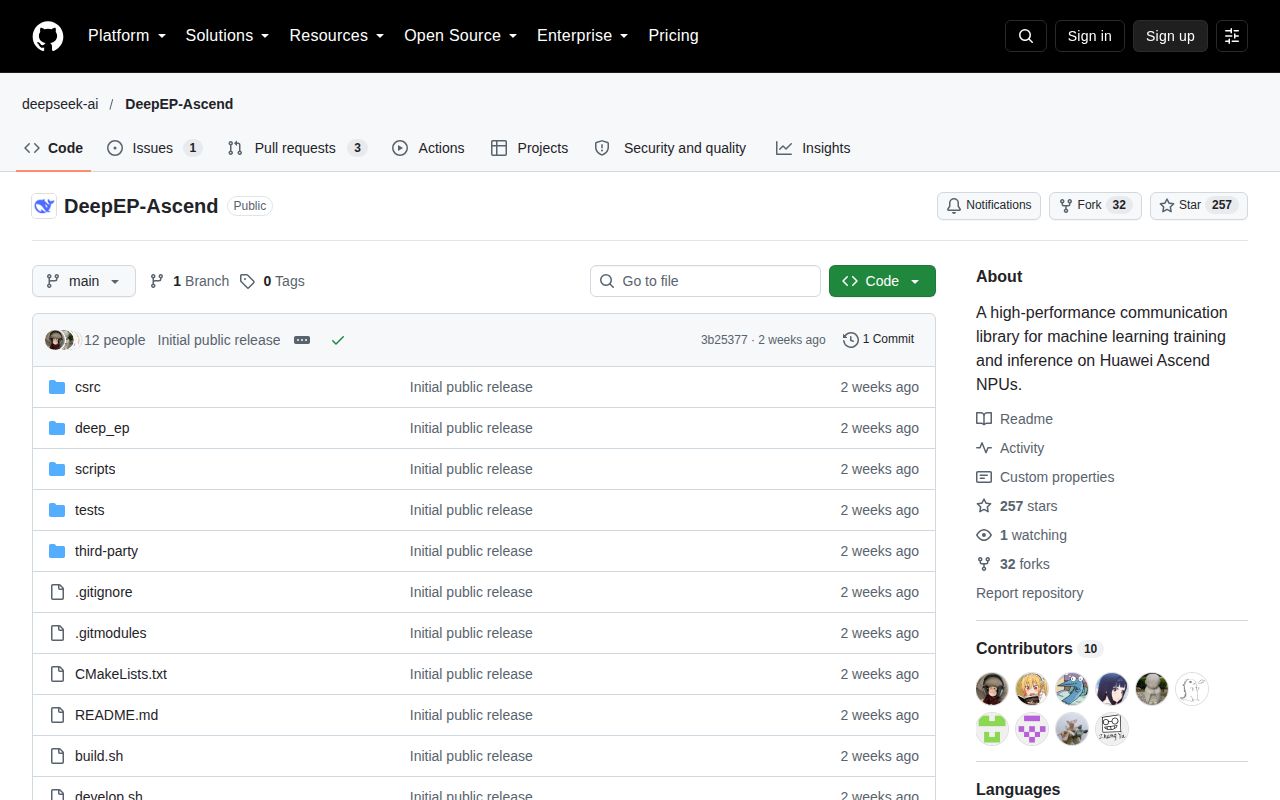
The last push was September 30, 2026, and GitHub listed 257 stars with 4 open issues and PRs. The fetched discussion includes focused contributions about reference dispatch and deferred wait hooks. The latest-release endpoint returned no release record. Those dates show current attention without demonstrating broad adoption or hardware validation. GitHub also detected no license, and issue 1 asks for an explicit license file.
I would require that license question to be resolved and an application-level communication trial on the intended Ascend stack before choosing this dependency. The documentation gives an unusually clear list of constraints for that trial. Our failed collection result leaves the runtime decision with your hardware team, and no author-provided bandwidth chart can remove that requirement.