The useful promise is a repeatable modding workflow
Universal-modder combines agent instructions, a Python CLI, and a shared knowledge base for making game mods. Its README supports Claude Code and other coding agents, with an MCP connection to fal for generated assets. The useful part is the order of work: identify the game and engine, read prior notes, choose a route, then verify a small change in the running game. That sequence gives a developer something concrete to supervise.
The broad claim about modding almost any owned PC game deserves a narrower buying decision. Engine detection doesn't establish that your version has a usable loader or an editable asset format. Our checkout had 650 files, about 26,584 source lines, and occupied 30.8 MB. Much of the project's appeal comes from accumulated game-specific instructions, so search those notes for your actual game before assuming the general workflow will find a way through it.
What happened when we ran it
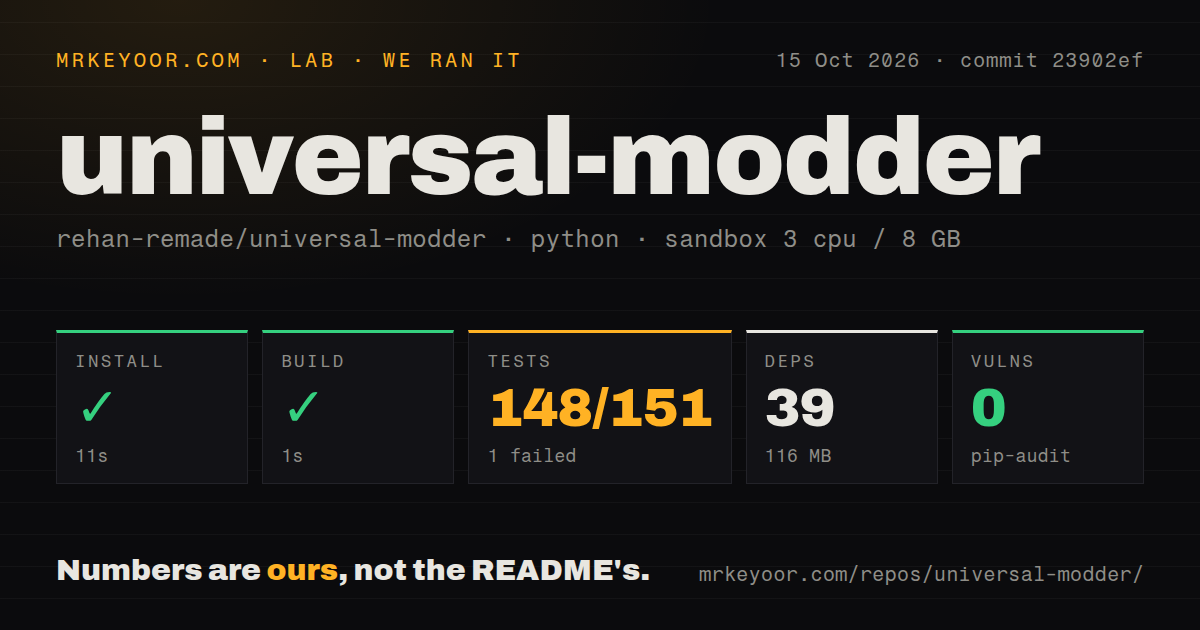
Our universal-modder install succeeded in 11 seconds, adding 39 packages and occupying 116 MB, and its build step passed in 1 second. We ran commit 23902ef on October 15, 2026, in an unprivileged Debian container using Python 3.12, 3 CPUs, 8 GB of RAM, and no secrets. Pip-audit reported 0 known vulnerabilities. The environment was straightforward to create, without establishing that an agent produced a usable mod.
The test command failed with exit code 1 after 6 seconds. Pytest reported 148 passed, 1 failed, 5 skipped, and 2 collection/setup errors. The supplied tail contains byte-string excerpts from documentation, then the result summary. It doesn't show the failed assertion or the underlying collection exceptions. We can't identify a broken CLI feature, missing service, or required system package from those fragments, and the passing cases don't erase the nonzero result.
Our scan found 2 CI workflow files and a tests directory, with no Dockerfile. The package checks are useful evidence about the repository, but they don't cover the decisive modding question: does the changed game behave as intended? The README itself requires verification in the running game. Our sandbox report contains no such result, no asset-generation request, and no comparison of game behavior before and after a mod.
Generated art needs a service or a local image server
The README's asset setup uses a fal API key, with browser OAuth available for its MCP endpoint. The CLI can store a key using the Linux desktop keyring or an owner-only secrets file elsewhere. Agent configurations read FAL_KEY, which is a separate configuration detail worth understanding before you expect both the agent and CLI to find the same credential. Local ComfyUI supplies an alternative path for images.
Python 3.10 or newer, Git, and ffmpeg are documented prerequisites, while Blender is required for rendering sprite views from a model. Those tools and the game installation sit outside the measured 116 MB Python environment. A generated model also still needs the right camera, dimensions, and asset format for its destination. The CLI's fitting and sprite-sheet tools address that work, but their presence doesn't establish that a particular game will accept the output.
Windows control and game loaders remain platform-specific
The CLI command catalog includes Windows capture, input, and game-audio tools. The README says Windows games are driven natively or from WSL. That matters if you mostly work on macOS or a remote Linux machine: portable agent instructions don't make the game-control path portable. Choose an environment where you can run the target game and observe what the agent actually changed.
The 148 passing Python cases are therefore a different kind of evidence from a successful in-game action. For Terraria, a direct tModLoader workflow may be easier to understand if that's your only target. BepInEx is another narrower comparison for supported Unity-game plugin routes. Universal-modder earns its extra scope when you want help spanning reconnaissance, asset preparation, and documentation, rather than when the loader and the change are already known.
The project explicitly refuses protection bypasses
The README excludes bypassing anti-cheat, DRM, or ownership checks, and refuses cheats against other players. It also requires permission before controlling your inputs, installing loaders into game folders, or publishing. Those are concrete product boundaries for anyone attracted by the word universal. A game whose only available route violates them is a reason to stop, rather than an invitation to let the agent keep probing until something runs.
Save backups and distribution checks belong to the workflow too. The CLI includes backup and publishing checks, while the contribution rules exclude game files and decompiled dumps. Our 0-known-vulnerability package audit doesn't establish that a mod archive has permission to redistribute every asset it contains. Keep locally extracted material separate from the files you intend to ship, and review the actual archive before treating an automated check as sufficient evidence.
October activity is mostly useful as a source of specific notes
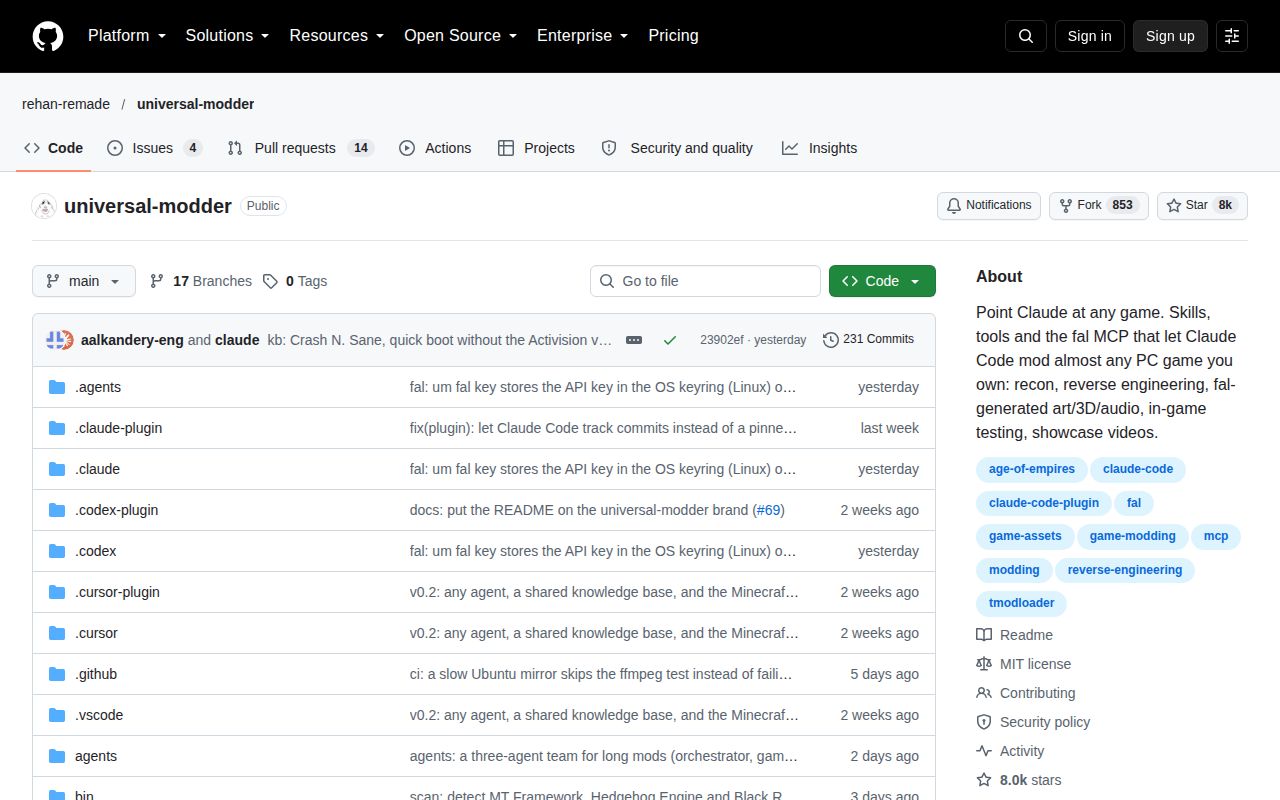
GitHub recorded a push on October 16, 2026, with 7,961 stars and 18 open issues and PRs combined. Recent contributions include game-specific field notes, while the latest-release endpoint returned no tagged release. The README calls the mod hub a coming feature, so evaluate today's CLI and knowledge base rather than assuming a finished sharing service. Start with one visible change in a backed-up game, then decide whether the instructions saved more work than reviewing the agent required.