mrkeyoor.com_
Sat 03 Oct 15:39 UTC
Dev Toolsevaluationupdated 03 Oct 2026

toolkit review

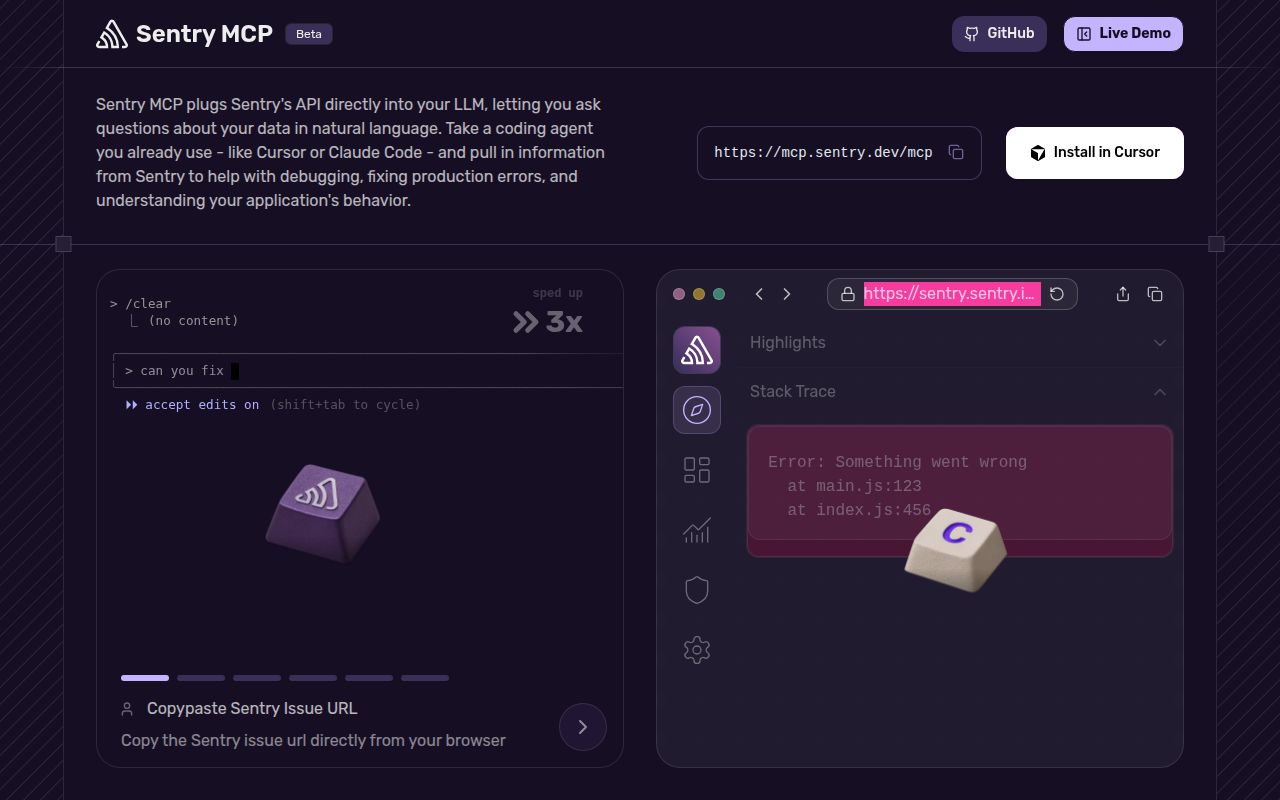
Sentry Toolkit is the TypeScript monorepo for Sentry's MCP service and its new `sentry` command-line client. It lets developers and coding agents investigate Sentry issues, traces, logs, and projects through a hosted service, a local stdio server, a Claude Code plugin, or the CLI.

Verdict

Our Toolkit run installed 1,375 packages and used 1,869 MB, then its root test command exited 1 despite a visible 15-of-15 node:test pass, so contributors should expect a large and currently imperfect monorepo. Use the hosted MCP service or packaged CLI when your team already lives in Sentry and can grant narrow access. Self-hosters, commercial competitors, and teams demanding a green source build should settle those limits before adopting it.

We ran it

Lab card: what happened when we ran toolkitScreenshot of toolkit (mcp.sentry.dev)
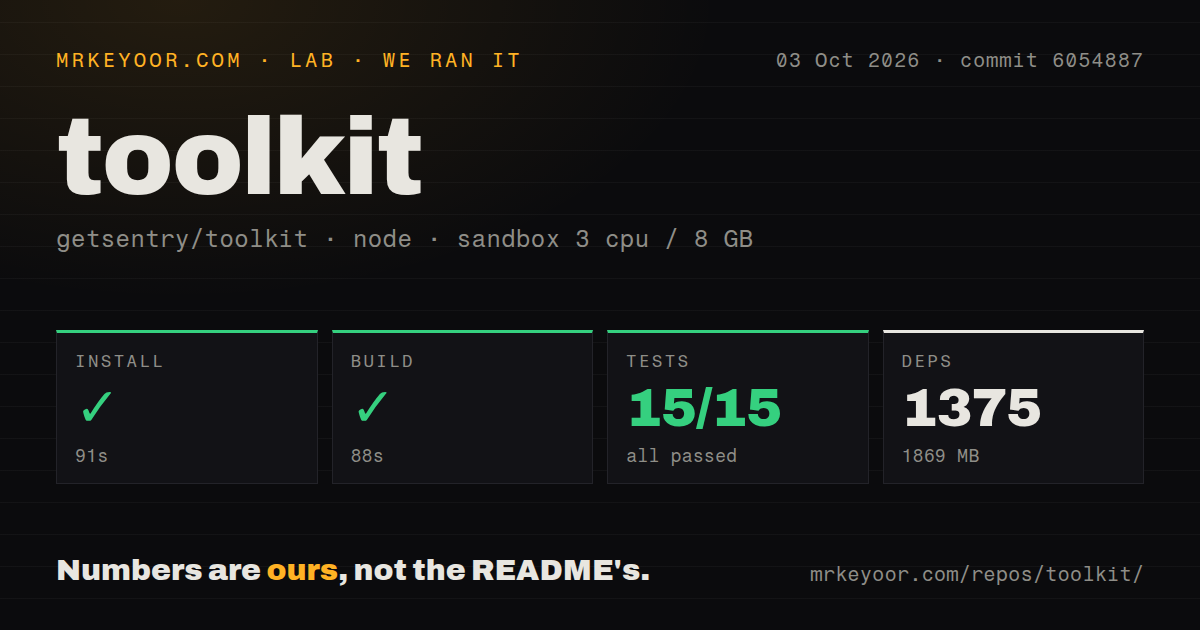
Install✓ · 91s1375 packages · 1869 MB
Build✓ · 88s
Tests✗ · 93s15 passed · 0 failed of 15 (node:test)
Repo2187 files~493,892 lines of source · 48.7 MB · 12 CI workflows

Answers from our run

Does toolkit build from source?

Dependencies installed in 91 seconds (1375 packages), and the build succeeded in 88 seconds. We cloned commit 6054887 into a clean Debian container with 3 CPUs and no project-specific setup.

Do toolkit's tests pass?

Yes: 15 of 15 passed when we ran the project's own test command (node:test). Some failures need services or credentials a bare container does not have.

Who should not use toolkit?

Teams seeking a general Sentry administration server: the README says MCP tool choices favor debugging and developer workflows rather than all Sentry functionality.

What are the alternatives to toolkit?

Sentry CLI, Grafana MCP, Sentry API. Our Toolkit run installed 1,375 packages and used 1,869 MB, then its root test command exited 1 despite a visible 15-of-15 node:test pass, so contributors should expect a large and currently imperfect monorepo.

Setup2/51,869 MB install and a failing root test command
Docs4/5Auth and transports are clear, but CLI and MCP docs are still merging
Community4/5908 stars, an October 2 push, and active release work
Maturity3/5Hosted MCP is established while CLI unification remains in progress

Who it’s for

Sentry teams that want coding agents to inspect errors and performance data with a human in the loop.
Claude Code users who want automatic delegation to a Sentry-focused subagent.
Self-hosted Sentry operators prepared to manage access scopes and feature differences.
Contributors working on Sentry's new CLI, MCP transports, OAuth flow, or agent evaluations.

Who it’s NOT for

Teams seeking a general Sentry administration server: the README says MCP tool choices favor debugging and developer workflows rather than all Sentry functionality.
Commercial products that would compete with Sentry using this code: FSL 1.1 restricts competing use until each version receives Apache 2.0 terms two years later.
Self-hosted users expecting SaaS parity: Seer is omitted by default, and issue 1355 reports search_events failing against Sentry 25.7.0.
Contributors requiring a green fresh-container check: our root test command exited 1 after 93 seconds even though the visible node:test summary said 15 passed and 0 failed.
Small development images: our install pulled 1,375 packages and occupied 1,869 MB before any external service was configured.

Setup reality

Our sandbox installed commit 6054887 in 91 seconds, adding 1,375 packages and using 1,869 MB. The build passed in 88 seconds. Tests exited 1 after 93 seconds; node:test reported 15 passed and 0 failed, then the CLI workspace's test:unit lifecycle returned exit 1 without the underlying cause in the supplied log tail.

Using the stdio MCP server needs a Sentry user token with documented organization, project, team, and event scopes. AI-powered search also needs OpenAI, Azure OpenAI, Anthropic, or OpenRouter configuration. Local OAuth development requires a Sentry OAuth app and client secret.

The 48.7 MB checkout had 2,187 files and about 493,892 source lines. It included 12 CI workflows and pnpm workspaces, but no root Dockerfile or tests directory. Root development requires Node 22.13 or newer; the CLI's contributor guide asks for Node 22.15+ and pnpm 11.8+.

Toolkit now joins Sentry MCP with the new CLI

The root README still opens as sentry-mcp, but the workspace now contains 9 packages plus a CLI documentation app. The MCP side is middleware for Sentry's API, shaped around debugging workflows for coding agents. The sentry package adds a terminal client and a programmatic Node SDK. Release 0.46.0 moved that CLI and its Git history into Toolkit on October 1, 2026.

This is useful consolidation for a Sentry shop. An agent can inspect errors, traces, logs, and issues, while a developer can use the CLI for the same service from a terminal or script. It is intentionally narrower than a general Sentry control plane. The README says tool selection favors human-supervised coding and debugging, so buyers should map required Sentry actions before assuming the MCP layer replaces the API.

What happened when we ran it

Our sandbox installed commit 6054887 in 91 seconds, pulling 1,375 packages and occupying 1,869 MB. The build succeeded in 88 seconds. We ran the pnpm monorepo in an unprivileged Node 22 container with 3 CPUs, 8 GB of RAM, and no secrets. The checkout used 48.7 MB before dependencies.

The test command failed with exit 1 after 93 seconds. A visible node:test summary reported all 15 tests passed and 0 failed. The log then repeated lifecycle errors and named packages/cli, where sentry@0.47.0-dev.0 test invokes pnpm run test:unit. The supplied tail does not include the earlier error from that unit-test command, so blaming coverage, generated files, or the environment would be guesswork.

The repository contained 2,187 files and about 493,892 source lines. Our scan found 12 CI workflow files and pnpm workspaces, with no Dockerfile or tests directory at the root. That does not mean the monorepo has no tests. Package scripts clearly run them. It means contributors must follow workspace-specific commands, and our fresh source check did not finish green.

Hosted MCP is easiest when Sentry already owns the identity flow

The production route lives at mcp.sentry.dev and uses MCP OAuth. Clients that support custom headers can instead send an upstream Sentry token under Sentry-Bearer, which the worker forwards without storing, exchanging, or refreshing it. A query string can narrow exposed skills. The Claude Code plugin adds a sentry-mcp subagent that receives debugging tasks automatically.

Stdio is the practical path for a self-hosted Sentry instance, though the README labels that transport a work in progress. Its user token needs 6 listed scopes across organizations, projects, teams, and events. Natural-language search tools add another dependency: one configured provider from OpenAI, Azure OpenAI, Anthropic, or OpenRouter. Without that provider, those search tools disappear while the other MCP tools continue working.

Self-hosted support has visible gaps

Pointing --host at a non-Sentry SaaS hostname removes the Seer skill by default because Seer is not part of standard self-hosted Sentry. Operators can opt back in when their deployment provides it. Plain HTTP also requires an explicit --insecure-http switch. Those defaults prevent the local path from pretending it has SaaS features or secure transport that the target does not supply.

Open issue 1355 documents a sharper compatibility break. With MCP server 0.42.0 and self-hosted Sentry 25.7.0, search_events calls a validation endpoint that returns 404 even though the underlying event query returns 200. The reporter pinned 0.36.0 as a workaround. Verify every required tool against your exact Sentry version before exposing it to an agent.

The new CLI is usable while the merge is still settling

The packaged CLI supports Node 20 or newer, stores credentials with mode 600, and offers JSON output for scripts. Development asks for Node 22.15+ and pnpm 11.8+. Version 0.46.0 configured Toolkit to publish binaries, the npm package, Homebrew formula, and website. Meanwhile, open issue 1357 tracks CLI and MCP unification, and issue 1363 asks to move MCP documentation out of the shared root.

One experimental area deserves a hard boundary. Issue 1385 says the init wizard can run server-supplied commands through shell: true after string-based checks, without an operating-system sandbox. The issue rates this low priority while the feature is experimental, but recommends stronger isolation before wider exposure. Do not grant an unattended agent permission to run that path on a developer workstation.

The license permits internal use and delays competing use

Toolkit uses FSL 1.1 with an Apache 2.0 future license. Internal use, non-commercial education, research, and services for a compliant licensee are named as permitted purposes. A commercial product that substitutes for this software or similar Sentry offerings is excluded. Each released version moves to Apache 2.0 on its second anniversary, so legal review matters for hosted products and redistributors.

GitHub showed 908 stars and 127 combined open issues and pull requests on October 3, 2026. The repository was pushed on October 2, one day after CLI 0.46.0 shipped. That pace supports using the official hosted service or packaged client today. Source contributors should budget the 1,869 MB we measured, reproduce the CLI test failure, and treat the MCP and CLI union as active construction rather than finished housekeeping.

Alternatives

ProjectWhat it isPick it when
Sentry CLISentry's older Rust CLI for releases, source maps, debug files, and scripted Sentry tasks.pick this instead when an existing release pipeline depends on the mature client and you accept that feature development has moved to Toolkit.
Grafana MCP gh↗An Apache-licensed MCP server for Grafana dashboards, data sources, alerts, incidents, and observability queries.pick this instead when Grafana is your operating console and the agent needs broader metrics, logs, dashboards, or alerting access.
Sentry APIDirect HTTP access to Sentry resources without an MCP or embedded-agent layer.pick this instead when a narrow script needs deterministic API calls and no natural-language search.

What people are saying

  1. [github-trending] getsentry/toolkit
  2. [github-trending] aws/agent-toolkit-for-aws

Sources

  1. Sentry Toolkit README
  2. Sentry Toolkit repository facts
  3. Sentry CLI 0.46.0 release
  4. Sentry CLI package README
  5. Toolkit FSL 1.1 license
  6. Self-hosted search_events compatibility report
  7. Init command execution hardening issue

More dev tools reviews

benilla · pi-gui · sqlfluff · ramda · ToolReplay · CUDA-for-AMD-Windows · the whole board →