TileLang lists 12 backend paths behind one Python syntax
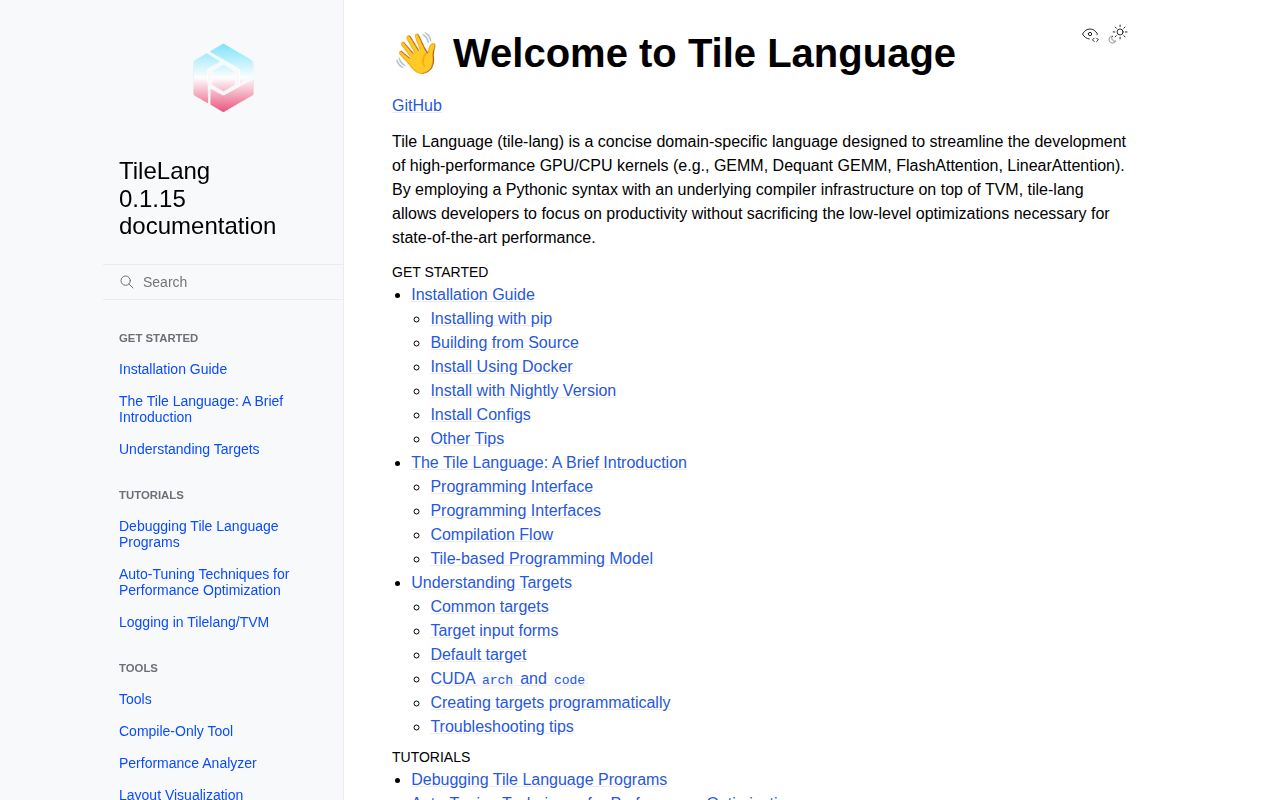
The v0.1.15 README's support table names 12 backend paths, from primary CUDA to separate adapters for 5 accelerator families. TileLang lets an author express thread blocks, tiled copies, matrix operations, layouts, and pipelined loops in Python. Its compiler lowers that program through TVM infrastructure to the selected target. This is useful when a PyTorch operation is too general and a handwritten CUDA kernel would take too much platform-specific work.
The abstraction stays close to the machine. TileLang's sample GEMM declares 3 block dimensions, allocates shared and fragment memory, chooses 128 threads, and runs a 3-stage pipeline. You still reason about tile shapes, data types, memory movement, and the accelerator underneath. TileLang provides a compact kernel language and reusable compiler passes while leaving the kernel engineering with you.
A 900-second install timeout blocks the one-line quick start
The official stable path is one command, pip install tilelang, followed by an import check. Our result did not match that simplicity. commit 994b44e occupied 538.7 MB before installation, with 29,325 files and about 3,896,456 lines of source. That is a compiler repository with bundled infrastructure and many examples, so teams should treat source work as a sizable engineering checkout.
Python 3.10 or newer is the common starting point, but the hardware decides the rest. NVIDIA requires host CUDA 10.0 or newer, unless you use the documented pip-provided CUDA 13.0 toolchain. AMD needs a host ROCm installation exposing hipcc, plus a ROCm build of PyTorch installed before TileLang. Ascend 950 adds CANN and torch_npu; the experimental CPU source build needs LLVM 15 or newer.
What happened when we ran it
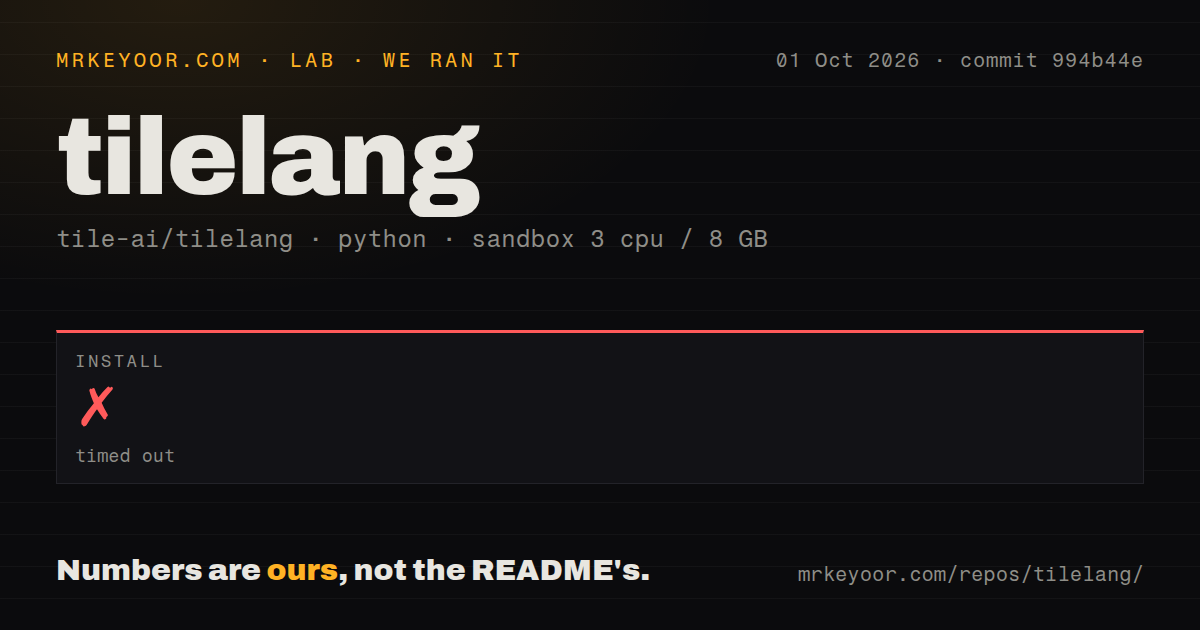
Our test method used commit 994b44e, 3 CPUs, 8 GB of RAM, Python 3.12 on Debian, no secrets, and no elevated privileges. We measured one decisive outcome: installation hit its 900-second limit and never completed. We therefore have no build result, test result, dependency count, vulnerability count, or runtime benchmark to report.
The lab scan found 5 CI workflow files, no Dockerfile, and no tests directory at the repository root. Those signals do not prove that TileLang lacks testing, because the workflows and source tree can organize checks elsewhere. They do change the buyer's next step: inspect the target-specific CI job and reproduce it on the exact CUDA, ROCm, Metal, Ascend, or CPU lane you plan to support.
v0.1.15 expands hardware support and changes interfaces
Release v0.1.15 arrived on September 30, 2026, with native Ascend 950 support, automatic CUDA warp specialization, unified block-scaled GEMM behavior, and a more expressive Python frontend. The same release notes include compatibility changes: parameters disappeared from T.Pipelined and T.gemm_sp, a ROCm import path changed, and some kernels now have to state threads= explicitly. Pinning the package is necessary for any maintained kernel set.
The support labels deserve equal attention. CUDA is the primary backend. ROCm, Ascend 950, and Metal are supported; LLVM CPU, CuTe DSL, and WebGPU are experimental. Another 5 vendor families use adapters in separate repositories with their own schedules. A kernel compiling on one target does not establish equivalent behavior on the other 11 paths, especially when matrix instructions and memory systems differ.
Issue 3301 documents 49 reproducible compiler reports
Open issue 3301 groups 49 cases that its author describes as reproducible and not already fixed or tracked. The list includes 32 wrong-code cases, 15 cases where invalid input is accepted, 1 compiler crash on valid code, and 1 cache security report. These claims come from the issue author; our CPU-only sandbox did not reproduce them. Silent wrong output is still the category a kernel team must take most seriously.
Several reports are tied to particular instructions or hardware, such as Hopper paths, sparse GEMM, vector atomics, and stepped loops. That specificity helps triage; it does not make a generic test suite sufficient. Compare every custom kernel against a trusted implementation across shapes, dtypes, edge sizes, and target architectures. For a compiler at v0.1.15, output equivalence belongs in your release gate, especially after upgrades.
September activity shows fast maintenance and a large queue
GitHub recorded a push on September 30, 2026, the same date as v0.1.15. On October 1, search showed 214 open issues and 158 open pull requests, with fresh fixes and backend work arriving that day. TileLang is plainly active. The 372-item combined queue also means adopters need to search by backend, architecture, and operation before assuming a bug report applies to their kernel.
TileLang makes the most sense for a team already measuring kernels and reading generated code. Triton is the cleaner comparison for a narrower GPU-language decision, while CUTLASS is closer to NVIDIA's own tuned building blocks and Apache TVM covers a wider model compiler job. Our 900-second timeout leaves TileLang unqualified on setup alone. Its language may still repay the effort when one custom kernel matters enough to justify a dedicated test matrix.