Triton is for the operator your framework cannot fix
Triton gives Python developers a language for custom deep-learning primitives and a compiler that turns those programs into GPU code. The attraction is control without writing every address calculation and scheduling detail in CUDA. You still think about tiles, memory movement, launch shapes, and numerical behavior, but the compiler handles more of the mechanical mapping to hardware. This is useful when a stock framework operator or composition of operators is the measured bottleneck.
The repository is compact beside a full ML framework, yet it is serious compiler code: our commit f4c8fdb checkout had 1,740 files, about 408,605 source lines, and occupied 28.7 MB. The implementation includes MLIR and LLVM layers plus Python-facing tools. Reading Python examples can make Triton look like a normal package; changing the compiler means working across those boundaries and understanding generated GPU code.
The pip wheel is easier than the development checkout
The README offers pip install triton for the stable release and says binary wheels cover CPython 3.10 through 3.14. That is the right way to evaluate the language. Start with a tutorial or a small kernel, compare its output against a known implementation, and inspect generated code only after the semantics are correct. A wheel removes the compiler build from setup, but it does not remove the need for compatible hardware and drivers.
Supported deployment is specific: Linux, NVIDIA GPUs with compute capability 8.0 or newer, and AMD GPUs with ROCm 6.2 or newer. CPU support is described as under development. Those limits belong at the start of a buying decision because a kernel is useful only where it can run. Teams shipping across older NVIDIA cards, Windows workstations, or several accelerator families need another implementation or a fallback path.
What happened when we ran it
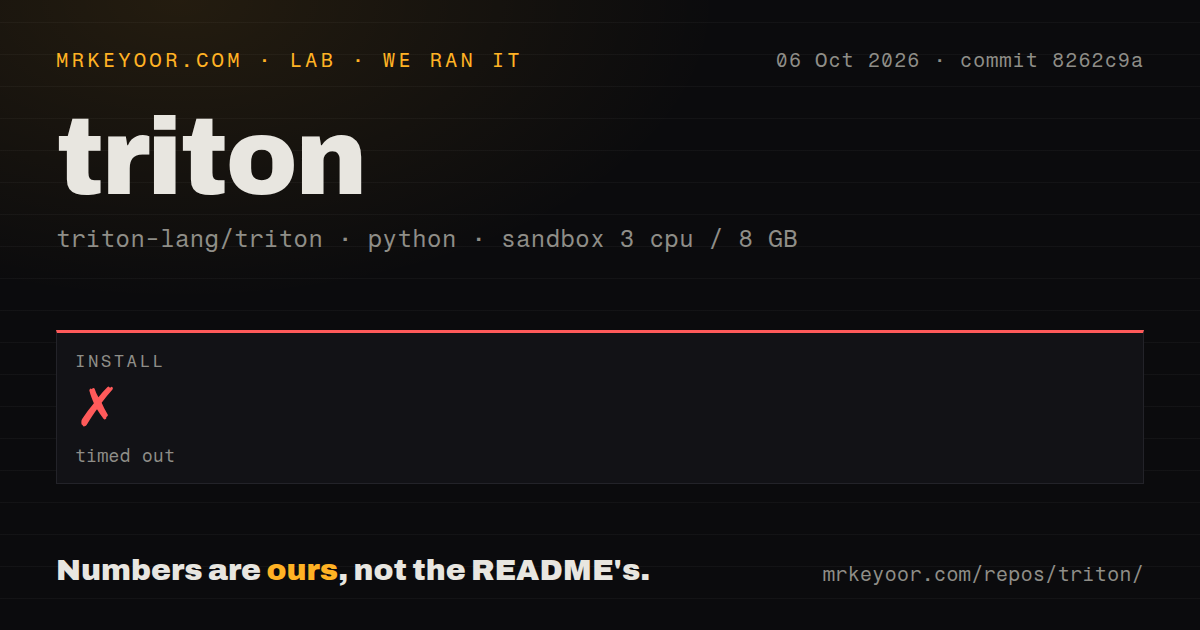
Our editable source install timed out at 900 seconds in an unprivileged Debian container using Python 3.12, 3 CPUs, and 8 GB of RAM. The log ended inside the build extension after cmake --build . --config TritonRelBuildWithAsserts -j16 returned exit status 1. That tail does not contain the underlying compiler diagnostic, so we cannot name a package, memory limit, or source defect as the cause.
We never reached a separate test step. The measured result is therefore an incomplete source install, not a failed Triton test suite and not evidence about the stable wheel. The repository has 10 CI workflow files and a tests directory, but no Dockerfile. Its README warns that there is currently no turnkey command for every test: make test requires a GPU, while make test-nogpu covers the portion that can run without one.
LLVM and build controls are part of the job
Triton normally downloads a prebuilt LLVM, and a custom LLVM checkout must match the revision recorded in cmake/llvm-info.json. The README states plainly that arbitrary LLVM versions will not work because LLVM lacks a stable API. Building a custom copy adds MLIR, LLVM, LLD, Clang, and target backends to the compilation job. That path is for compiler engineers who need to modify the stack, not a routine installation preference.
The documented knobs tell the same story. Contributors can limit build jobs with MAX_JOBS, enable ccache, switch to clang and lld, preserve build isolation choices, change the cache directory, dump MLIR or LLVM IR, create reproducers, and override compiled stages. These controls are useful when diagnosing a compiler or kernel. They also mean reproducibility depends on recording more than a Python requirements file. Keep the commit, LLVM revision, build flags, driver, and GPU model with any reported result.
Performance claims require your own kernel and hardware
The project aims to make fast custom primitives easier to write than CUDA, but that aim is not a benchmark for your workload. Kernel performance depends on shapes, data types, memory access, fusion choices, and the exact GPU. Triton's autotuning and inspection controls help search and diagnose configurations. They do not excuse comparing against a framework implementation with representative inputs, including awkward sizes and boundary cases.
Release 3.7.1, published June 18, 2026, is a useful reminder that correctness comes first. It fixed 2 regressions: one missing fence could permit an async copy to read shared memory too early, and one LLVM optimization could miscompile an addition pattern. Custom kernels need numerical tests across target shapes, and production teams should follow patch releases rather than pinning an old compiler indefinitely.
Active maintenance does not make the work ordinary
GitHub showed 1,236 open issues and pull requests on August 25, 2026, with a push on the same date. That combined queue is expected for an active compiler used around fast-moving GPU software; it is not a count of verified bugs. Search it by backend, GPU generation, data type, and operation before committing to an optimization. Hardware-specific reports often matter more than a generic popularity signal.
Triton is a good tool when profiling identifies a costly operation and someone on the team can own kernel correctness, compilation, and hardware coverage. Numba is broader for accelerated Python functions, TVM addresses whole-model compilation across targets, and JAX supplies compiler-backed array transformations at a higher level. The simple test is organizational: if nobody wants to read IR or debug a GPU race, keep using maintained framework kernels.