Direct option scores avoid generating an answer you will throw away
SemIf reads probabilities from a model's option logits and samples 0 answer tokens. A model would usually write an answer, the application would parse it, and the result would often become a simple branch. This project instead takes the question, state, and typed options. The result includes the scores, model revision, timing data, and a prompt hash, which makes a decision easier to trace than a free-form reply.
That design is useful for routing, retry choices, evidence checks, and other bounded judgments. It is less useful when you need reasoning text, tool arguments, or an explanation for a person. SemIf is also independent of Jev and TypeSafe. The README is unusually plain about that boundary: it copies an interface pattern, not the closed model or its undisclosed training.
Reusing one state across 21 criteria can change the choices
The repository's owned workload contains 37 states crossed with 21 criteria, or 777 decisions. The direct mode scores each row on its own, but SemIf also has serial prefix reuse and a shared mode for many criteria against one identical state. Its published measurements favor the reuse paths, though the README also reports that BF16 reuse changed 5 to 6 argmax choices relative to fresh scoring.
That caveat is more useful than a clean speed claim. Reusing model state can change the answer, so the faster path needs decision-level comparison on your data. The project commits fixtures, raw timings, predictions, and verification material for its own runs. You still need labeled examples from the queue, policy check, or retrieval job you actually plan to automate.
What happened when we ran it
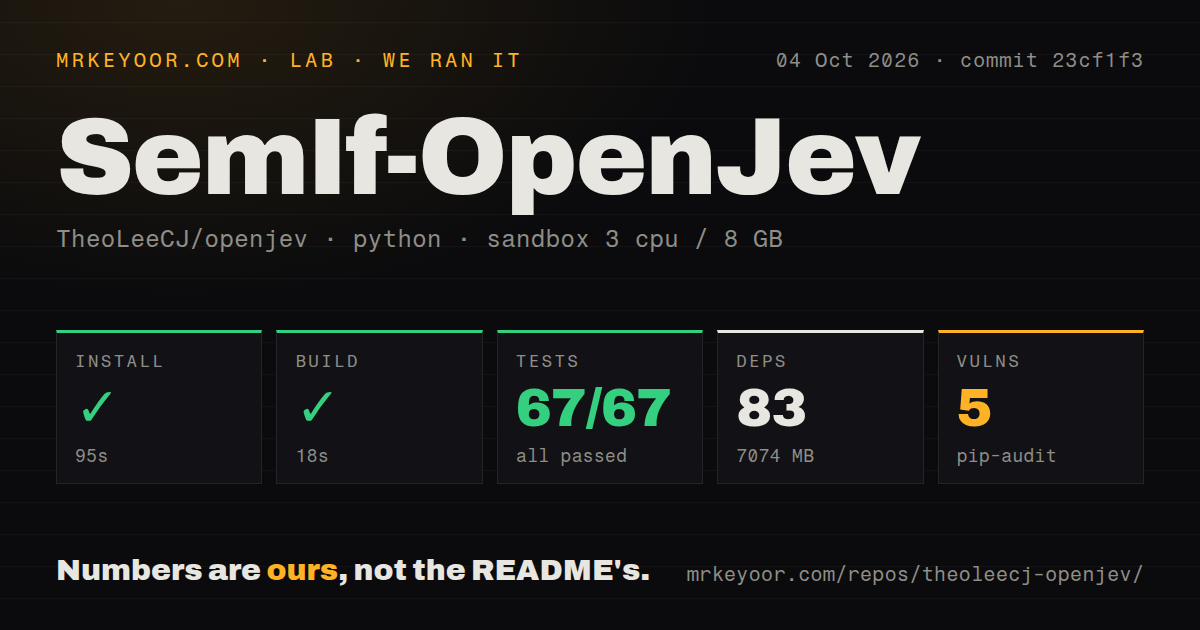
Our sandbox installed commit 23cf1f3 in 95 seconds, pulling 83 packages and occupying 7,074 MB. The build succeeded in 18 seconds. Pytest then completed in 16 seconds with 67 passed, 0 failed, and 3 skipped in the reported 67-test run. This was a fresh unprivileged Debian container with 3 CPUs, 8 GB of RAM, Python 3.12, and no secrets.
Pip-audit reported 5 known vulnerabilities. The supplied measurement does not name the affected packages or severity, so claiming a particular exposure would go beyond the result. It does justify a dependency review before deployment. Our repository scan also found a tests directory, 0 CI workflow files, and no Dockerfile. Passing locally is good evidence for the checked commit, but the repository does not show an automated GitHub test gate.
The checkout had 158 files, about 6,046 lines of source, and occupied 20.8 MB. None of those figures includes a 4B model checkpoint. We did not measure inference latency, choice accuracy, GPU memory, or browser download time, so the project's published model comparisons should not be confused with our sandbox findings.
A working CLI still leaves the service boundary to you
The standard route asks for Python 3.10 or newer, CUDA, and enough GPU memory for a 4B BF16 model. Apple Silicon users can choose MLX or MPS. CPU users install the llama.cpp extra and supply a GGUF file, while the browser demo uses quantized artifacts through WebGPU. These are meaningful options, but they are different operating paths rather than one portable deployment.
The README's primary example is semif-score, which reads and writes files. Issue 38 asks about a TypeSafe-compatible API, and pull request 27 proposes semif-serve; neither establishes a merged service in the commit we measured. If your application needs concurrent requests, authentication, request limits, health checks, or rolling model updates, you must build or review that layer separately.
A smaller packaging problem is already visible in issue 49, which says Jinja2 is needed for prompt rendering but is not declared as a runtime dependency. Pull request 54 proposes the corresponding fix. Our installation and tests passed, yet this report matters for consumers installing a narrower extra set than our test environment.
Three published calibration checks do not transfer to your workload
SemIf includes temperature scaling fitted per workload and says calibration does not change the selected option. Its published table covers 3 workloads. The clearest improvement appears on WANLI, while intervals overlap on the authored decisions and Every workloads. Raw scores therefore should not be treated as equally trustworthy across a new queue, policy, or retrieval job.
Option wording and order still deserve attention. Pull request 42 proposes measuring order sensitivity and an optional stabilizer, which tells you this is an active engineering concern rather than a settled property. Before a score can trigger an action, test paraphrases, swapped option order, ambiguous cases, and a reject threshold on held-out examples. A probability without that work is a number, not a safety policy.
September activity is high, but the project has no tagged release
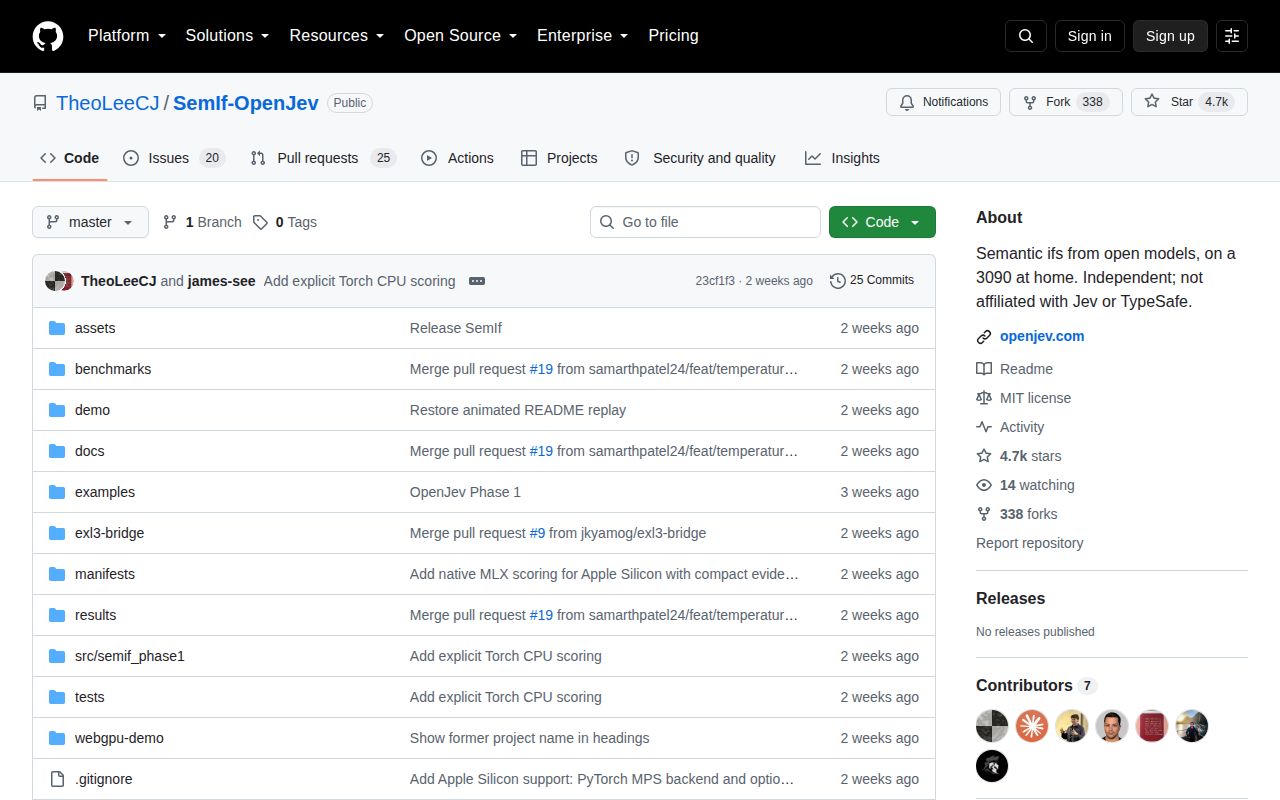
GitHub reported 4,693 stars and 45 open issues and pull requests, split into 20 issues and 25 pull requests in the API results we checked. The repository was pushed on September 23, 2026, and a new pull request arrived on October 4. There is no latest GitHub release. This is an active young project with a crowded contribution queue, not a versioned dependency with a settled upgrade path.
Use SemIf for an experiment where direct scoring matches the decision shape and every mistake can be compared with labels. The 67 passing tests make that experiment easier to justify. The 7,074 MB environment, 5 audit findings, hardware branches, and missing merged server make a production commitment harder. Its best feature is not that it makes decisions for you. It gives you enough evidence to discover where those decisions stop being dependable.