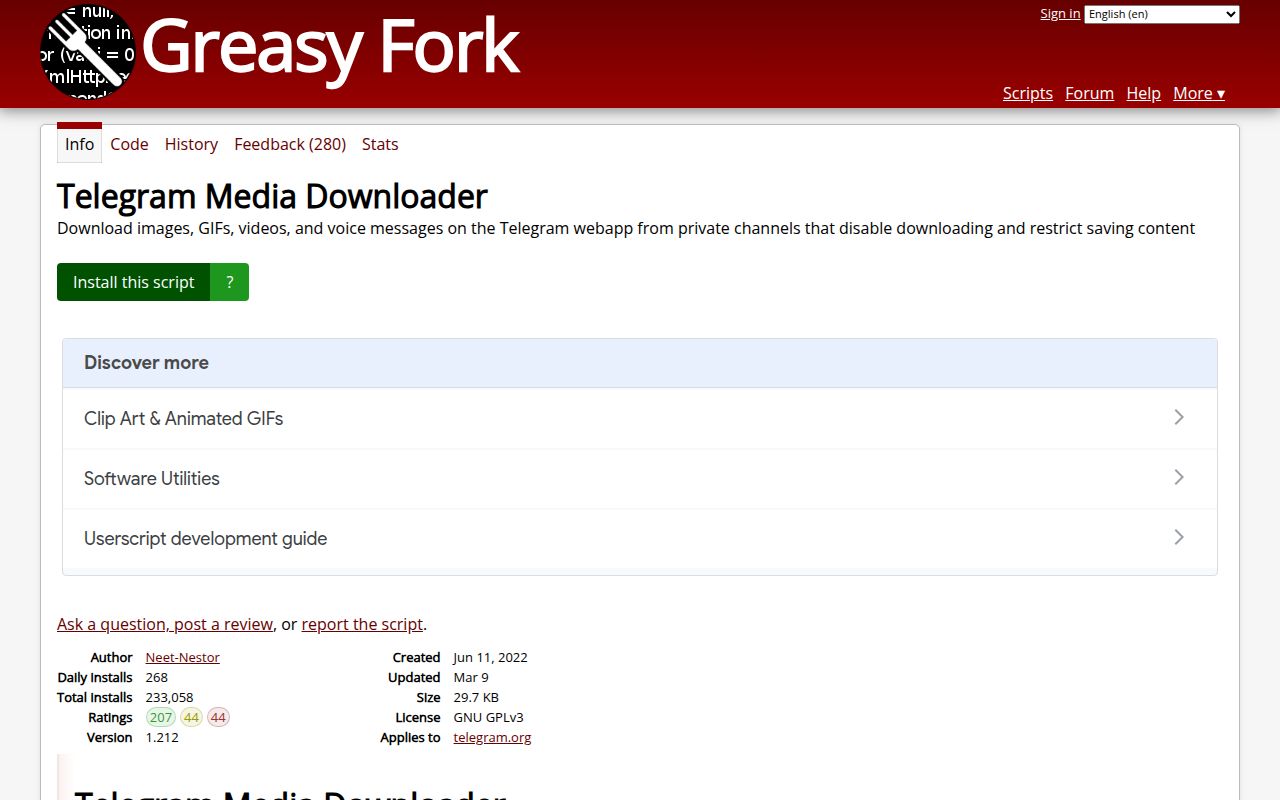
Version 1.212 restores controls in two Telegram Web clients
Telegram Media Downloader 1.212 is a userscript for Telegram WebK and WebA. It inserts download controls for images, GIFs, audio, videos, and stories, including media in chats or private channels where Telegram disables saving. The README recommends WebK, and voice-message downloads are available only there. When Telegram already provides its own download control, the script is designed to stay out of the way rather than add a second button.
The source at commit 169a678 is centered on one 30 KB JavaScript file plus documentation and translations. Its userscript header matches Telegram's Web, WebK, and WebZ addresses. Installation is through Greasy Fork or by dragging src/tel_download.js into a userscript manager. There is no application server, database, bot token, or Telegram API ID. The user's existing browser session supplies access to whatever media the account can already view.
A 500 ms DOM scan finds media and adds buttons
Version 1.212 checks Telegram's changing page structure on a 500 ms interval, locates active media viewers, and adds its own download action when the official one is absent. Images use a temporary browser link. Video and audio paths issue ranged fetches, inspect Content-Range, track offsets, and stop when the complete reported size has arrived. Videos get a bottom-right progress display; the README says images and audio do not.
Browsers with the File System Access API can write chunks to a chosen file. The fallback keeps blobs in memory, joins them, creates an object URL, and triggers a normal browser download. That makes the script convenient for one item, but the architecture is tied closely to Telegram's class names, media elements, and URL formats. A Telegram frontend change can remove the button even when the userscript itself still loads without an obvious error.
What happened when we ran it
Commit 169a678 received a NOT RUN result from the lab. The repository is JavaScript, but it has no supported package ecosystem for the harness and no Dockerfile. Its root contains documentation and src, without a package manifest that defines installation, a build target, or a test command. A browser userscript is a legitimate format; it simply falls outside the reproducible container path used for these reviews.
No timing, dependency count, build result, test count, or vulnerability audit exists for this checkout. A green claim in any of those categories would be invented. The useful setup evidence comes from the published structure: version 1.212 is installed into a userscript manager and exercised inside an authenticated Telegram Web tab. Buyers should test the exact browser, manager, and Telegram interface they intend to use, then open the saved media before deleting its source.
Version 1.212 can finish before file writes settle
Open issue 164 points to a specific sequence in version 1.212. On the File System Access path, writable.write() starts and the next chunk can be fetched without waiting for that promise. The final close can also begin before earlier writes have settled. The report says this may produce incomplete or corrupt video files, especially with large media or a slow disk. The current source contains the unawaited write shown in the issue.
Firefox has a separate long-running report. Issue 18 says video downloads produced 9-byte MP4 files while the same action worked in Chrome. Issue 132 describes downloads becoming aborted after several files, and issue 120 says the tool handles one video at a time rather than a batch. These reports come from different environments and do not prove one shared cause. They do make file size, playback, and spot checks part of responsible use.
Sixty-eight open items outpace recent code changes
GitHub listed 5,397 stars and 68 combined issues and pull requests when fetched. The last repository push was March 9, 2026, while issue 120 received activity on August 19 and issue 164 opened on August 13. That combination shows ongoing user demand without equally recent code on the default branch. The latest-release endpoint returned no release, even though the userscript header carries its own 1.212 version.
The GPL-3.0 license permits inspection and modification under its terms, which is useful for a script that runs inside a logged-in messaging session. Still, a visible source file is not a substitute for an automated check. Telegram has 2 documented web variants, several browser managers, and frequently changing DOM details. Maintainers ask contributors to test WebK and WebZ plus major userscript managers, but the repository does not publish a machine-run matrix that we could verify.
Version 1.212 suits single saves, not an archive job
The script is at its best when one authorized image or video is visible and Telegram has removed the normal save button. Installation takes browser-level trust, and the code's narrow purpose is easy to understand. It also bypasses a deliberate channel restriction, so the user's right to retain and redistribute the media must be settled before clicking. Technical access and permission are separate questions.
For a 1-file job, Telegram Media Downloader avoids API setup and adds exactly the missing control. For a channel archive, tdl, Telegram Desktop export, or a custom Telethon client gives better control over batches and metadata. The open 9-byte Firefox report and unawaited-write finding are enough to rule out unattended use. Save one file, verify it, and keep the original available until the downloaded copy has passed a playback check.