Wails puts a Go API behind the operating system webview
Wails packages Go code, compiled frontend assets, and a desktop window into one application. JavaScript can call exported Go methods, while generated TypeScript definitions describe the bound structs and functions. Native dialogs, menus, theme detection, window effects, and an event bus cover the common gaps between a browser UI and a desktop program. The frontend can use familiar frameworks or plain HTML, CSS, and JavaScript.
The main architectural choice is the system webview. Windows runs WebView2, macOS uses WebKit, and Linux uses WebKitGTK. This keeps Wails from bundling a full Chromium copy with every application. It also means the rendering engine and native dependencies vary by platform. A design that looks correct on one machine still needs testing on the other 2 desktop families, especially around window controls, file dialogs, drag and drop, and frontend-to-Go calls.
Stable v2 and beta v3 are different adoption decisions
The repository houses 2 active generations. The README labels v2 stable and v3 beta, with separate install commands and documentation sites. Release v2.14.0 was published on August 10, 2026, and fixed error handling around downloading the WebView2 bootstrapper. v3 contains newer APIs and mobile work, but its beta status makes it a poor default for a product that needs a settled compatibility contract today.
This split can confuse research because current pull requests often target v3 while the production release remains v2. Pick a generation before reading examples or judging an issue. Our lab entered the ./v2/ project and used its Go module. None of our build or test results says whether a v3 desktop or Android application works.
For a new commercial desktop app, stable v2 is the conservative choice unless a specific v3 feature is worth migration work. Existing v2 teams should also resist copying a v3 fix into their plan without checking the branch and API. Wails uses enhancement proposals for public behavior changes, which gives larger changes a visible review trail.
What happened when we ran it
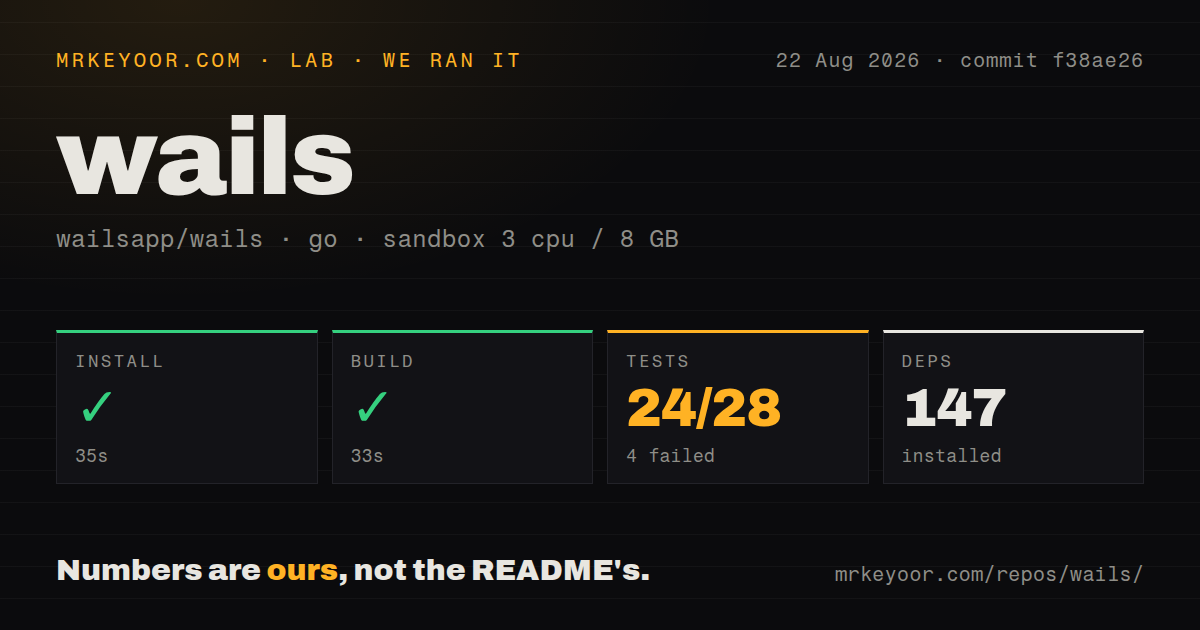
Our sandbox installed 147 Go packages in 35 seconds using Go 1.24 on fresh Debian with 3 CPUs and 8 GB of RAM. Building v2 succeeded in another 33 seconds. The repository was large, with 11,949 files, about 319,485 lines of source, and 160.7 MB checked out. It included 20 CI workflow files and a tests directory, though no Dockerfile.
The test command exited with status 1 after 25 seconds. Of 28 packages counted by the harness, 24 passed and 4 failed. The log tail supplied to this review shows template packages with no test files, successful runs for test/4882 and test/5034, and then the final FAIL. It does not include the error output for the 4 failed packages, so we cannot say whether system libraries, the container, or project code caused them.
A successful 33-second build is useful evidence that the v2 source and Go dependency graph assemble in a clean container. The 4 failures still matter because desktop frameworks touch platform behavior that a plain compile cannot exercise. Before adopting Wails, run its suite on the same Windows, macOS, and Linux versions that your users will run.
Native webviews save bundle weight and add platform variance
Wails is attractive when your business logic already lives in Go. You can expose selected methods directly to the frontend without maintaining an HTTP server, local port, authentication scheme, or browser launch flow. Generated bindings reduce handwritten glue and make Go structs visible to TypeScript. A single compiled application is also easier for many users to understand than a daemon plus a browser tab.
The bridge is part of the risk surface. Issue #4418 reports that a v2 Windows application with heavy WebView2 bridge traffic sometimes left JavaScript promises unresolved, while the same application worked on Linux. The reporter moved affected calls to HTTP as a workaround. The report cannot establish frequency across Wails apps. It gives teams with chatty frontends a precise stress test: fire concurrent bound-method calls soon after startup and fail any promise that never settles.
Generated types need runtime checks too. Issue #3588 shows a nil Go slice serialized as null while generated TypeScript interfaces described only an array under strict null checks. Teams should decide whether backend methods normalize nil collections to empty ones or frontend code accepts nullable values. Generated code saves time only when its contract matches the values crossing the bridge.
Linux dependencies and release packaging remain your job
Wails can create and build a project, yet desktop delivery reaches beyond go build. Linux needs GTK and WebKitGTK development packages. Issue #4457 reports a Fedora 41 case where wails doctor said the WebKit dependency was installed even though wails dev failed until the package was added. That report is narrow, though it argues for making an actual sample build part of workstation validation.
Windows distribution may need the WebView2 bootstrapper, installers, and signing. macOS releases bring signing and notarization. Frontend package installation, icons, application metadata, updates, and per-platform CI are owned by the app team. Wails supplies tooling around many of those steps, but it cannot provide certificates or decide support policy.
The repository was pushed on August 26, 2026, one day after several platform fixes moved through pull requests. GitHub showed 312 open issues and pull requests, which is a work queue rather than 312 confirmed defects. Wails is active, well documented, and mature enough for serious v2 desktop work. Its best users accept the system webview trade: smaller distribution and native integration in return for real cross-platform testing.