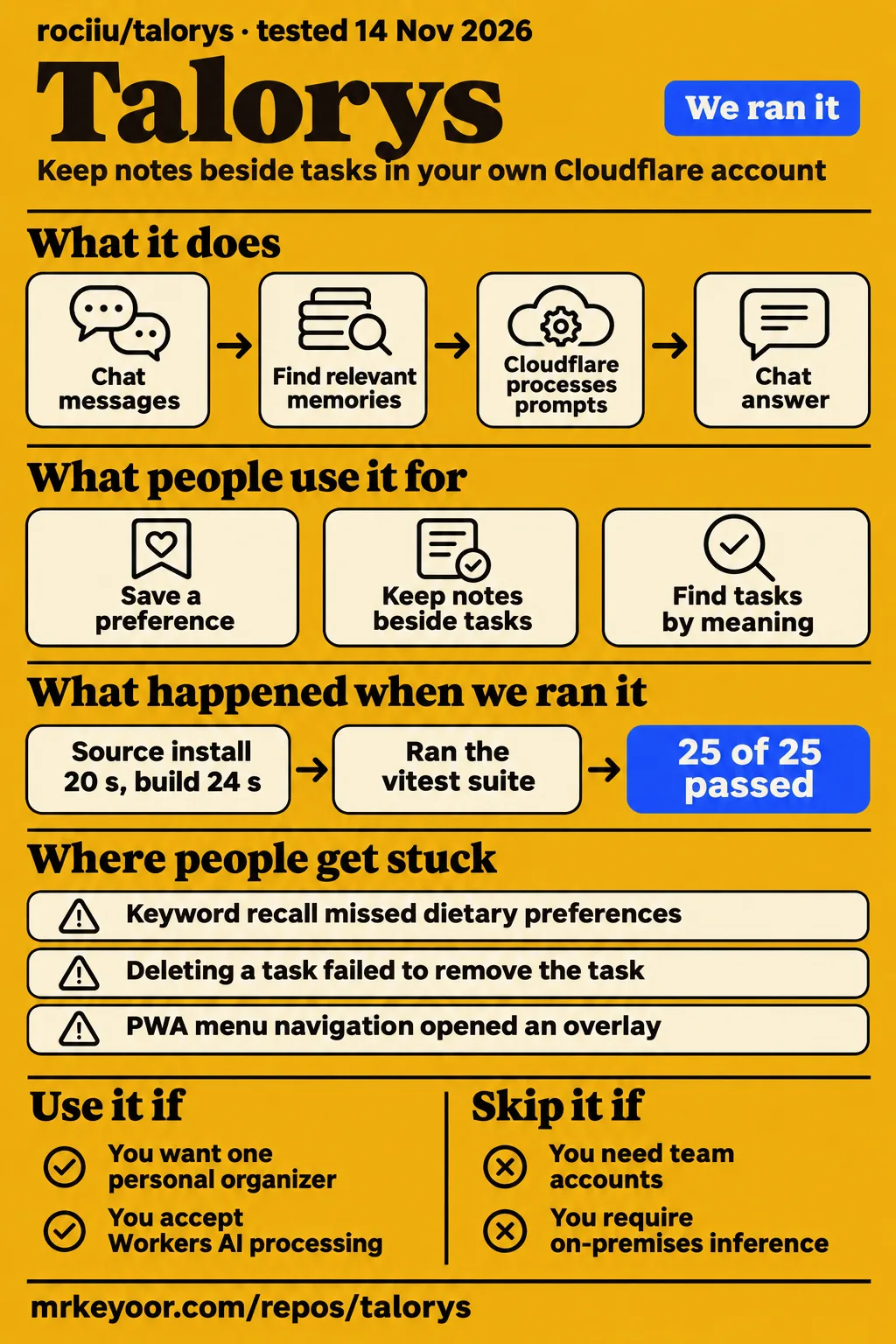
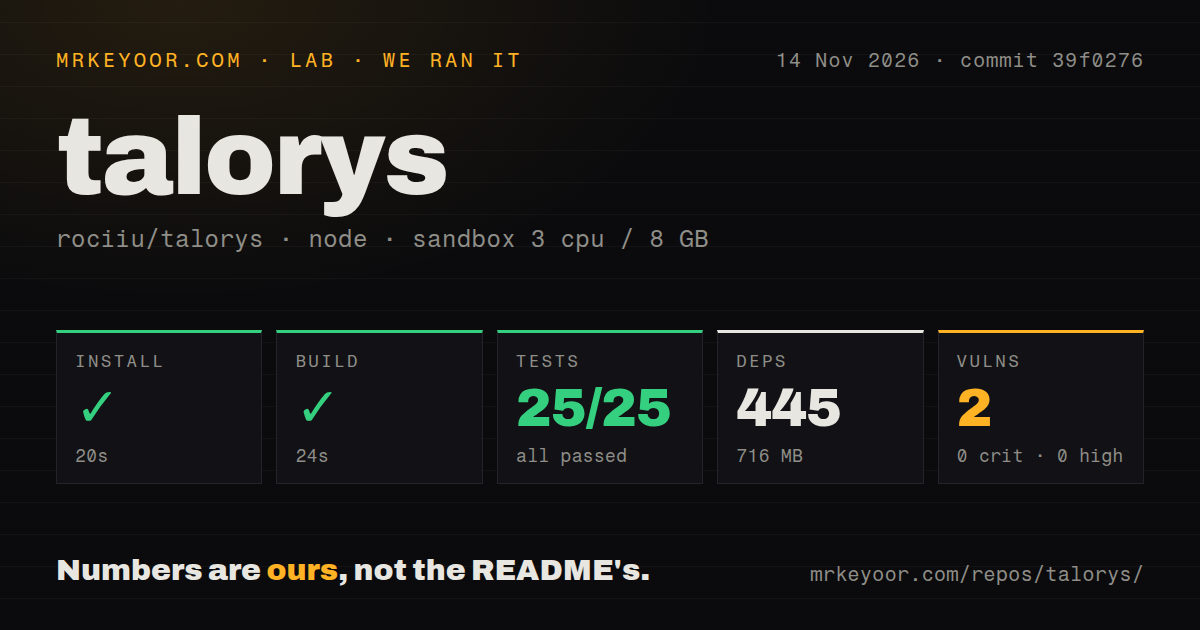
Talorys installed in 20 seconds and built in 24 seconds in our sandbox; its recorded Vitest result was 25 passed, zero failed. Use it if you want a personal organizer inside your own Cloudflare account and can manage its settings. Skip it if you need team accounts, processing on your own hardware, or a conventional container deployment. The source checks passed, but the separate deployment harness stopped before a live assistant session.
What people use talorys for
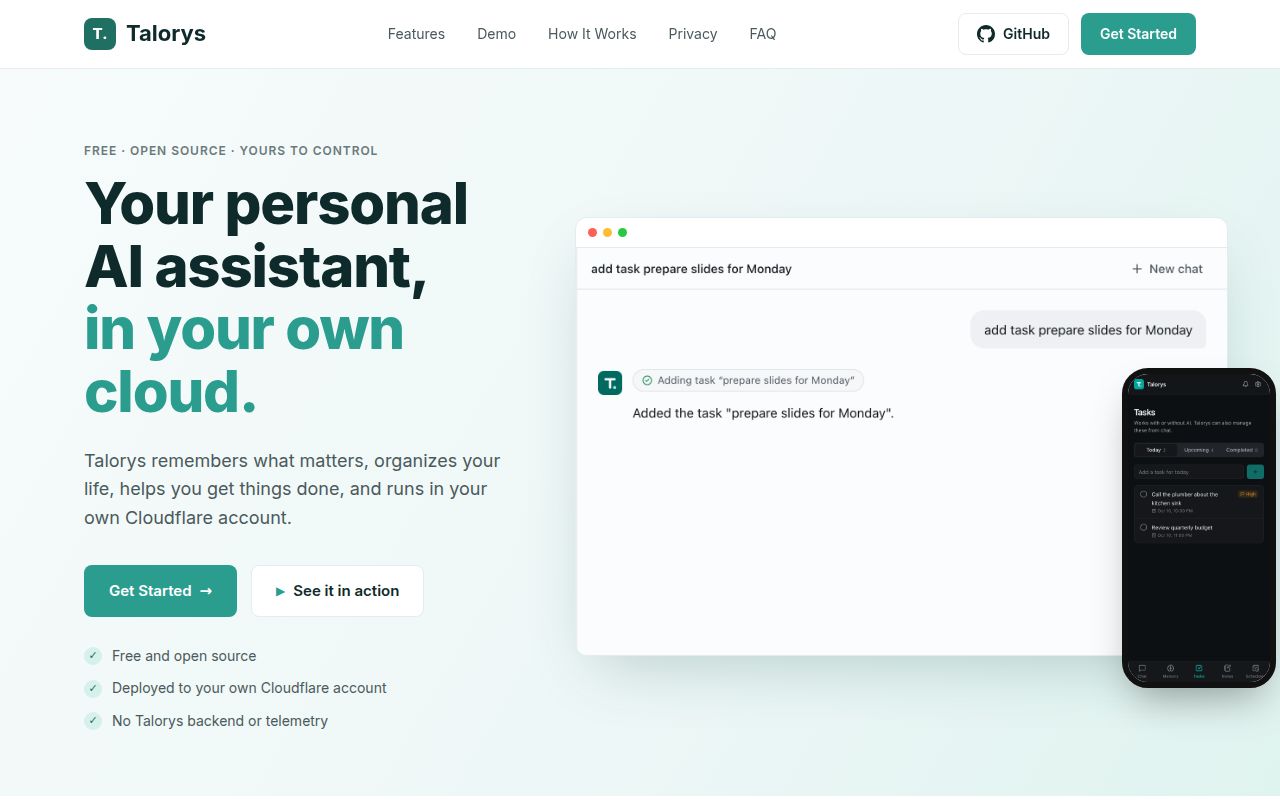
Talorys gives one person chat, editable memories, tasks, notes, projects and scheduled reminders in a Cloudflare account. The project README describes a browser workspace backed by Workers and SQLite in a Durable Object. That makes it worth considering for someone who wants their organizer's records under their own cloud account without maintaining a server.
The useful community evidence is specific enough to repeat, including the failures:
- The user opening issue #2 saved a vegetarian preference, started a new chat and received chicken and salmon suggestions. They also saved a replacement car, then got the old car back when asking what they drove. These were tests of memory recall, not a complaint that the Memory screen had lost the entries.
- The contributor proposing issue #44 tried differently worded searches for a doctor's appointment task, a birthday note and a bin-day automation. They reported that bge-m3 ranked each intended item first. The thread later says the main implementation PR merged, with follow-up work in #53.
- MikaelFangel used the installed PWA and reported menu links opening an overlay in issue #78. Their follow-up says updating Talorys and the PWA made it work. That is a user-confirmed recovery for that report.
- The owner requesting Polish in issue #46 was already running a personal instance. Contributors then divided translation and string-extraction work. The maintainer's reply said the infrastructure had merged while only the sign-in page had been extracted at that stage.
The Dev.to author technoblogger14o3 also reports using custom APIs for calendar events and deadlines, including a missed meeting after mishandling time zones. That account has no corroborating execution record and includes incorrect startup instructions. It should not become evidence that Talorys ships a calendar connector. For your first task, use its documented organizer functions before adding a custom integration with another clock and another failure path.
What happened when we ran it
Our source run installed Talorys in 20 seconds, built it in 24 seconds and completed the test step in 380 seconds, with 25 Vitest passes and zero failures. The lab used commit 39f0276 on 14 November 2026, with a recorded configuration of 3 CPUs, 8 GB RAM and image label lab-node:22.
| Recorded source check | Result | What it tells you |
|---|---|---|
| npm install | Succeeded in 20 seconds; 445 dependencies recorded | Dependency setup completed in this sandbox |
| Installed footprint | 716 MB on disk | Allow room for the development dependencies |
| Build | Succeeded in 24 seconds | The recorded source build completed |
| Test step | Succeeded in 380 seconds; 25 passed, zero failed of 25 | The recorded suite passed at this commit |
| npm audit | 2 moderate advisories; zero critical, high or low | Dependency advisories need attention |
| Repository scan | 345 files, about 42,193 source lines, 3.2 MB checkout | A workspace repository with a much larger installed footprint |
| Project signals | 2 CI workflow files, tests directory, no Dockerfile | Source-check infrastructure exists |
The 716 MB dependency footprint matters more to a contributor's laptop than to the eventual Cloudflare deployment. Do not mistake it for the assistant's running memory consumption. Likewise, the test step's 380 seconds is a source-check duration, not the delay before a chat answer. Those distinctions keep a successful developer setup from turning into an invented product benchmark.
The separate hands-on harness failed its safety step: none of compose.yaml, compose.yml, docker-compose.yaml or docker-compose.yml existed, and its rule required a Compose file. Its label "unsafe repo" describes that eligibility check. The README's installation route is Cloudflare, so this result is a mismatch with the harness's deployment requirement, not proof of a broken installer.
The run-summary record uses boilerplate saying it deployed with Docker Compose. The failed step contradicts that summary; we accept the specific step result and do not claim a deployment. The teardown record says teardown was OK. No successful chat task accompanies these records.
Where people get stuck: recall and installer versions
The user in issue #2 showed that storing a preference and retrieving it for a new question are separate operations. Their dinner question shared no words with the saved vegetarian preference. The car example added another problem: a newer fact needed to replace an older one. These are different acceptance checks, so a single successful memory lookup is too weak a test for a personal assistant.
Talorys now documents optional semantic recall and memory history. The former finds relevant information by meaning; the latter tracks facts that change and puts unclear conflicts up for review. The practical first-session check is to save a preference, ask about it indirectly in a new chat, then change a fact and ask again. Inspect the stored memory as well as the answer. The current README describes both controls.
For the switch itself, the maintainer's answer in issue #26 is precise: open Settings → AI and find Semantic memory recall below Usage. The switch exists without reinstalling. Enabling it reveals the embedding model, daily cap and reindex controls; the installer option merely enables it on first boot.
| Report | What happened | Resolution shown by the evidence |
|---|---|---|
| Task deletion, #15 | Confirmation showed an undefined title, left the dialog open and retained the task | A commenter identifies the Dialog lifecycle fix on main in 9ff8012, PR #3, and says installer 0.1.4 still contained the bug |
| Meaning-based item search, #44 | Differently worded queries missed organizer records | The thread reports the main PR merged; the current changelog lists the feature under 0.1.7 |
| Phone input layout, #35 | Focusing input pushed the page sideways and raised the bottom bar | The issue extract has no explanation; 0.1.7 release notes separately list a phone text-field layout fix |
| PWA navigation, #78 | Menu navigation opened an overlay | The reporting user confirmed recovery after updating the app and PWA |
| First mobile message, #31 | The first message appeared as two bubbles | Closed, with no explanatory comment in the supplied extract |
| Fresh-checkout testing, #61 | Collection encountered ENOENT for an installer template | The reporter identifies building the installer first as the workaround and proposes moving scaffolding into beforeAll |
Issue #15 is the reason to record your installer version before troubleshooting. Someone reading main could see a fix while someone installing the published package still received the defect. The current changelog supplies release-level evidence for semantic item search in 0.1.7. Use that stronger evidence where it exists; a merged PR alone is a different milestone.
Free-tier limits affect chat before the organizer
The README says chat pauses when the daily Workers AI allocation is exhausted, while everything else keeps working and stored data stays untouched. Simple reminders and task digests never use AI. That split is a useful reason to consider Talorys: reaching the inference allowance does not, by itself, remove access to your organizer. This is the project's documented behavior, rather than a quota-exhaustion experiment from our lab. README
Budget controls count model calls, not just messages you type. Reasoning steps, history summaries and memory checks also count toward the daily AI request limit. Embeddings have a separate cap. A short exchange can therefore consume more than one model request, and switching on semantic recall adds embedding activity. Set limits around the jobs you expect to do rather than assuming a daily request cap equals that many conversations.
The Usage panel separates provider-reported tokens from fallback estimates. Its estimated Neurons and USD inference value exclude account-wide usage and free allowances: they are neither a Cloudflare bill nor a remaining-quota display. Use the linked Cloudflare dashboard for those questions. An unpriced model also does not mean free inference. These distinctions are documented in the README's usage explanation.
For script-driven organizer work, Anchor Terminal's documentation review flags two API constraints: create requests lack server idempotency keys, and list routes have caps without pagination. A client should deduplicate retries and treat capped results as partial. Those are reasons to keep an integration narrow, especially if it creates reminders or assumes it has downloaded every record.
Security: Cloudflare processes prompts, and MCP sends tool arguments
Cloudflare processes chat messages and relevant memories for Workers AI inference. Data stored under your account still passes through Cloudflare's services; the README expressly says so. The same document says Talorys sends nothing to its developers and has no telemetry, analytics, tracking or advertising code. Choose it because you accept this account and provider arrangement, not because "self-hosted" promises processing on your own premises. Data handling
Remote MCP adds another destination. The MCP documentation says tools start off, and enabled tools ask for approval on every call by default. The approval card shows the server, tool and exact arguments. Choosing "Run without asking" is your trust decision about that server; a read-only label supplied by the server is not an independently checked permission guarantee.
MCP supports public HTTPS Streamable HTTP servers. Older HTTP+SSE transport, stdio and local servers are outside the supported production connection path. Tools are offered in chat, never to scheduled AI routines. That rules out an easy but mistaken assumption: adding an MCP calendar tool does not automatically give a background routine access to it.
If a connection fails after an approved external call was sent, the docs say it may or may not have run. Check the external service before repeating a write. Approved calls are not automatically retried. This is the recovery instruction that matters when the tool can change something outside Talorys, where an ambiguous timeout could otherwise lead you to create the same item twice.
English comes first; Korean has release evidence
English is the default in the localization discussion, and the current changelog lists the Korean web UI translation in 0.1.8. The earlier issue #46 records a request for Polish, localization infrastructure merging and contributors coordinating extraction work. Its statement that most UI remained English belongs to that stage of development. It should not override the later 0.1.8 changelog.
For a worldwide English reader, the English README and documented default make the project approachable. Someone choosing it specifically for Polish should read the selected release's language files rather than interpret a contributor's proposal as a shipped translation. Interface translation and the language a model uses in its reply are also separate questions; the issue deliberately leaves the system prompt and tool descriptions outside the localization proposal.
Talorys vs OpenClaw, Odysseus and Tab
Koda positions OpenClaw for messaging and voice, and Odysseus for an existing server with email and calendar. These are useful workflow distinctions, not evidence of a speed or reliability winner. The table preserves the comparisons' attribution instead of turning their scores into our measurements. OpenClaw's own README lists Discord, iMessage, Slack, Teams, Telegram and WhatsApp among its channels. OpenClaw README
| Candidate | Why the comparison points you there | Decision for a Talorys reader |
|---|---|---|
| OpenClaw | Koda describes messaging channels and voice | Start there if reaching the assistant through messaging apps matters more than a dedicated organizer workspace. Koda |
| Odysseus | Koda describes a Docker Compose workspace including email and calendar | Consider it if you already maintain a server and want those functions together. Koda |
| Tab | Anchor Terminal positions it as a private-beta assistant in Messages or WhatsApp that books, calls and buys with approval | Consider that workflow if the assistant acting through existing messaging is the goal. Comparison |
| Talorys | Its README describes one owner's Cloudflare workspace | Choose it for editable organizer records, browser access and ownership of the deployment account. README |
Pick the place you want to work before counting features. Keeping notes beside tasks in a browser is a different daily habit from asking for actions in a messaging thread. Someone who already owns a Docker server also has a different reason to value Cloudflare's deployment route than someone trying to avoid maintaining one. The alternatives are candidates to investigate on that basis.
What the other reviews get wrong
Petronella's description of local, on-premises processing conflicts with Talorys's documented Cloudflare architecture and inference path. Its claim that payload data never leaves the premises cannot describe Workers AI processing, and enabled remote MCP tools add external argument delivery. The Petronella record and README support correcting those specific claims, without guessing about the author's deployment.
The technoblogger14o3 Dev.to article points readers at github.com/Talorys/talorys.git and npm run start. The official repository is rociiu/talorys; its README documents npm run dev for local development and npx create-talorys@latest for cloud installation. AI/TLDR and the older Sanjay Singh overview also describe an older Node requirement. The current README requires Node.js 22 or newer. Use the official instructions rather than combining commands from those pages. Dev.to instructions, older overview
JuryPress's statement about unversioned release tags is dated by the versioned GitHub release and changelog. Its container-portability concern is a separate, useful trade-off. The older Dev.to statement that Talorys has no outbound HTTP tools is also overtaken by documented MCP support. JuryPress, release, MCP docs
Attention needs the same care. The supplied r/hypeurls record is a link post with no comments; the r/hackernews record contains a bot pointer to HN. On X, deeponailabs describes the architecture and asks how to keep memory useful, rather than reporting a controlled recall experiment. These records show circulation, not deployment success. The supplied YouTube records have empty extracts, so there is no creator demonstration to recount. Reddit link, HN pointer, X posts
Questions people ask
Talorys installs into your own Cloudflare account through npx create-talorys@latest, with Node.js 22 or newer and an owner password. The README distinguishes that cloud installation from local development with a mock AI provider.
How can I run a personal AI assistant in my own Cloudflare account?
Run npx create-talorys@latest, authorize Cloudflare, choose the account and owner password, then open the printed pages.dev URL. Keep the generated talorys directory for updates. Talorys GitHub development starts from rociiu/talorys, not a separate Talorys organization. Installation instructions
Can I keep a personal assistant online around the clock without buying a server?
Talorys uses Cloudflare hosting and Durable Object alarms, so scheduled reminders do not require your browser to stay open. That removes the need to maintain your own server; Cloudflare quotas and service availability still govern the deployment. Official site
What do I need to install Talorys?
You need Node.js 22+, a terminal, a Cloudflare account with the required permissions and an owner password. Browser authorization uses Wrangler's OAuth flow. Local development instead uses npm run dev and a deterministic mock provider without Cloudflare login. Requirements
Is Talorys free to use?
Talorys is MIT-licensed and designed for Cloudflare's free plan. It does not enable paid features itself. Free plans have quotas, and a paid account can incur charges beyond its included usage. A commercial frontier-model API key is not a documented prerequisite. Cost explanation
What keeps working when Talorys exhausts its free Workers AI quota?
Tasks, notes, memories and non-AI reminders keep working; real chat inference resumes after the daily reset. Demo mode uses mock responses rather than another inference provider. The separate request limits help manage usage before exhaustion. README
Where does Talorys store and process my data?
Records live in SQLite in a Durable Object in your Cloudflare account. Cloudflare processes inference prompts, including relevant memories. An enabled MCP call sends its arguments to the connected server outside that account. Data path
Which AI models does Talorys use?
The README's architecture identifies Workers AI's @cf/zai-org/glm-4.7-flash for chat. The semantic-recall proposal identifies @cf/baai/bge-m3 as the default embedding model and describes a changeable setting. These are documented model choices; our source checks exercised no live chat workload. Architecture, semantic recall
Can I export my Talorys data?
Settings → Privacy → Download backup exports conversations, memories, tasks, notes, projects, settings and automations, excluding sessions and credentials. Imported automations arrive paused; imported MCP servers arrive disabled without tokens or enabled tools. Re-enter credentials and choose tools before restoring those connections. Backup instructions, MCP import rules
Why does Talorys ignore saved preferences or recall outdated facts?
Issue #2 reports keyword recall missing a vegetarian preference and selecting an obsolete car fact. Current documentation describes semantic recall for meaning and memory history for changed facts. Treat retrieval relevance and fact replacement as separate checks. Original report, current README
How do I enable semantic memory recall without reinstalling?
Turn on Semantic memory recall under Settings → AI, below Usage. The maintainer says the switch exists even when the installer was run without --semantic; the other controls appear after it is enabled. Maintainer's explanation
Can Talorys find tasks, notes and reminders by meaning rather than exact keywords?
The current changelog lists meaning-based chat search for tasks, notes and automations in 0.1.7. The contributor's examples in #44 concern chat retrieval; the proposal explicitly leaves in-app search boxes keyword-only. Changelog, proposal and merge report
How do you keep a personal agent's memory small enough to stay useful?
Talorys sends only the most relevant memories on each turn and lets the owner inspect, edit or delete saved entries. Review stale facts and use memory-history controls when facts change. The README documents selective recall, not a promise that growing memory always improves answers. Memory controls
What we have not tested yet
Our evidence establishes successful source checks, not a functioning cloud deployment or dependable personal recall. We have not run the supported Cloudflare installer, measured inference latency, exhausted a real account's allowance, checked reminder delivery over time or repeated the original vegetarian and replacement-car failures after enabling the newer controls. The image label does not establish the actual runtime or operating-system version; those require the raw toolchain logs.
The missing-Compose stop leaves no live-answer screenshots or known-answer chat results. We have not exercised mobile keyboards, duplicate-message behavior, PWA updates, MCP authentication and ambiguous-call recovery, API retries at volume, or a complete backup migration. A migration trial should inspect paused automations, disabled imported servers and credentials that must be entered again before accepting reminders as restored.
The audit's two moderate advisories are dependency findings, not a security assessment of authentication, backup imports or MCP permissions. Anchor Terminal's security observations are tied to its inspected snapshot, not a release-independent certificate. We have not reproduced those findings or compared the alternatives on a shared workload. Directory assessment
Documentation is the only numerically rated dimension here: 4/5 for explicit requirements, data paths, quota accounting, recovery commands and MCP boundaries. Our documentation scale runs from 1 for missing essential instructions, through 3 for a usable setup path, to 5 for independently demonstrated coverage of the documented operating paths. Setup ease, community support capacity and operating maturity are unassessed. The passed source suite earns its stated result, not a rating for the live assistant.
Before moving important reminders into Talorys, make the assistant retrieve a saved preference in a fresh conversation, replace a stale fact and deliver a scheduled notification on your actual phone. Keep the old reminder system until those checks work.